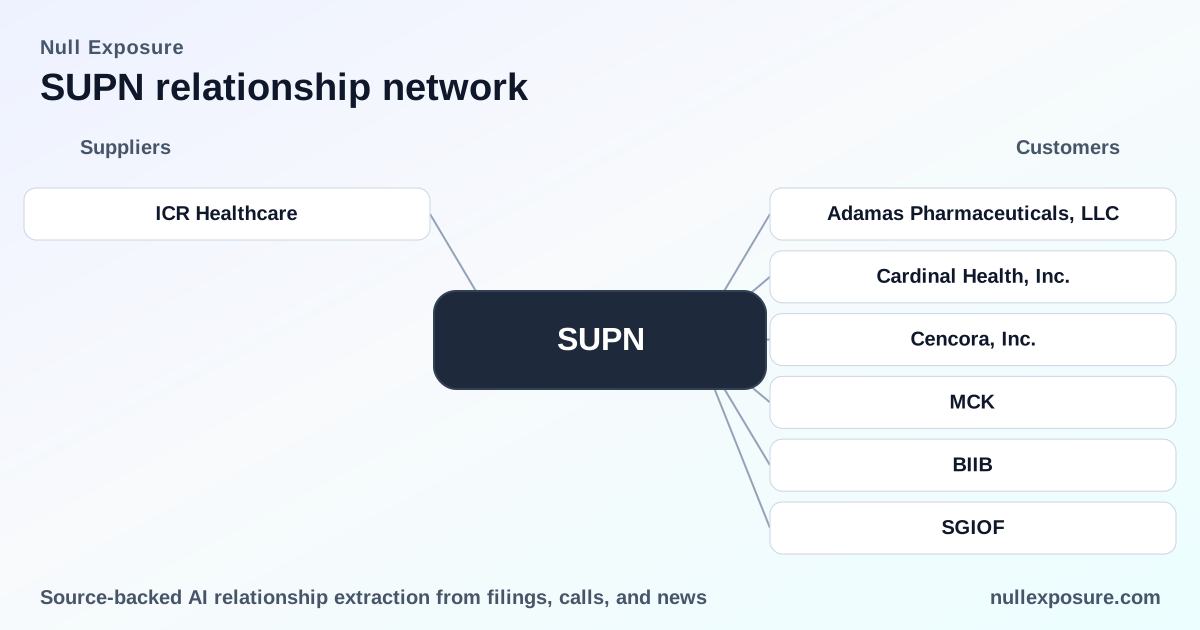
Supernus Pharmaceuticals (SUPN): Customer Relationships and Commercial Leverage
Supernus develops and commercializes central nervous system therapies and monetizes through product sales to pharmaceutical wholesalers, specialty pharmacies and distributors plus collaboration and licensing arrangements that generate royalties and milestone/license revenue. For investors, the core thesis is straightforward: Supernus' cash flows are heavily dependent on a small set of downstream distributors and a handful of collaboration partners, which concentrates both upside and counterparty risk. Learn more about the coverage at https://nullexposure.com/.
Why customer dynamics drive the investment case
Supernus operates a distribution-led commercial model: it sells finished products into the U.S. market and recognizes revenue when control shifts to customers who then resell to pharmacies, hospitals and other payors. As a result, wholesaler and distributor relationships directly determine revenue cadence, working capital and collection risk. The company couples that with collaboration deals that yield licensing and milestone receipts, which influence reported revenue volatility.
Key operating and business-model constraints you need to price in
- Geography / sales footprint: Supernus markets its key products through its own U.S. sales force, indicating a predominantly North American commercial footprint rather than global direct distribution. This is a company-level signal from the FY2024 filing.
- Concentration and criticality: Three customers accounted for more than 77% of total product revenue in 2024, a high concentration that makes counterparty performance and contract terms material to earnings. This is a company-level signal.
- Role and contracting posture: Most counterparties act as buyers/distributors — wholesalers, specialty pharmacies and distributors — meaning Supernus is upstream, recognizing product sales on transfer of control; distributors then carry downstream demand risk and reimbursement interplay.
- Segment focus and revenue mix: Product sales are the principal revenue source, with collaboration and licensing receipts important for episodic upside. This mixture shapes cash-flow predictability and margin profile.
Together these constraints imply a mature commercial rollout domestically with high counterparty concentration: powerful near-term cash flow when major channels perform, but material single-counterparty disruption risk and limited geographic diversification.
Relationship walkthrough — every reported counterparty
Below I cover each relationship flagged in the source results and the disclosure that supports it. Each bullet is a 1–2 sentence plain-English summary with the source cited.
Cardinal Health, Inc.
Cardinal Health is identified as one of Supernus’ three major customers that each contributed more than 20% of product revenue in 2024, making Cardinal a material distributor of Supernus products. According to Supernus’ FY2024 Form 10‑K, the three major customers collectively accounted for more than 77% of product revenue in 2024.
Cencora, Inc.
Cencora is likewise one of the three wholesalers singled out in Supernus’ disclosure and therefore represents a large channel partner through which end-market sales flow. The FY2024 Form 10‑K lists Cencora as a >20% product revenue customer contributing to the >77% collective concentration.
Adamas Pharmaceuticals, LLC
Adamas is referenced in the 10‑K in connection with Namzaric and licensing/royalty arrangements, indicating Adamas receives royalties under its licensing structure and is part of Supernus’ collaborator and competitive landscape. The FY2024 Form 10‑K discusses the Namzaric licensing relationship and royalty mechanics.
MCK
The MCK entry in the results is the ticker-level mention for McKesson and is listed by Supernus as one of the three distributors that each accounted for over 20% of product revenue in 2024, underscoring McKesson’s role as a heavyweight wholesale channel. This is disclosed in Supernus’ FY2024 Form 10‑K.
McKesson Corporation
McKesson Corporation is explicitly named in the same FY2024 Form 10‑K disclosure as a major customer and therefore is a critical distribution partner for Supernus’ U.S. sales. The company’s 10‑K confirms McKesson as one of the three customers driving more than 77% of product revenue collectively in 2024.
United Therapeutics (UTHR)
United Therapeutics reported that it pays a single-digit percentage royalty on net product sales of Orenitram under its license agreement with Supernus, which indicates Supernus’ licensing model produces recurring low-double-digit or single-digit royalty income streams from partnered commercialization. This payment structure was referenced in a StockTitan summary of SEC filings in March 2026.
BIIB (ticker) / Biogen (company)
Biogen is reported in Supernus’ Q4 2025 earnings call context: Biogen-reported U.S. sales of ZURZUVAE increased materially year-over-year, and Supernus records collaboration revenue tied to ZURZUVAE where collaboration receipts represent roughly 50% of Biogen’s net revenues for the product. The Q4 2025 earnings call (March 2026) and related press coverage (GlobeNewswire, November 2025) note that collaboration revenue equates to approximately half of Biogen’s reported ZURZUVAE sales.
Biogen Inc.
Duplicate entries for Biogen in the results reiterate the same point: Biogen’s reporting and Supernus’ disclosure link collaboration revenue to material product sales growth for ZURZUVAE, reinforcing how partner economics flow into Supernus’ top line. This is supported by the Q4 2025 call and the November 2025 GlobeNewswire release.
SGIOF (ticker) / Shionogi
Shionogi is referenced in Supernus’ recent commentary where a $15 million licensing revenue item was recognized in Q4 2025 tied to a regulatory milestone under the collaboration agreement, indicating milestone-driven upside in partner deals. This disclosure is noted in Q4 2025 earnings coverage and transcript excerpts reported in March 2026 (InsiderMonkey summary).
Shionogi
The separate Shionogi entry repeats the same milestone observation: the collaboration produced a discrete licensing receipt tied to regulatory progress, demonstrating that Supernus’ collaboration contracts include milestone-triggered cash events. The Q4 2025 earnings transcript and coverage detail the $15 million recognition.
Investment implications and positioning
- Concentration is the dominant risk/return lever. With three wholesalers accounting for over 77% of product revenue in 2024, contract terms, pricing, and stocking decisions by those distributors will materially move revenue and working capital. This increases operational leverage even as it compresses diversification.
- Collaboration and licensing provide upside but add volatility. Milestones and royalties (e.g., Shionogi milestone, United Therapeutics royalties, Biogen collaboration splits) are meaningful sources of discrete revenue and can swing results quarter-to-quarter.
- U.S.-centric commercialization limits geographic diversification. The company markets via its U.S. sales force and recognizes most product revenue domestically, concentrating regulatory, reimbursement and payer risk in a single region.
If you want a consolidated view of these counterparty exposures and how to model them into scenario-based cash flows, visit https://nullexposure.com/ for the full analytic suite.
Bottom line
Supernus’ commercial model generates predictable product revenue when distribution partners perform, but the company’s high distributor concentration and reliance on milestone/collaboration receipts create asymmetric operational risk that investors must price into valuations and downside scenarios. The disclosures cited above — principally the FY2024 Form 10‑K and recent Q4 2025 earnings commentary and press releases — provide the factual foundation for that assessment.