Grupo Supervielle (SUPV): What the Cordial Microfinanzas Sale Reveals About Counterparty Strategy
Grupo Supervielle is a Buenos Aires–based financial holding that earns through traditional banking channels — net interest margin, fee income and client trading — while periodically reshaping its asset mix via targeted disposals. The firm monetizes retail and corporate lending, payment services and treasury operations inside a high-volatility Argentine macro context, and it uses strategic divestitures to rebalance risk and redeploy capital. For a concise corporate data snapshot, see the company profile and market metrics at Null Exposure: https://nullexposure.com/.
The headline transaction and why it matters to investors
In FY2017 Grupo Supervielle completed a sale of its microfinance arm that illuminates two persistent characteristics of its counterparty posture: the willingness to exit non-core segments via negotiated sales to public-sector–backed buyers, and a preference for discrete, bilateral transactions rather than open-market divestitures. The nature of the buyer — a consortium tied to the Banco de la Ciudad de Buenos Aires and a municipal development vehicle — signals that Supervielle executed a deal with a buyer whose credit and political profile reduce execution risk but also limit upside from a competitive auction.
If you want a quickly accessible record of SUPV customer and counterparty interactions as captured in public reporting, Null Exposure catalogs these linkages at the company level: https://nullexposure.com/.
Known counterparties from the Cordial Microfinanzas sale
-
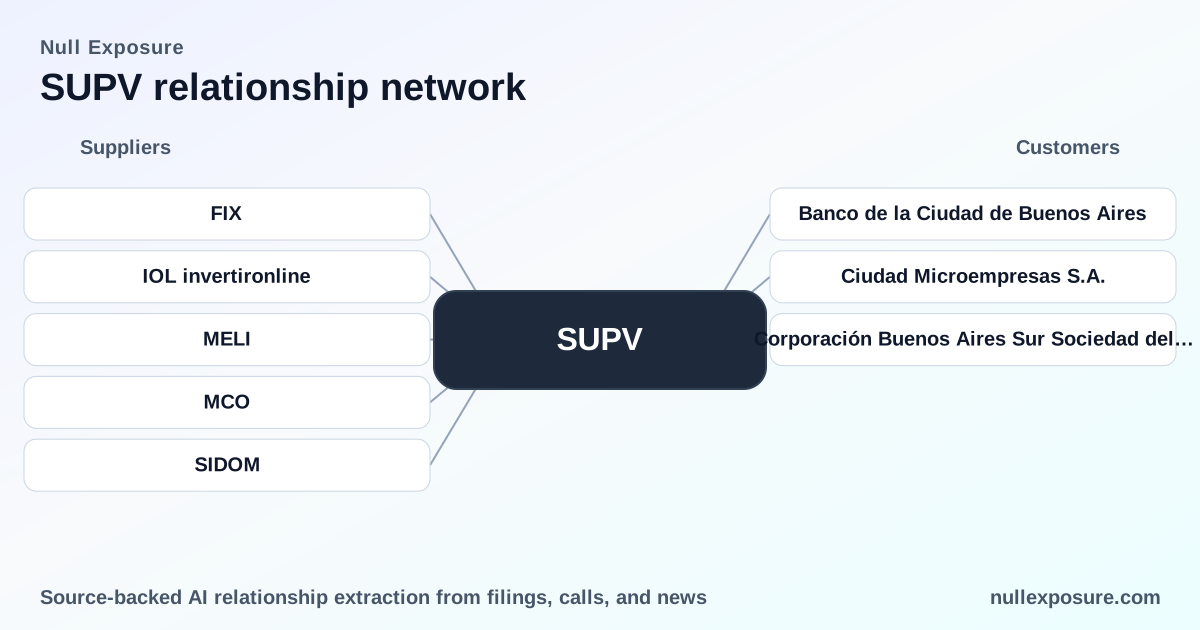
Banco de la Ciudad de Buenos Aires — Grupo Supervielle and Banco Supervielle acted as sellers in a negotiated transaction in which the Banco de la Ciudad participated as part of the buyer consortium for Cordial Microfinanzas. According to a LexLatin report covering the FY2017 transaction, the city bank participated in the buyer vehicle that acquired 100% of the microfinance unit. (LexLatin, FY2017: https://lexlatin.com/noticias/ortiz-y-perez-alati-asesoran-en-adquisicion-de-cordial-microfinanzas-por-el-banco-ciudad)
-
Ciudad Microempresas S.A. — The acquiring entity, Ciudad Microempresas S.A., purchased the entire share capital of Cordial Microfinanzas from Grupo Supervielle; its shareholders included the Banco de la Ciudad and Corporación Buenos Aires Sur. LexLatin notes that Grupo Supervielle accepted an offer on 100% of the microfinance subsidiary in the FY2017 deal. (LexLatin, FY2017: https://lexlatin.com/noticias/ortiz-y-perez-alati-asesoran-en-adquisicion-de-cordial-microfinanzas-por-el-banco-ciudad)
-
Corporación Buenos Aires Sur Sociedad del Estado — This municipal development corporation was part of the buyer consortium integrated into Ciudad Microempresas S.A., and it shared ownership of the acquisition vehicle with Banco de la Ciudad. The FY2017 LexLatin coverage identifies Corporación Buenos Aires Sur as a constituent of the buyer and describes the sellers as Grupo Supervielle S.A. and Banco Supervielle S.A. (LexLatin, FY2017: https://lexlatin.com/noticias/ortiz-y-perez-alati-asesoran-en-adquisicion-de-cordial-microfinanzas-por-el-banco-ciudad)
What these relationships reveal about SUPV’s customer and counterparty strategy
The Cordial Microfinanzas sale is instructive for three strategic signals relevant to investors:
-
Contracting posture: Supervielle negotiates bilateral, direct sales when exiting businesses. The FY2017 sale was executed to a defined buyer consortium rather than an open auction, indicating a preference for controlled transfers that preserve regulatory goodwill and avoid market volatility.
-
Concentration and counterparty profile: Buyers tied to the Buenos Aires city apparatus and the Banco de la Ciudad indicate that when Supervielle exits businesses it selects counterparties with public-sector linkage or systemically recognized profiles, reducing execution risk but limiting price discovery upside.
-
Criticality and maturity of the divested asset: The microfinance unit was treated as a non-core, mature asset suitable for strategic disposal rather than retention for growth. The sale suggests Supervielle treats microfinance exposures as assets to reallocate capital away from lower-return segments under certain conditions.
These are company-level operating signals rather than itemized risk metrics: they reflect how management trades off execution security and political/market considerations when choosing buyers.
Financial context that frames counterparty decisions
Grupo Supervielle’s most recent public metrics show a company operating with negative EPS and compressed margins while still commanding meaningful revenue throughput. Market capitalization is roughly $751 million, trailing and forward valuations show stress from local macro and profitability trends, and equity returns are negative, which rationalizes selective asset sales to shore up capital or refocus on core banking operations. Management’s decision to divest a microfinance unit to a buyer with public-sector ties aligns with a strategic imperative to reduce balance-sheet complexity without exposing the firm to a prolonged sales process that consumes capital and management bandwidth.
Investor implications: risks and tactical takeaways
-
Risk mitigation through buyer selection: By selling Cordial Microfinanzas to a buyer linked to a major city bank and a municipal corporation, Supervielle removed an asset that likely required elevated operational oversight, but the choice of buyer limits upside from a competitive auction.
-
Regulatory and reputation management: Transfers to public-sector–backed buyers reduce political friction and reputational risk in a sensitive regulatory environment, which is valuable in Argentina’s cyclical policy landscape.
-
Capital redeployment signal: The divestiture is consistent with capital redeployment toward core net-interest-bearing activities or liquidity strengthening, a behavior investors should view as tactical management of balance-sheet risk.
-
Counterparty concentration watch: While a sale reduces asset concentration on the seller’s balance sheet, the counterparty landscape shows Supervielle’s willingness to transact with government-linked bodies; future counterparty concentration could increase if the company chooses to partner or contract with a narrow set of large public institutions.
Closing take
The FY2017 Cordial Microfinanzas transaction provides a clear, replicable signal about Grupo Supervielle’s counterparty strategy: management prioritizes controlled, low-execution-risk sales to buyers with stable, often public-sector profiles, trading upside for certainty and regulatory ease. For investors assessing SUPV’s customer and counterparty exposures, this historical sale is a useful template for anticipating how the company will manage non-core assets under pressure.
For a consolidated view of SUPV’s relationships and how they fit into broader counterparty maps, consult the Null Exposure company page: https://nullexposure.com/.