SURF: From Partnered Biotech to Tactical Asset — What Investors Should Know
Surface Oncology operated as a clinical-stage immuno-oncology company that developed tumor-microenvironment–targeting antibodies and licensed select programs to large pharmas while retaining upside through milestones and royalties. The company monetized through upfront licensing fees, milestone/royalty structures with partners (notably GSK and Novartis), and a sale of the corporate shell and programs to Coherus, which transferred most commercial and clinical risk off Surface’s balance sheet while preserving contingent upside for former shareholders. For primary research or diligence, see the firm overview at the Null Exposure homepage: https://nullexposure.com/.
What the business model looked like in one line
Surface’s model combined early-stage discovery with selective partnering to de‑risk development spend: license high-potential assets to pharma partners for guaranteed upfronts and retain contingent value through milestone and royalty splits.
Quick takeaways investors should keep front of mind
- Strategic partnering, not direct commercialization, was Surface’s path to value realization.
- Concentration in a small set of large pharma collaborators increased downside if program momentum faded, but also created outsized upside through milestone pools.
- The ultimate sale to Coherus converted potential milestone upside into a known acquisition consideration and CVR structure for former Surface holders.
Read more on partner exposure and practical implications at Null Exposure: https://nullexposure.com/.
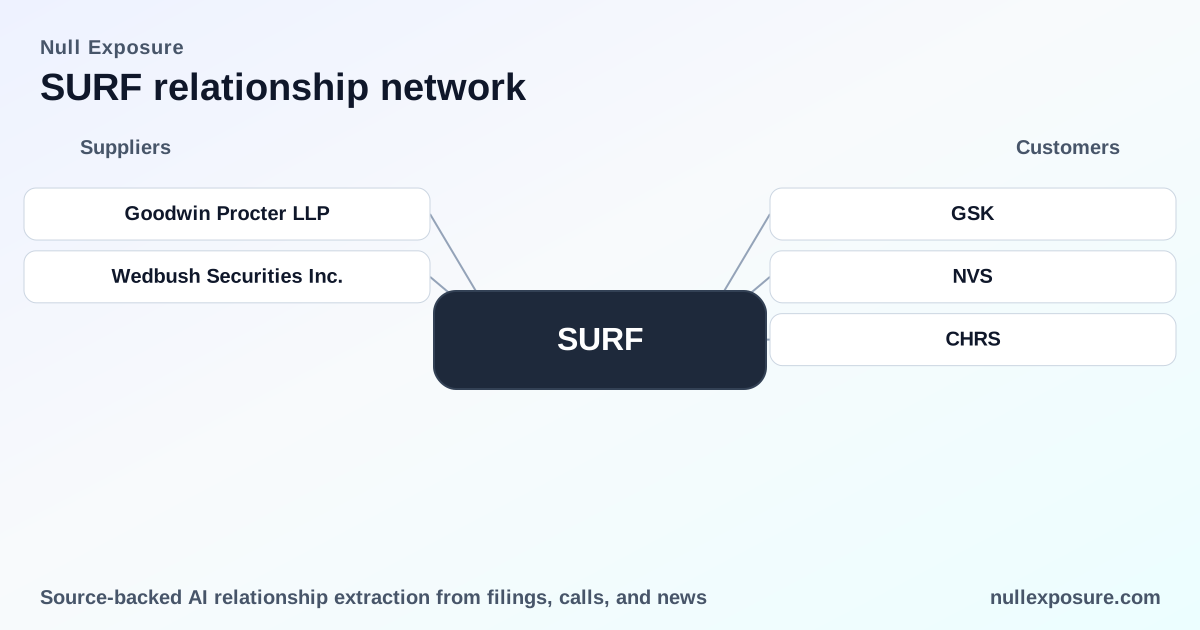
SURF’s partner map — every relationship from the public record
Below I walk through every relationship surfaced by contemporary reporting and filings. Each entry is two sentences and cites the reporting used in the aggregation.
Coherus BioSciences (CHRS)
Coherus completed an all‑stock acquisition of Surface, valuing the business at roughly $40–65 million in stock plus cash components depending on the reporting source, and absorbed Surface’s lead programs and assets into its pipeline. According to Latham & Watkins and multiple industry reports in early May 2026, the deal closed in FY2023/FY2024 reporting windows and transferred control of Surface’s clinical assets to Coherus, with former Surface shareholders receiving contingent value rights tied to program milestones and royalties. (See Latham & Watkins news release and Biocentury/Oncologypipeline coverage, May 2026.)
GlaxoSmithKline (GSK)
Surface granted GSK exclusive worldwide licensing rights to SRF813 under a significant collaboration established around FY2020, positioning GSK as the commercial driver for that asset while Surface retained downstream contingent economics. Biotech press coverage from BioSpace and follow‑up disclosures confirm the exclusive license terms and the inclusion of SRF813 in the CVR pool paid to Surface shareholders after the Coherus acquisition. (See BioSpace and GlobeNewswire filings, FY2020–FY2023.)
Novartis (NVS)
Surface entered a research collaboration with Novartis that generated upfront cash, equity, and near‑term milestone potential—industry reporting quantified the initial value package in the vicinity of $170 million when accounting for upfronts and near‑term commitments. BiopharmaDive and GlobeNewswire reporting attribute a material portion of Surface’s external funding and program de‑risking to the Novartis collaboration, and the Novartis‑linked programs were included in the contingent value right distribution following the Coherus transaction. (See BioPharmaDive and GlobeNewswire summaries, FY2023.)
How those relationships translated into capital structure and exit mechanics
Surface’s licensing and research agreements with GSK and Novartis provided near‑term non‑dilutive cash and validation, but the company never evolved into a commercial-stage operator. Instead, the firm leveraged partner-funded development to create program value and then executed a strategic sale to Coherus, which centralized clinical and commercialization obligations under one buyer; GlobeNewswire and Latham & Watkins detail the CVR mechanics that carried forward milestone economics to former shareholders. The net effect for investors: short‑term cash from partners and long‑tail upside preserved in contingent instruments rather than direct equity exposure to a standalone commercialization path.
Operational and business-model constraints investors should treat as company-level signals
- Contracting posture: Surface relied on exclusive licensing and research collaboration agreements to transfer development and commercial execution risk to large pharmas, producing predictable upfronts but ceding control of go‑to‑market decisions.
- Concentration: A small number of large pharmaceutical partners (GSK, Novartis) represented the company’s most significant commercial relationships, implying high counterparty concentration risk if one program stalled.
- Criticality: The partners’ investment in specific assets (e.g., SRF813, SRF114) indicates program-level strategic fit for the partner portfolios rather than broad platform dependence by multiple buyers.
- Maturity: Surface remained clinical-stage at exit; the business model emphasized licensing milestones and CVRs instead of building in‑house commercialization capability.
Those characteristics explain why an acquisition by a commercial‑stage buyer like Coherus was a rational endgame: it consolidates clinical execution and monetizes partner‑driven upside for shareholders.
Risk and value levers for a post‑deal investor or operator
- Milestone realization: CVR holders’ returns hinge on successful trial readouts and partner filings; realization risk is binary and program-specific.
- Partner execution: GSK and Novartis control development timelines for their respective assets; partner trial cadence and regulatory strategy directly determine CVR payoffs.
- Consolidation execution: Coherus’ ability to integrate Surface assets and prioritize SRF114/SRF813 across its pipeline will drive near‑term valuation inflection points.
Investors should model outcomes as scenario trees with binary milestone payoffs rather than continuous revenue streams.
Bottom line for investors and operators
Surface executed a classic biotech partnering playbook: validate assets through alliances, extract upfront capital, and preserve upside through contingent payouts before exiting to a buyer that could operationalize development and commercialization. The firm’s value to investors was concentrated in a few program‑level outcomes rather than recurring revenues, and the acquisition by Coherus converted asymmetric program upside into a structured payment mechanism for shareholders.
For a concise, investor‑grade dossier on SURF counterparty exposure and CVR mechanics, visit Null Exposure: https://nullexposure.com/.
Key sources referenced in reporting above include Latham & Watkins’ advisory note on the Coherus acquisition (May 2026), BiopharmaDive and BioCentury coverage of the Coherus transaction and Novartis collaboration (FY2023 reporting), BioSpace reporting on the GSK exclusive license (FY2020), and GlobeNewswire filings summarizing the CVR arrangements (FY2023).