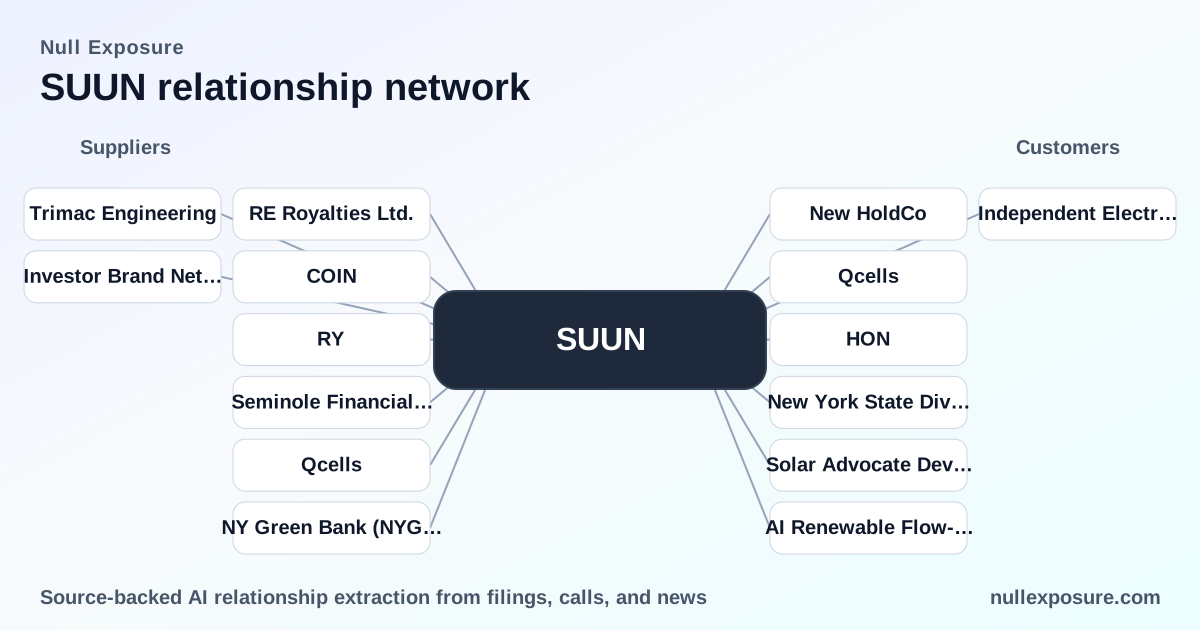
SolarBank (SUUN) — customer relationships that define a development-to-exit merchant
SolarBank builds and develops renewable energy projects and monetizes through project sales, long-term power purchase agreements (PPAs), community solar subscriptions and targeted commercial partnerships. The company routinely moves assets from development to disposition while retaining operational or contracting roles, generating cash from asset sales and securing recurring revenue via PPAs and subscription programs. For investors, the revenue mix is therefore a balance of one-time cash inflows from sales and longer-duration, lower-margin contracted cash flows — a dynamic that drives valuation volatility but also provides clear growth levers when project pipelines convert into funded assets. Learn more about the relationship mapping at https://nullexposure.com/.
How to read SolarBank’s customer relationships: development plus selective offtake
SolarBank’s public relationship activity shows a consistent pattern of developing projects and selling them to strategic buyers or financing vehicles, while also securing long-term offtake for remaining assets. That operating posture supports near-term liquidity via asset sales and the creation of contracted revenue via PPAs or community subscriptions for assets held long term.
Key operating-model signals from the relationship record:
- Contracting posture: transactional (asset sales) plus strategic contracts (20-year PPAs referenced).
- Concentration and counterparty mix: sales to corporate buyers (Honeywell, Qcells), strategic buyers/owners (New HoldCo, Solar Advocate), and institutional sponsors (AI Renewable Flow-through Fund).
- Criticality of relationships: some contracts are high-criticality (long-term PPA with a state military authority) and others are one-off disposals that materially impact cash flow.
- Maturity profile: evidence of both early-stage development activity and completed asset exits, indicating a development-to-exit business model rather than a pure long-hold utility operator.
Relationship evidence — source-by-source readout
Below are every relationship mention captured in the coverage set, each summarized in plain English with source attribution.
New HoldCo — 97 MW membership interest purchase (PR Newswire, FY2025)
SolarBank announced that New HoldCo will purchase membership interests in project companies owning 97 MW of generating capacity from ASP, subject to customary closing conditions, as part of a structured acquisition of developed assets. According to a PR Newswire release in March 2026, the transaction is framed as a membership interest purchase agreement for the identified portfolio.
Qcells — four upstate New York projects, ~25.6 MW (SustainableBiz, FY2025)
A SustainableBiz report noted that Qcells agreed to acquire four upstate New York solar projects from SolarBank totaling approximately 25.6 MW for roughly $71 million, signaling strategic corporate demand for completed community solar assets. The article was published in May 2026 and highlights Qcells’ role as an acquirer of SolarBank-developed projects.
Qcells — four ground-mount projects, 25.577 MW (PR Newswire, FY2025)
SolarBank confirmed via PR Newswire in March 2026 that Qcells, through an affiliate, entered agreements to acquire four ground-mount solar projects representing 25.577 MW, formalizing the commercial sale of those developments. The corporate release frames the transfer as part of SolarBank’s disposition strategy.
Honeywell (HON) — $41M deal for 21 MW (Entrepreneur, FY2025)
Entrepreneur reported that SolarBank completed a $41 million deal with Honeywell to build a 21-megawatt solar project in upstate New York, illustrating a corporate-sponsor transaction that converts development work into cash proceeds. The mention appears in an industry feature published in March 2026.
Honeywell — 21-megawatt project for $41M (Entrepreneur, FY2025)
A second Entrepreneur mention reiterates that Honeywell acted as the counterparty on a $41 million transaction for a 21 MW community solar project, reinforcing the buyer-seller relationship between SolarBank and a major industrial partner. This reporting dates to March 2026.
Honeywell (HON) — $41M / 21 MW referenced in Forbes India (FY2025)
Forbes India also described the $41 million sale of a 21 MW project to Honeywell, using the deal as a case study for corporate energy procurement tied to data center and industrial customers. This branded coverage ran in March 2026.
Honeywell — repeat coverage of the 21 MW sale (Forbes India, FY2025)
A separate Forbes India placement again highlights the same Honeywell transaction — further media confirmation that the sale closed and received market attention in early 2026.
Solar Advocate Development LLC — buyer of Elmira and Jordan Road projects (SAHM Capital, FY2026)
SAHM Capital noted that SolarBank previously sold the Elmira, Jordan Road 1 and Jordan Road 2 projects to Solar Advocate Development LLC, indicating targeted dispositions of multiple small-to-mid-size projects to specialized owners. This update appeared in February 2026 investor commentary.
Honeywell International — 21 MW community solar sale in 2023 (CarbonCredits.com, FY2025)
CarbonCredits.com recorded that SolarBank sold 21 MW of community solar sites in Upstate New York to Honeywell International for US$41 million in 2023, confirming the same transaction as an earlier closed-year event and establishing historical precedent for buyer interest. The piece references the 2023 sale.
Walmart — West Coast EV charging partnership (SustainableBiz, FY2025)
SustainableBiz reported that SolarBank is partnering with Walmart on the West Coast for EV charging, with operations planned to start within the reporting year, positioning SolarBank in commercial energy services beyond pure generation. The article is dated May 2026 and highlights diversification into electrification infrastructure.
New York State Division of Military and Naval Affairs (DMNA) — potential long-term offtake (SAHM Capital, FY2026)
SAHM Capital reported that PowerBank intends to sell clean energy generated by certain projects to the DMNA under 20-year power purchase agreements, or alternatively offer local subscriptions, indicating pursuit of long-term contracted revenue streams once projects are operational. This disclosure is in a February 2026 investor update.
Honeywell (re-reporting) — again cited for the 21 MW / US$41M sale (CarbonCredits.com, FY2025)
CarbonCredits.com’s repetition of the Honeywell transaction reinforces the buyer relationship and sale economics for a 21 MW package sold in 2023 for US$41 million.
AI Renewable Flow-through Fund — lead developer/builder role (PR Newswire, FY2025)
A PR Newswire release in March 2026 states that a Project is owned by AI Renewable Flow-through Fund and SolarBank served as lead developer and builder, confirming SolarBank’s role as developer-for-hire on institutional sponsor-owned assets.
Independent Electricity System Operator (IESO) — awarded contracts under E-LT1 RFP (PR Newswire, FY2024)
PR Newswire notes that in July 2023 certain Projects were awarded contracts by IESO under the Expedited Long-Term RFP (E-LT1 RFP), establishing regulatory and contracted revenue potential for those Ontario projects and validating market acceptance at the procurement level.
What this pattern means for investors
The documented relationships show SolarBank executing a hybrid monetization model: develop and sell to strategic acquirers (Honeywell, Qcells, Solar Advocate) while also structuring long-term offtake (DMNA, IESO awards) and working as lead developer for institutional capital (AI Renewable Flow-through Fund). That mix creates two core investment characteristics:
- Revenue lumpiness driven by project sales timing; large disposals materially affect quarterly cash flows and leverage metrics.
- Risk diversification when long-term PPAs and subscription programs are in place, lowering merchant exposure for assets retained on the books.
For a deeper, interactive look at these relationship maps, visit https://nullexposure.com/ to inspect counterparties and source documents.
Investment implications — upside and headline risks
- Upside: repeatable sale appetite from corporate and institutional buyers (Honeywell, Qcells, specialized owners) supports a monetization runway and near-term cash generation. Long-term PPAs (20-year deals) provide durable cashflow for retained assets.
- Risks: concentration of cash on a few sizeable dispositions means programmatic development must convert consistently into closed transactions; failure to close deals or worsening buyer pricing would pressure liquidity. Regulatory awards (IESO) reduce offtake risk for specific projects but execution and construction risk remain.
Bottom line
SolarBank’s public relationship record frames it as a project developer that successfully converts pipeline into buyer-funded exits and targeted long-term contracts. Investors should view SUUN as a development-led play with episodic cash generation from asset sales and a secondary runway of contracted revenue where long-term PPAs have been secured. For source-level detail and to track new counterparties, consult the relationship feed at https://nullexposure.com/.