Sinovac Biotech (SVA): Customer Map and What It Means for Investors
Sinovac Biotech operates as a vertically integrated vaccine developer and manufacturer that monetizes through long‑term supply agreements with governments and public health institutions, commercial distribution deals with regional partners, and direct project financing for infrastructure and trials. Revenue is driven by bulk vaccine sales to sovereign and public-health buyers and by contract manufacturing relationships with regional distributors, a mix that creates predictable demand when public programs are active and episodic spikes tied to epidemic response. For a concise investor briefing and systematic relationship intelligence, visit https://nullexposure.com/.
How Sinovac sells value — the commercial model in plain terms
Sinovac develops, manufactures, and sells vaccines for infectious diseases; its commercial model centers on selling finished vaccine doses and technology transfer or support to local partners and public health agencies. The business combines low-margin high-volume public contracts with higher-margin project work (technology transfers, P3 lab support and clinical cooperation), producing a revenue base that is concentrated in government and institutional customers rather than retail channels.
What the relationship set looks like — a quick map
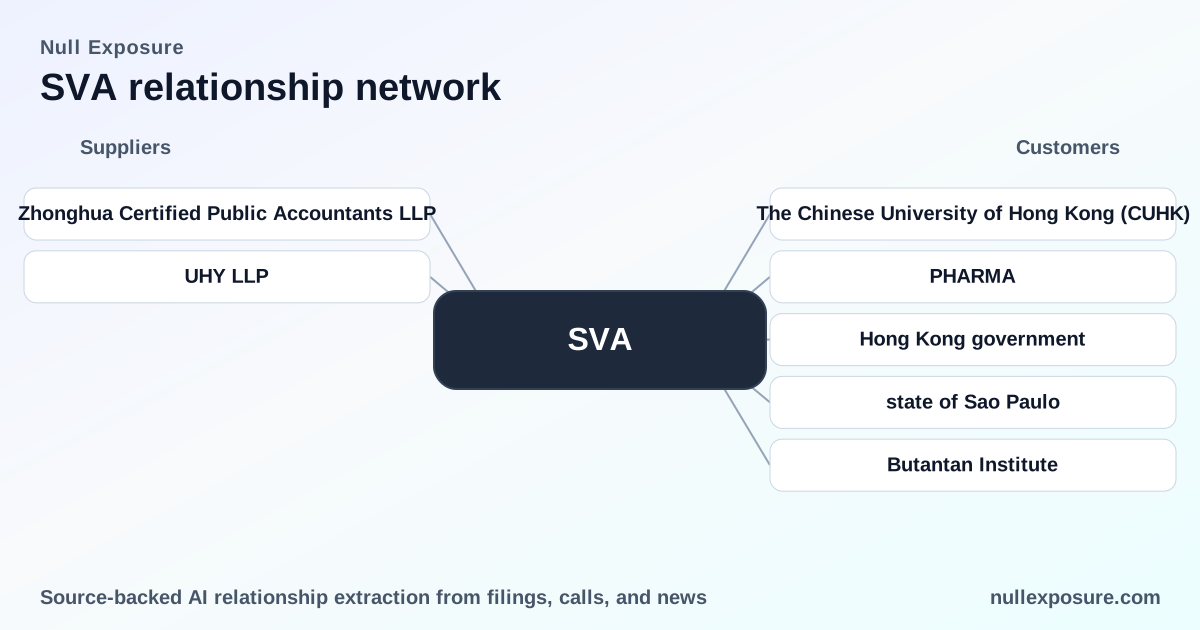
Below I walk through every customer record returned in the dataset, with a short plain‑English description and the reporting source.
-
The Chinese University of Hong Kong (CUHK)
Sinovac agreed to provide technology, funding and other resources to build a P3 laboratory, while CUHK is responsible for academic support and coordination with Hong Kong SAR government departments. This is a capacity‑building, institutional partnership that reflects Sinovac’s role beyond supply into infrastructure funding (CUHK press release, March 2026: https://www.cpr.cuhk.edu.hk/en/press/cuhk-and-sinovac-biotech-join-in-hands-in-building-p3-laboratory-developing-the-city-into-high-ground-for-biomedical-sciences/). -
PHARMA (inferred symbol PHARMA)
Sinovac publicly stated that Malaysia’s Pharmaniaga Bhd was solely responsible for distribution of its COVID‑19 vaccines in Malaysia and that no third parties were involved, clarifying contractual distribution lines for that market. The disclosure was made in the context of a local news report addressing a donation and distribution controversy (Yahoo Malaysia, March 2026: https://malaysia.news.yahoo.com/scam-donation-row-sinovac-says-151344748.html). -
Pharmaniaga Bhd (PHARMA)
The company-level statement specifically names Pharmaniaga as the exclusive distributor for Sinovac’s COVID‑19 vaccines in Malaysia, indicating a principal‑agent distribution relationship and centralized commercial control in that market. This was communicated in the same March 2026 Yahoo Malaysia report (Yahoo Malaysia, March 2026: https://malaysia.news.yahoo.com/scam-donation-row-sinovac-says-151344748.html). -
Hong Kong government
The Hong Kong government agreed to receive 7.5 million doses of Sinovac’s vaccine, a straightforward sovereign procurement contract that underscores reliance on public tenders and national immunization programs as a core revenue stream (Boston Globe report, December 2020: https://www.bostonglobe.com/2020/12/24/business/chinese-pharmaceutical-firm-sinovac-says-its-covid-19-vaccine-is-more-than-50-percent-effective-data-withheld/). -
State of São Paulo (Brazil)
Millions of CoronaVac doses were shipped to the state of São Paulo, reflecting a regional government procurement and logistics arrangement that translated clinical trial scale into mass immunization orders. The São Paulo shipments are documented in contemporaneous reporting on Sinovac’s Brazil trial and early deployment (Boston Globe, December 2020: https://www.bostonglobe.com/2020/12/24/business/chinese-pharmaceutical-firm-sinovac-says-its-covid-19-vaccine-is-more-than-50-percent-effective-data-withheld/). -
Butantan Institute (Brazil)
The Butantan Institute conducted the late‑stage trial in Brazil and reported the vaccine as safe and effective, while also noting confidentiality clauses tied to data dissemination as part of contractual arrangements with Sinovac. This indicates classical trial‑to‑procurement dynamics where a local public research institute both evaluates and facilitates access to supply (Boston Globe, December 2020: https://www.bostonglobe.com/2020/12/24/business/chinese-pharmaceutical-firm-sinovac-says-its-covid-19-vaccine-is-more-than-50-percent-effective-data-withheld/).
Contracting posture, concentration, criticality and maturity — company-level signals
The dataset contains no explicit contractual constraints reported against SVA’s customer relationships. No constraints were returned in the relationship data, which operates as a company‑level signal: the disclosed relationships emphasize open procurement and distribution contracts with governments and public institutes rather than private restrictive covenants. From this signal we draw the following operating-model characteristics:
- Contracting posture: Sinovac operates with public‑facing supply and partnership agreements—procurements and institutional partnerships—rather than exclusive technology lock‑ins; the data shows a posture oriented to sovereign customers and regional distributors.
- Customer concentration: The customer map is concentrated among governments and public health entities (Hong Kong, São Paulo, Butantan) and a few named distributors (Pharmaniaga), suggesting high counterparty concentration by type even if the list spans multiple jurisdictions.
- Criticality: The relationships are functionally critical—public health procurement and trial partners are mission‑critical counterparts that determine large volume demand and reputational outcomes.
- Maturity: The presence of late‑stage trials and multi‑million dose deliveries indicates mature operational deployments rather than exploratory collaborations.
These signals combine into a commercial profile where Sinovac’s revenue exposure is skewed toward public buyers and regional principal distributors, and its operational profile is anchored to large, high‑impact contracts rather than many small retail contracts.
Risk and value implications for investors
- Revenue predictability tied to public programs: Contracts with governments and institutes produce lumpiness—stable when programs are active, volatile when outbreak demand subsides. The customer set in the data confirms reliance on sovereign purchasing decisions.
- Concentration risk is tangible: A small number of institutional buyers and distributors can meaningfully move top‑line results; Pharmaniaga’s exclusive distributor status in Malaysia is an example where a distribution partner controls market access.
- Reputational and contractual terms matter: Trial confidentiality and coordination clauses (as with the Butantan Institute and CUHK P3 collaboration) influence release timing and market perception, which in turn affects demand and pricing leverage.
- Operational scaling and capital roles: Sinovac’s role funding and building lab capacity (CUHK P3 lab) shows the company invests directly in enabling sales channels and regulatory capabilities—this is a value‑accretive but capital‑intensive approach.
For investors and operations managers, the key monitoring items are sovereign procurement pipelines, distributor exclusivity arrangements in key markets, and the status of institutional collaborations that enable regional manufacturing or trials.
How to use this map in your diligence
- Cross‑check procurement volumes and contract terms in target jurisdictions against public health budgets and tender schedules.
- Validate exclusivity claims with local distributor filings and regulatory communications (the Pharmaniaga disclosure is an example to verify).
- Track institutional partnerships that expand manufacturing capacity or transfer technology, since those can be both revenue drivers and capital commitments.
If you want a structured, exportable view of Sinovac’s customer relationships and comparable profiles for peer companies, review our platform at https://nullexposure.com/ for consolidated relationship intelligence.
Bottom line
Sinovac’s disclosed customer relationships are dominated by government and institutional buyers and a small set of regional distributors, creating a revenue model that is predictable under active public health programs but concentrated and sensitive to local distribution arrangements and policy choices. Investors should treat Sinovac as a government‑facing vaccine manufacturer with concentrated counterparty risk, operational commitments to local partners, and revenue volatility tied to epidemic cycles and procurement decisions.