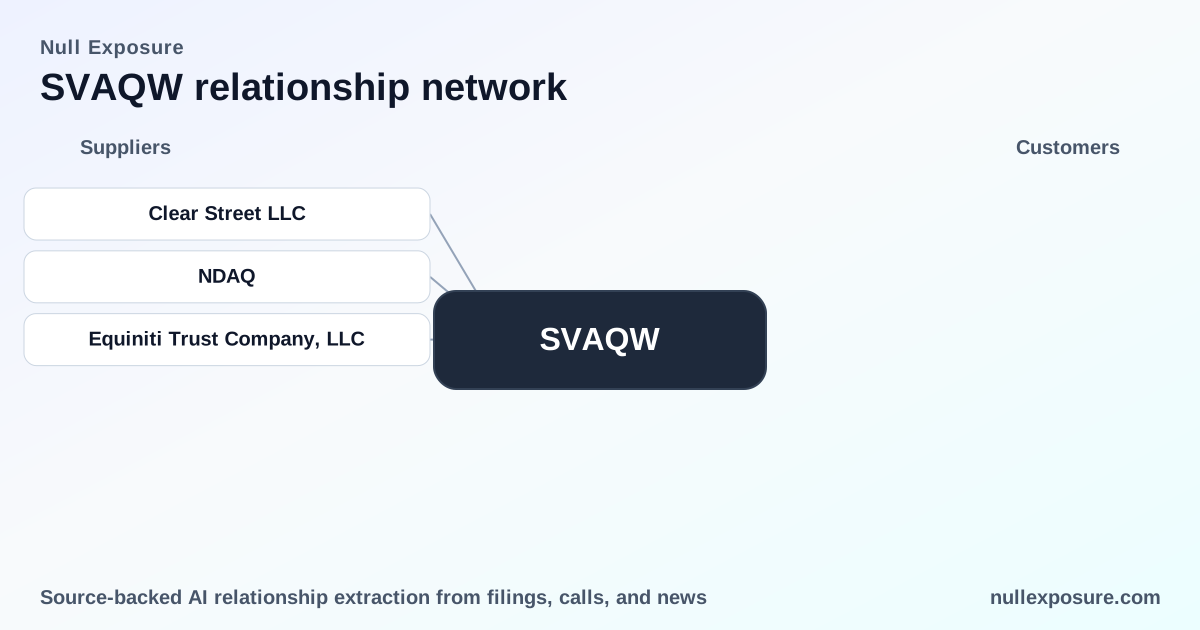
SVAQW: Sponsor and underwriter placements set the tone for near-term warrant value
Silicon Valley Acquisition Corp. Warrants (SVAQW) are a pure-play SPAC instrument: they provide leveraged upside tied to a future business combination while deriving immediate positioning and initial float dynamics from the sponsor and underwriting syndicate. The company monetizes investor interest through its IPO and private-placement process—units sold to the sponsor and to underwriters determine initial ownership concentration and distribution, which in turn drive early trading liquidity and redemption pressure for the warrants. For investors and operators evaluating counterparty exposure, the recent filing-driven placements are the most material customer/partner events to digest. For further relationship signal detail, see https://nullexposure.com/.
What the May 2026 filing changes for warrant holders
A public SEC filing summarized in Investing.com dated May 4, 2026 reports the completion of the SPAC’s $200 million IPO alongside parallel private placements. The allocation of units to the sponsor and the underwriter representative confirms the typical SPAC capital structure: sponsor economics are preserved through a concentrated allocation, and underwriters receive placement units to facilitate distribution. That configuration shapes both short-term liquidity in the warrant market and the negotiating dynamics ahead of any de-SPAC transaction.
An immediate operational consequence for investors: concentrated sponsor ownership can compress free float while underwriter allocations influence initial aftermarket absorption and market-making capacity. These are not theoretical points—the May 2026 placement directly established those concentrations and therefore are central to any short- to medium-term trading or event-driven strategy.
Who the company transacted with (the full list)
Below are the relationships identified in the filing, each presented with a plain-English summary and source.
Clear Street LLC
Clear Street LLC was the representative of the underwriters and received 200,000 units in the private placement associated with the IPO, which positions Clear Street as the underwriting counterparty responsible for distribution and syndicate coordination. An Investing.com report on May 4, 2026 described the allocation and Clear Street’s representative role in the transaction.
Silicon Valley Acquisition Sponsor LLC
Silicon Valley Acquisition Sponsor LLC received 425,000 units in a sponsor private placement, reflecting standard sponsor economics that allocate a material initial stake to the SPAC sponsor and preserve alignment of incentives between the sponsor and public investors. The same Investing.com filing summarized the sponsor allocation on May 4, 2026.
What these relationships imply for operating posture and business model
There are no explicit operational constraints recorded in the relationship dataset for SVAQW; that absence is itself a company-level signal. Interpreting that signal in the SPAC context leads to the following operating model characteristics:
- Contracting posture: Sponsor-driven and frontloaded. The sponsor’s private placement is a primary source of non-public capital and defines the core counterparty relationship; contract terms are typically set at formation and are not renegotiated frequently.
- Concentration: High. The sponsor allocation produces concentrated insider ownership, while the underwriter representative and syndicate determine initial market distribution; both factors compress independent free float at launch.
- Criticality: Material to warrant economics. Sponsor and underwriter roles are critical for liquidity provisioning at IPO and for driving the initial market for warrants and units; their actions influence redemption dynamics and price discovery leading up to a business combination.
- Maturity: Early-stage. This SPAC is in formation/post-IPO phase where sponsor and underwriting mechanics dominate operational risk and investor returns, rather than operating cash flows from an acquired business.
Those characteristics dictate how investors should frame risk-adjusted expectations: in early life, counterparty configuration and allocation mechanics matter more than revenue or balance-sheet performance, because warrants are derivative instruments whose value will be decided by the de-SPAC path and sponsor behavior.
Key investment implications and risk items to monitor
The transaction allocations produce a short checklist of high-impact items for both investors and operators:
- Concentration risk: Monitor sponsor holdings and any subsequent transfers or dilution events; sponsor allocations create alignment but also reduce tradable float.
- Distribution capability: Track Clear Street’s secondary-market activity and whether additional distribution partners or market-makers step in to support liquidity.
- Redemption and float dynamics: Watch early redemptions after the combination window is set—redemption trends will directly affect the warrant premium or discount to pro rata value.
- Timeline pressure: SPACs operate under a finite search period; sponsor capital and underwriter commitments shape negotiation leverage when pursuing targets.
A concise list of implications:
- Sponsors preserve upside but concentrate voting and economic power.
- Underwriters control initial liquidity and can influence short-term price mechanics.
- No recorded contractual constraints in the dataset increases emphasis on monitoring filings and PIPE activity for new signals.
For a structured view of relationship signals and ongoing monitoring, visit https://nullexposure.com/.
Practical guidance for valuation and position management
Valuing SVAQW requires a blend of event and counterparty analysis rather than traditional cash-flow modeling. For investors and operators:
- Price sensitivity will be driven by rumor and target announcements; sponsor credibility and underwriter activity are the primary fundamental anchors until a combination is announced.
- Treat ownership concentration as a liquidity and governance risk factor; stress-test scenarios where sponsor or underwriter sales coincide with adverse market moves.
- Maintain a short timeline for re-assessment—every filing that updates allocations, lock-ups, PIPE commitments, or redemption rates materially changes warrant forward value.
Bottom line
The May 2026 IPO and parallel private placements establish the sponsor and underwriter relationships that will define SVAQW’s near-term market behavior. Clear Street LLC’s role as underwriter representative and Silicon Valley Acquisition Sponsor LLC’s sponsor allocation are the two discrete counterparty events disclosed; both materially affect float, distribution, and alignment ahead of any business combination. Investors should prioritize monitoring further filings, sponsor lock-up schedules, and underwriter market activity as the principal drivers of warrant performance.
For ongoing relationship signals and filing-driven summaries, see https://nullexposure.com/.