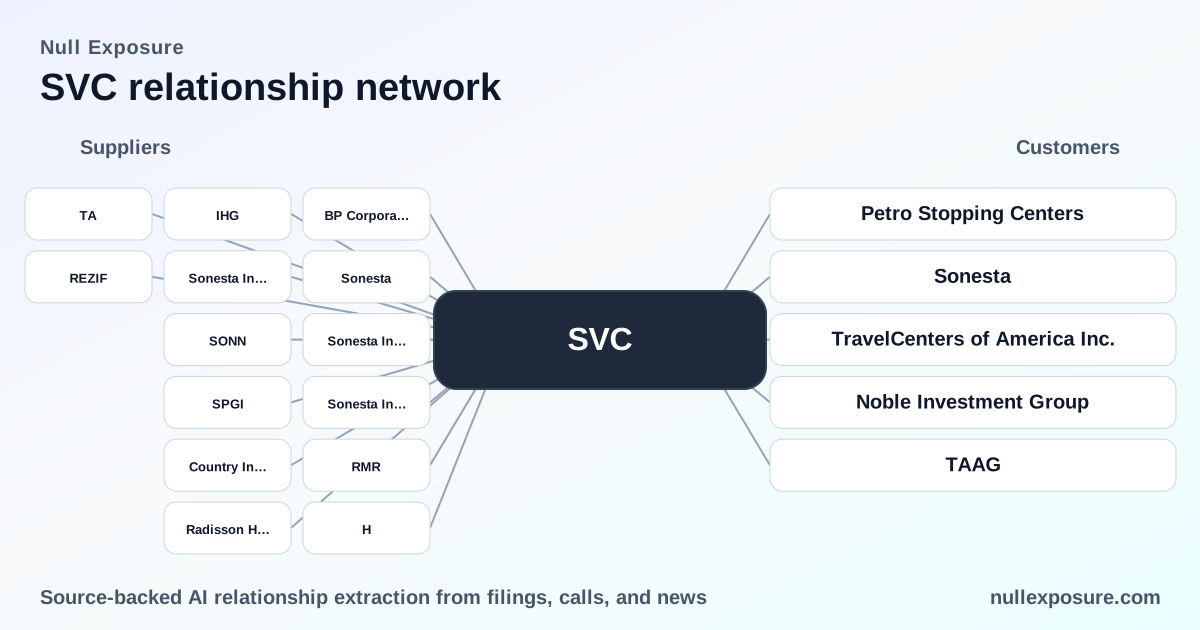
Service Properties Trust (SVC): customer relationships that drive cash flow — and concentration
Service Properties Trust is a net-lease and hotel REIT that monetizes real estate by owning hotels and service-focused retail properties and collecting fixed rents and owner returns under long-term leases and hotel operating arrangements. Its business is driven by two structural features: large, long-dated leases to travel center operators (principally TA) and a hotel platform concentrated with Sonesta operating most rooms. For investors, the thesis is straightforward — stable, contractually backed cash flow tempered by meaningful tenant concentration and active portfolio recycling. Learn more at https://nullexposure.com/.
Why tenant mix matters: concentrated cash flow, contract-first posture
SVC’s portfolio is structured around long-term net leases and hotel operating arrangements, not short-term spot leasing. The company reports a weighted average lease term for the net-lease portfolio of about eight years and states explicit long-dated master leases with renewal options for its single largest tenant. That contract orientation produces predictable rent rolls and supports valuation multiples appropriate for REITs but also creates single-counterparty concentration risk when one tenant represents a material share of invested capital. According to SVC’s FY2024 10‑K, these contract features are central to the operating model.
The headline relationships — line by line
Below I walk through every relationship SVC lists in its customer results and the news coverage tied to those counterparties. Each entry is a concise, investor-focused note with source context.
TravelCenters of America Inc. (TA) — largest tenant, long-term master leases
TA is SVC’s largest tenant, with 175 travel centers leased under five master leases that expire in 2033, and the TA portfolio represents roughly 28.7% of SVC’s historical real estate investments as of December 31, 2024; those leases include multiple ten-year renewal options. According to SVC’s FY2024 10‑K, these facts establish TA as a dominant, long-term rent generator for the REIT.
Sonesta — hotel operator that underpins half the hotel base
Sonesta operated 181 of SVC’s 206 hotels, representing 50.0% of SVC’s historical real estate investments as of December 31, 2024, and Sonesta owed owner priority returns to SVC in the reported periods. SVC’s FY2024 10‑K documents Sonesta’s central role in the hotel segment and the related owner-return balances.
Petro Stopping Centers — significant net-lease investment segment
SVC reports approximately $1.0 billion invested in 44 Petro Stopping Centers‑branded properties totaling about 1.37 million square feet, positioning Petro as a meaningful tenant group within the net-lease portfolio. This investment detail is disclosed in SVC’s FY2024 10‑K.
TANNI (news: BP / TravelCenters transaction) — strategic long-term lease alignment after BP deal
A TruckingInfo report on BP’s acquisition of TravelCenters of America notes that amended lease agreements with Service Properties Trust establish long-term real estate access as part of the transaction, indicating continuity of SVC’s lease economics post‑deal (TruckingInfo, March 2026).
Noble Investment Group (news: Sonesta Simply Suites sale) — buyer of hotel assets from SVC’s Sonesta pool
Industry press reported that Noble Investment Group acquired a 35-asset portfolio of Sonesta Simply Suites from SVC’s Sonesta parent, totaling more than 4,000 rooms across multiple states, demonstrating SVC’s active portfolio recycling in the hotel segment (HotelInvestmentToday, March 2026; TopHotel News, March 2026).
TANNI (context from 2023 ARKO bid reporting) — SVC’s landlord role influenced M&A process
Coverage of the 2023 ARKO inbound proposal referenced Service Properties Trust’s assessment of counterparty credit and execution risk when evaluating offers for TA; the Board cited TA’s landlord relationship with SVC as a material consideration in the strategic review (CDLLife coverage of FY2023 events).
TA (news: net lease segment description) — how market commentary frames the TA relationship
Market commentary and company segment reporting emphasize that SVC’s Net Lease segment focuses on service‑focused retail net lease properties, including travel centers leased to TA, reinforcing the strategic centrality of TA to that business line (TradingView market summary, May 2026).
TA (10‑K entry reiteration) — 28.7% commitment and lease count detail
SVC’s FY2024 10‑K reiterates that TA represents 28.7% of historical real estate investments and that SVC leases 175 travel centers (131 TravelCenters of America brand; 44 Petro brand) to a TA subsidiary under five master leases that expire in 2033.
TAAG (10‑K duplicate entry) — same underlying TA facts restated in filings
The company filing also lists the TA counterparty under the TAAG designation with the same data points: 175 travel centers, 28.7% of invested capital, five master leases expiring 2033, confirming the consistency of the disclosure in SVC’s FY2024 10‑K.
TAAG (duplicate result repeat) — filing duplicate preserves legal naming conventions
A second TAAG result repeats the FY2024 filing disclosures; the repeated entries reflect filing nomenclature and reiterate that TA’s footprint is large and contractually locked through 2033 per SVC’s 10‑K.
What the relationships and constraints imply for investors
SVC’s customer profile shows two structural truths:
-
Contractual stability: The company selectively pursues long-term, net-lease and operating arrangements. The portfolio’s weighted average lease term (~8 years) and TA’s master leases with multiple renewal options indicate a contracting posture designed for predictable cash flow, not turnover-driven upside.
-
Concentration and materiality: Sonesta and TA together constitute the majority of SVC’s invested capital (Sonesta ~50%, TA ~28.7% by historical cost). That concentration is a primary portfolio risk but also explains why SVC trades with REIT‑style cashflow expectations rather than hotel‑operating multiples.
Other company-level signals pull through consistently: the net-lease focus is geographically U.S.-centric, tenants are largely service- or necessity-based retailers, and SVC acts as a landlord/buyer of rent cash flows — not an operator — which frames credit exposure as the key underwriting focus.
Risk profile and investment considerations
- Credit and counterparty risk are front‑of‑mind because large tenants drive cash flows; underwritten creditworthiness of TA (and BP’s involvement post-acquisition reporting) and Sonesta’s operating performance determine rent conversion and distribution stability.
- Lease term and renewal optionality reduce volatility relative to spot hotel revenues, but portfolio concentration translates downside into single-counterparty scenarios.
- Active asset recycling (e.g., sale of Sonesta Simply Suites assets to Noble) shows management action to reallocate capital and de-risk certain hotel exposures, which supports liquidity and balance sheet management.
For a focused investor or analyst, the due diligence checklist should prioritize tenant lease schedules and credit support documents for TA and Sonesta, review the timing and structure of master lease expirations and renewal mechanics, and audit recent asset sales to verify proceeds and redeployment plans.
If you want a compact investor brief or a customer‑counterparty exposure dashboard for SVC, visit https://nullexposure.com/ for an executive summary and linked source references.
Bold takeaways: SVC’s revenue engine is contract-driven and concentrated; TA and Sonesta are material counterparties; lease term structure supplies cash-flow stability while creating counterparty concentration risk.