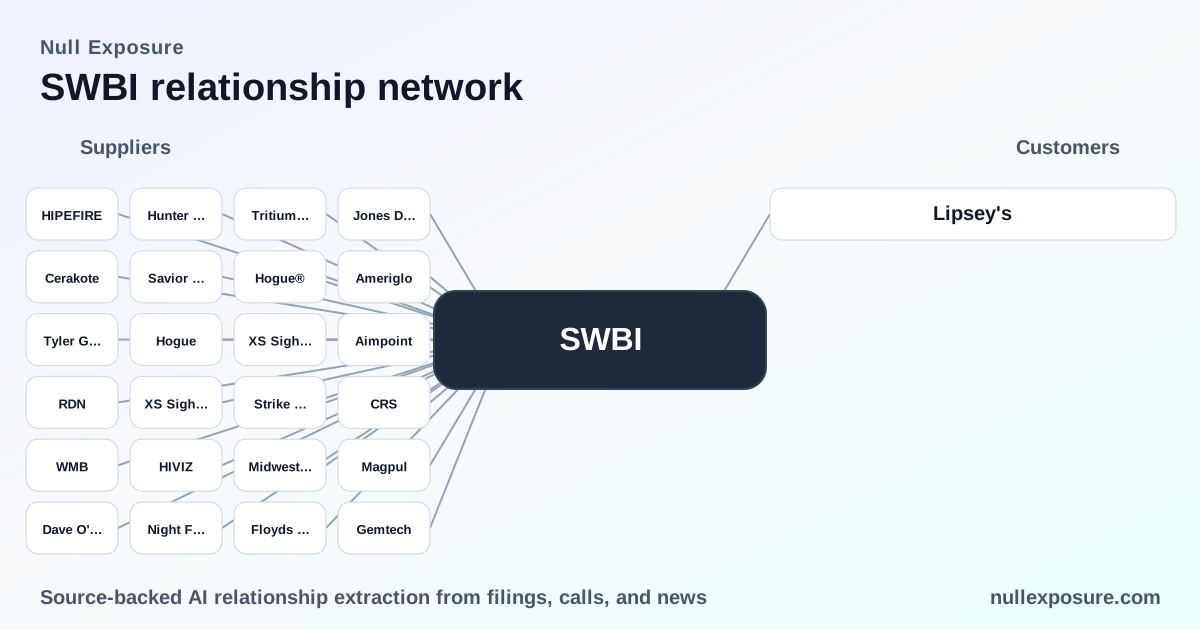
Smith & Wesson Brands (SWBI) — customer map and what it means for investors
Smith & Wesson Brands, Inc. designs, manufactures and sells firearms, accessories and select manufacturing services, monetizing through direct product sales to distributors, retailers, individuals, law enforcement and government agencies, plus contract manufacturing under its Smith & Wesson Precision Components unit. Revenue is concentrated in a small set of commercial distributors while also including meaningful government and individual end‑markets, yielding a mix of predictable channel sales and concentration risk that investors should price into valuation. Learn more about counterparty dynamics and concentration signaling at https://nullexposure.com/.
How Smith & Wesson’s customer model works in plain language
Smith & Wesson operates primarily as a manufacturer and seller of firearms and related products, selling internationally but routing most commercial volume through a short list of distributors that in turn service retail and institutional buyers. The company also sells manufacturing capacity to other businesses to level-load factories — a secondary monetization lever that smooths utilization over product cycles. International sales are small (around 4–5% of net sales), while one unnamed customer accounted for 14.6% of 2025 net sales and 36.1% of accounts receivable, making concentration a material financial characteristic. These are company-level operating signals drawn from the firm’s recent reporting and disclosures.
Operating constraints and corporate posture investors need to price
- High counterparty concentration and distributor dependence. The top five U.S. commercial distributors represented roughly 45% of net sales in FY2025, 2024 and 2023, signaling tight channel concentration and potential revenue volatility if distributor relationships change.
- Mixed counterparty types — government and individuals. Smith & Wesson’s customers include distributors, individuals, law enforcement and military agencies; this mix creates both diversification of end markets and layered contracting terms (commercial distributors vs. government procurements).
- Limited international exposure. International sales historically account for about 4–5% of net sales, indicating the business is largely U.S.-centric and sensitive to domestic firearm market cycles and regulation.
- Manufacturer plus service provider role. The company is both a product manufacturer and a seller of manufacturing services under the Smith & Wesson Precision Components banner, which moderates factory idle risk but does not eliminate end-market concentration.
- Materiality of a single customer. A single customer representing 14.6% of sales and 36.1% of receivables is a clear credit and operational risk that impacts working capital and bargaining leverage.
Relationship roll call — what the recent signals show
Below are the customer and channel relationships surfaced in public reporting and industry releases. Each entry includes a concise, plain-English summary and the relevant source.
Lipsey’s — multiple exclusive co‑branded product releases (FY2025–FY2026)
Smith & Wesson has released multiple Lipsey’s exclusive revolvers and limited Night Guard reintroductions, indicating an ongoing retail partnership for exclusive product lines that targets collectors and specialty retail customers. Source: The Outdoor Wire press releases, February–March 2026.
GrabAGun / PEW — retail and logistics platform ties (FY2025–FY2026)
Industry announcements list Smith & Wesson among the “industry‑leading brands” supplied through GrabAGun’s platform, implying channel distribution through national online retailers and logistics partners that broaden retail access. Sources: GrabAGun press releases on The Outdoor Wire (Jan–Mar 2026) and a coverage piece on 01net (May 2026).
U.S. Air Force — historical supply relationship (referenced FY2026 article)
A historical note in recent coverage references Smith & Wesson supplying custom Model 41 pistols with suppressors to the U.S. Air Force in 1967, underscoring the company’s longstanding connection to government and military end‑users even if contemporary contracts are not enumerated in these items. Source: TradersUnion news article, May 2026.
Gallery of Guns — platform-specific product development (FY2026)
Reporting indicates product development tailored for the Gallery of Guns platform, reflecting collaborations with retail platforms for model-specific upgrades or launches that serve platform customers and help rotate product lines. Source: TradersUnion coverage referencing platform development, May 2026.
What these relationships mean for revenue quality and risk
- Channel-driven sales, not direct‑to‑consumer exclusively. The pattern of exclusive retail editions (Lipsey’s, Gallery of Guns) and listings with large online retailers (GrabAGun) confirms the company sells through intermediaries rather than relying solely on direct channels — a dynamic that concentrates revenue by distributor relationships and retail partnerships.
- Concentration is the dominant single risk factor. The company disclosure that one customer was 14.6% of sales and over a third of receivables in FY2025 is a material credit and negotiation risk, which elevates the importance of monitoring receivable aging and distributor credit terms in future quarters.
- Government and institutional exposure provides some ballast. Sales to law enforcement, government and military customers diversify demand across secular and cyclical use cases, but these channels typically involve longer sales cycles and procurement constraints.
- Manufacturing services reduce utilization swings but not end‑market cyclicality. Selling excess factory capacity through contract manufacturing smooths margins over the cycle, but it does not eliminate dependence on core firearm product demand.
Key investor takeaways and actionable watch points
- Concentration management is the primary valuation risk. Investors should monitor quarterly disclosures for changes in the identity or share of the top customer, accounts receivable trends, and any renegotiation of distributor terms.
- Retail partnerships drive product premiuming. Exclusive co‑branded releases (Lipsey’s, Gallery of Guns) support margin capture in specialty segments and increase brand visibility among collectors and enthusiasts.
- Regulatory and domestic demand cycles will dominate growth. With limited international revenue, U.S. market dynamics and policy developments are the fundamental macro drivers for top‑line performance.
- Operational diversification is real but modest. Manufacturing services are a useful smoothing tool; they reduce downside from temporary demand troughs but are not a substitute for diversified final customers.
For analysts building counterparty risk views or operators benchmarking channel exposure, this customer map gives a concise picture of where Smith & Wesson captures margin and where downside concentration sits. Explore deeper counterparty analytics and comparable company mapping at https://nullexposure.com/.
Bottom line
Smith & Wesson combines manufacturing strength and retail channel partnerships with a clear exposure to distributor concentration and U.S. market cycles. For investors, the tradeoff is straightforward: brand and product leverage versus concentrated counterparty risk and domestic demand dependence. Monitor top‑customer disclosures and receivable dynamics quarter to quarter to capture the earliest signals of risk or relief.