Latham Group (SWIM): customer relationships that drive revenue and concentrate risk
Latham Group designs, manufactures and markets residential in-ground swimming pools and related products, monetizing primarily through wholesale sales to a network of distributors and dealers across North America, Australia and New Zealand, with a supplemental direct-dealer channel for fiberglass products. Revenue is driven by a two-step distribution model for most products, a one-step dealer channel for fiberglass pools, and targeted marketing and sponsorships that support demand generation and brand equity. For a deeper look at counterparty concentration and customer-side dynamics, see more at https://nullexposure.com/.
What the commercial picture looks like today
Latham runs a hybrid B2B manufacturing and distribution business: manufacturing is core, distribution is strategic, and the company relies on a mix of national distributors and hundreds of small, locally owned dealer outlets to reach homeowners. The company’s public filings and recent press activity reveal a business with material customer concentration (one customer ~21% of net sales in recent years) and top-ten relationships accounting for roughly 43% of sales in 2024—a profile that amplifies both operating leverage and counterparty risk. The firm also reports trade receivables tied to large customers in the low millions (about $4.6 million outstanding for a notable customer at year-end 2024), which is consistent with significant, but not single-counterparty-dominant, working capital exposure.
Operational constraints and structure:
- Distribution posture: Latham operates both one-step and two-step channels; most product flows through distributors who warehouse and sell to dealers, while fiberglass pools are sold directly to dealers. This dual route creates differentiated margin profiles and distribution risk vectors.
- Customer concentration and materiality: One customer historically represented about 21% of net sales across 2022–2024, and the top ten dealers and distributors accounted for ~42.8% of sales in 2024—a non-trivial concentration that investors must monitor.
- Geographic footprint: The company is North America-centric with significant operations and market share in Australia and New Zealand, signaling exposure to APAC residential cycles as a secondary revenue engine.
- Counterparty composition: The end route to market uses many small, family-owned dealers, while distributors are fewer but larger and strategically important.
- Spend and receivables signal: Reported receivable balances tied to one large customer place that relationship in a mid-tier spend band (single-digit millions), consistent with critical but manageable credit exposure.
For continuing analysis and relationship-level tracking, visit https://nullexposure.com/.
Relationship roll call: five documented customer/partner entries
Below are the documented relationships in the public record and press listings, each described in plain language with source context.
-
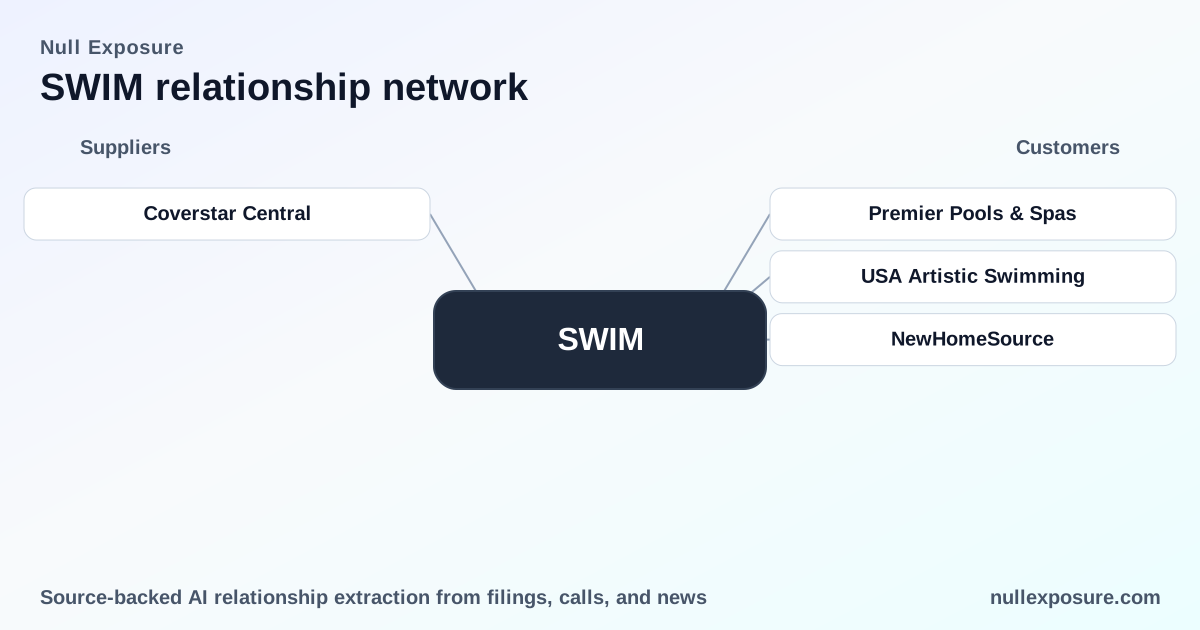
Premier Pools & Spas — exclusive supply agreement tied to an investment. According to Latham’s 2024 Form 10‑K filing, Latham entered into an exclusive supply agreement with Premier Pools & Spas and related franchisees in connection with Latham’s investment in Premier, formalizing a preferred supply channel. (Latham 2024 Form 10‑K, fiscal year ended December 31, 2024.)
-
USA Artistic Swimming — national sponsorship to enhance brand visibility. A Finviz news item dated March 10, 2026 reported Latham has signed on as an official sponsor of USA Artistic Swimming, positioning the company for consumer-facing brand exposure tied to an Olympic sport. (Finviz, March 10, 2026.)
-
NewHomeSource — product feature in 2026 Virtual Concept Home (press syndication). A Bitget news summary from May 4, 2026 noted that Latham products will be showcased in the 2026 Virtual Concept Home produced by NewHomeSource, amplifying visibility to homebuilders and prospective homeowners. (Bitget press summary, May 4, 2026.)
-
USA Artistic Swimming — additional press coverage of the same sponsorship. Taiwanese and international press outlets reported the sponsorship as well; Taiwan News on March 10, 2026 reiterated that Latham signed on as an official sponsor of the national governing body for artistic swimming in the United States. (Taiwan News, March 10, 2026.)
-
NewHomeSource — corporate press release confirming trade-show and Virtual Concept Home placement. In a February 17, 2026 GlobeNewswire release, Latham announced a booth presence at the 2026 International Builders’ Show and confirmed that its products will be featured in NewHomeSource’s 2026 Virtual Concept Home. (GlobeNewswire press release, February 17, 2026.)
What these relationships imply for investors and operators
-
Commercial lock-ins and stable channel revenue: The exclusive supply agreement with Premier Pools & Spas creates a predictable, contractual route to market that supports sales stability for specific product lines and reduces spot-market channel friction. Exclusive supply arrangements are a revenue-stabilizing asset but increase dependency on a named counterparty when paired with existing concentration metrics.
-
Marketing investments that scale brand equity, not immediate revenue: Sponsorship of USA Artistic Swimming and curated placements in NewHomeSource’s Virtual Concept Home are brand-building activities intended to support long-cycle purchase behavior in housing and remodeling markets. These activities improve long-term demand for premium pool products while having limited near-term impact on margins.
-
Concentration and credit risk remain key monitoring items: With one customer historically contributing roughly 21% of sales and top-ten relationships near 43% of net sales, customer concentration is the single most material commercial risk. Receivable balances in the low millions tied to large customers require active credit management and contingency planning.
-
Channel complexity demands differentiated commercial playbooks: Operating both one-step and two-step channels means Latham must maintain separate pricing, fulfillment and service standards for distributors versus direct dealers, with showroom and installation support for dealer partners. This structure complicates margin forecasting but raises barriers to entry once dealer relationships are entrenched.
-
Geographic diversification cushions but does not eliminate cyclicality: Presence in North America and APAC (Australia/New Zealand) spreads exposure across housing cycles, but the company remains primarily North America-driven, so domestic housing trends and discretionary consumer spend dynamics will dominate near-term results.
Practical checklist for next steps (for investors and operators)
- Review Latham’s most recent Form 10‑K and earnings call for counterparty identities and the exact terms of the Premier supply agreement.
- Quantify the top-ten customer concentration trend over time and stress-test receivable recoverability under slower housing markets.
- Track marketing spend versus measured topline lift from sponsorships and NewHomeSource placements to evaluate ROI on brand programs.
- Monitor distributor inventory levels and the one-step fiberglass dealer channel for margin variability and order cadence changes.
Final take
Latham’s revenue engine is anchored in manufacturing and structured distribution, supported by targeted sponsorships and strategic supply agreements. The company’s strengths—market leadership in in-ground pools, a hybrid distribution model, and targeted brand programs—are balanced by meaningful customer concentration and mid-single-digit millions of receivable exposure that investors should monitor closely. For ongoing signals and relationship-level diligence, explore updated coverage at https://nullexposure.com/.