Stanley Black & Decker (SWK): customer relationships that shape revenue and risk
Stanley Black & Decker operates as a global manufacturer and branded distributor of tools, hardware and security products, monetizing primarily through point‑of‑sale product volumes and aftermarket accessories across professional and consumer channels. Retail and mass‑merchant distribution is the commercial backbone—large home centers buy inventory in bulk while end users drive repeat purchases of consumables and batteries—creating a revenue profile tightly coupled to a handful of large customers and broad retail reach. For a concise, searchable view of these customer relationships, visit https://nullexposure.com/.
Why customers matter more than product lines right now
Stanley Black & Decker is structurally a seller of tangible goods, recognizing the majority of revenue at the time of sale, and uses a multi‑channel distribution model that mixes large enterprise retail customers with individual DIY and tradesperson end users. That combination produces high visibility on volume swings through major retail partners while retaining margin upside from professional channels and proprietary brands such as DEWALT and CRAFTSMAN. The company has also been pruning non‑core industrial assets to reduce leverage and sharpen focus on core hardware cash flows.
The customer roster you need to track
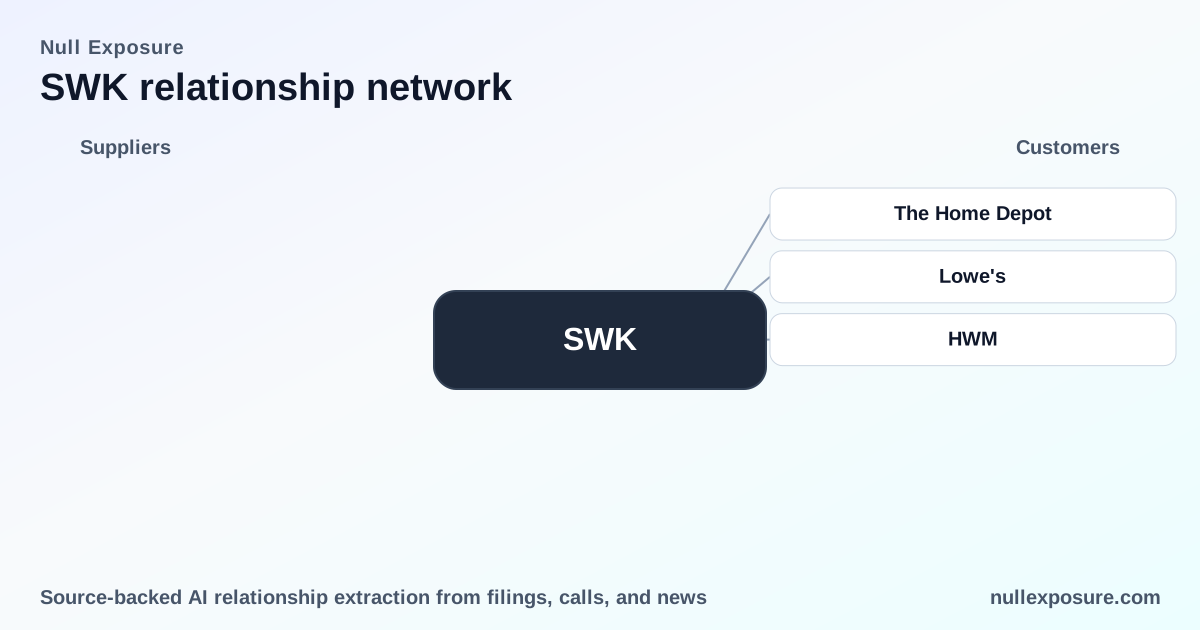
Lowe’s
Lowe’s is one of SWK’s largest retail partners, representing a sizeable and recurring channel for both consumer and professional product lines. According to Stanley Black & Decker’s 2024 Form 10‑K, Lowe’s accounted for approximately 14% of consolidated net sales in 2024, the same figure in 2023 and 15% in 2022, making Lowe’s a material revenue contributor. A Lowe’s earnings call in 2025 also referenced promotional activity that included DEWALT and CRAFTSMAN brand promotions, confirming DEWALT’s active merchandising in Lowe’s stores (Lowe’s Q2 2025 earnings call; SWK 2024 10‑K).
The Home Depot
The Home Depot is an equivalent strategic customer and distribution node for the company’s professional and consumer tools. The 2024 Form 10‑K notes that The Home Depot accounted for approximately 14% of consolidated net sales in 2024, and slightly lower percentages in prior years, which combined with Lowe’s brings the two largest customers to roughly 28% of total revenue—an important concentration metric for investors considering demand risk and working‑capital exposure (SWK 2024 10‑K).
Howmet Aerospace (HWM) — buyer of CAM
Howmet Aerospace acquired Stanley Black & Decker’s Consolidated Aerospace Manufacturing LLC (CAM) business in a transaction that materially reduced SWK’s debt. Multiple news reports and the company’s Q1 2026 commentary confirm that the CAM sale to Howmet was agreed in December 2025 for $1.8 billion, and the deal closed in April 2026, generating approximately $1.6 billion in net proceeds that contributed to debt reduction (press coverage including TradingView/Zacks, InsiderMonkey Q1 2026 call transcript, and closing reports in March–May 2026).
Skilled Trades College (DEWALT partnership)
Stanley Black & Decker has extended its DEWALT brand through education and workforce channels: Skilled Trades College announced a multi‑year partnership making DEWALT the official power tool partner across all STC campuses in Canada, with product integration into training programs and campus retrofits—an example of channel diversification into skills development and institutional partnerships (SimplyWall / client announcement, 2026).
What the relationship signals tell you about operating constraints
The extracted signals from filings and public commentary outline a consistent operating model:
- Counterparty mix: The company serves both large enterprise customers (home centers and mass merchants) and individual end users through branded consumer offerings, reflecting a two‑tier go‑to‑market strategy rather than reliance on a single customer type (company disclosures on channel mix).
- Geographic footprint: Approximately 62% of 2024 revenues were U.S.‑based, with material contributions from Europe, emerging markets and Canada; the Tools & Outdoor unit operates at global scale but remains North America‑heavy (SWK 2024 10‑K).
- Concentration and materiality: The two largest customers represented ~28% of consolidated net sales in 2024, a point the company discloses explicitly—this is a structural concentration that affects demand sensitivity and negotiating leverage (SWK 2024 10‑K).
- Contracting posture and revenue recognition: The business predominantly sells products at a point in time, distributing through retailers and third‑party channels, which limits long‑duration contractual lock‑ins but benefits cash conversion when retail stocking is robust (company revenue recognition policies).
- Relationship stage and role: Customer relationships are active and transactional, with SWK acting primarily as a seller of branded hardware and accessories across the professional and consumer segments.
- Segment focus: The Tools & Outdoor segment—power tools, hand tools, accessories and outdoor equipment—is the strategic core driving recurring revenues and brand equity.
Investment implications: where upside and risk converge
Stanley Black & Decker’s customer footprint creates a clear set of investment trade‑offs:
- Upside: Strong brand equity (DEWALT, CRAFTSMAN, BLACK+DECKER) and professional channel exposure support margin expansion when industrial and construction demand firms; divestitures such as CAM reduce leverage and concentrate capital on higher‑margin hardware.
- Concentration risk: Material reliance on Lowe’s and The Home Depot concentrates volume and working capital exposure; any sustained promotional cutbacks or inventory destocking at those partners would transmit quickly to SWK top‑line.
- Channel dynamics: The mix of large enterprise customers and individual consumers means swings in retail promotions, DIY cycles, and trade activity will jointly determine near‑term revenue volatility.
- Strategic mitigation: The company’s active divestiture program and institutional partnerships (e.g., Skilled Trades College) demonstrate a push to diversify revenue pathways and reduce non‑core exposure.
Key takeaways for investors:
- Retail concentration is a primary risk factor but is offset by deep brand penetration in professional channels.
- Sale of CAM to Howmet materially improved the balance sheet, supporting potential reinvestment in core categories or return of capital.
- Track promotional cadence at Lowe’s and Home Depot as a leading indicator for short‑term volume trends.
For researchers building a commercial view of SWK, start with the 2024 Form 10‑K for detailed channel and customer breakdowns and layer in recent earnings commentary and press coverage on divestitures to understand balance‑sheet impacts. For an integrated customer‑relationship lens and searchable references, visit https://nullexposure.com/.
Sources referenced in‑text include Stanley Black & Decker’s 2024 Form 10‑K, the company’s Q1 2026 earnings materials and transcripts, and multiple press reports covering the CAM divestiture and DEWALT partnership announcements (TradingView/Zacks, InsiderMonkey, SimplyWall, The Globe and Mail, March–May 2026).