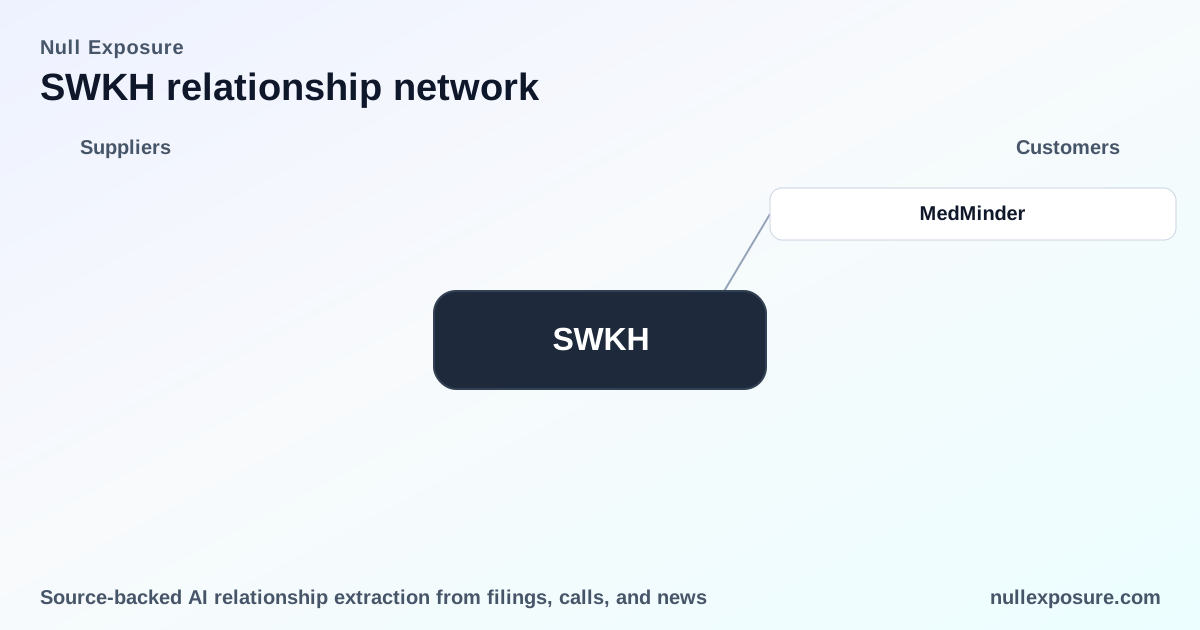
SWKH Customer Relationships: Credit, Concentration, and Cashflow Implications
Thesis: SWK Holdings operates principally as a direct credit investor and balance-sheet lender to growth-stage healthcare and life‑science companies, monetizing through interest income, financing fees, and structured exit provisions tied to its loan and credit facility agreements. For investors, the immediate lens is credit performance and revenue concentration rather than transactional volume—SWK’s return profile is driven by loan underwriting, fee capture, and selective equity participation in portfolio companies.
Visit the full SWKH profile for deeper relationship signals and document-level evidence: https://nullexposure.com/
Market posture in plain terms SWK executes bilateral credit facilities and term loans to niche healthcare businesses, capturing income through scheduled interest, accrued fees and negotiated exit charges. This business model trades off scale for higher credit yields and control over loan terms; portfolio outcomes hinge on borrower performance, repayment cadence, and a small number of economically significant counterparties.
What the disclosed relationships show Below I cover every customer (counterparty) relationship surfaced in the collected results. Each entry is concise and source-linked for verification.
MedMinder
- SWK provided a credit facility that supported MedMinder’s connected‑pharmacy operations, contributing to an additional financing round of about $35 million alongside equity partner Accelmed Partners. According to HitConsultant (August 31, 2022), the credit facility was closed to fund scale and operations for the company’s senior‑care medication management business. (HitConsultant, Aug 2022)
ELUT (Elutia)
- Elutia repaid the full $26.9 million outstanding principal, accrued interest and accrued exit fees associated with its loan from SWK Holdings during the fourth quarter, which significantly reduced reported interest expense for the borrower. This repayment was disclosed in a Jan 12, 2026 press release summarized via GlobeNewswire/ManilaTimes. (GlobeNewswire / ManilaTimes, Jan 2026)
How these relationships map to SWK’s operating model
- Direct-lending emphasis. Both items are examples of SWK acting as a direct lender or provider of credit facilities rather than a passive equity investor; the MedMinder financing was a credit facility and Elutia was an explicit loan that reached repayment. These structures create predictable cash yields through interest and exit fees when performance is as expected.
- Credit terms and exit economics matter. The Elutia record specifically references not only principal and interest but accrued exit fees, highlighting that SWK’s compensation is not limited to coupon income but includes contractual make‑whole or exit charges that enhance recoveries.
- Event-driven cashflow. Repayments and facility draws generate discrete cash events that materially affect near-term earnings and liquidity metrics; investors should monitor repayment timing and fee recognition schedules in earnings narratives.
Concentration and criticality: one company drove the pharma development stream
- Material concentration is a central signal. For the year ended December 31, 2024, the company reported that one customer accounted for approximately 96.0% of pharmaceutical development revenues—a company-level disclosure that signals extreme revenue concentration within that revenue line. This is a critical risk for top-line stability and negotiable pricing power.
- Implications for contracting posture and risk management. High concentration compresses SWK’s bargaining leverage over that revenue line and increases counterparty exposure; disciplined underwriting and collateral coverage become necessary mitigants when a single counterparty dominates revenue.
Contracting posture, concentration, criticality and maturity explained
- Contracting posture: bilateral, negotiated credit facilities and term loans with explicit interest, accrual mechanics and exit fee provisions. SWK’s instruments focus on contractual cashflow capture rather than distributed, rate‑sensitive product exposures.
- Concentration: Company disclosures show high concentration risk within pharmaceutical development revenue, creating earnings volatility tied to a narrow set of counterparties.
- Criticality: When single relationships contribute materially to revenue, counterparty performance becomes systemically important to SWK’s reported operating results and loan performance metrics.
- Maturity profile: Loan structures include term repayments and exit fees; the Elutia repayment demonstrates full-cycle credit realization where principal, interest and exit economics are settled—this reduced borrower interest expense and returned capital to SWK.
Risks and investor considerations
- Counterparty risk dominates. A concentrated revenue base and a lending model mean the company’s earnings are sensitive to individual borrower default, restructuring, or early repayment behavior.
- Fee recognition timing creates earnings volatility. Exit fees and accrued interest generate lumpy income; investors must model timing and collection probabilities rather than rely on steady coupon assumptions.
- Repricing and reinvestment risk. Returns depend on the ability to redeploy repaid capital into equally attractive loans; market liquidity and underwriting discipline will determine whether realized yields sustainably meet targets.
Strategic takeaways for portfolio managers
- Prioritize credit quality and covenant enforcement disclosure in quarterly filings and investor calls—loan performance metrics, non‑accruals, and covenant waivers are the linchpins of near‑term earnings visibility.
- Monitor borrower concentration trends across subsequent filings; a declining concentration ratio would materially reduce idiosyncratic revenue risk, while persistence at high levels elevates downside scenarios.
- Use documented repayments (such as Elutia’s full repayment and exit‑fee settlement) as data points for recovery assumptions; observed repays validate underwriting outcomes and inform expected loss modeling.
Mid‑article resource For a structured dossier on SWKH’s counterparty footprints and document-level evidence, see the NullExposure company hub: https://nullexposure.com/
Bottom line SWK Holdings’ customer footprint as shown in the disclosed results is consistent with a direct‑lending, credit‑fee monetization model that delivers concentrated, contractually anchored income streams. The combination of high concentration in pharmaceutical development revenues and loan‑style instruments with exit fees creates both upside in disciplined credit cycles and asymmetric downside if a major counterparty weakens. Investors should weight credit performance, fee realization timing, and borrower concentration as primary drivers of SWK’s near‑term earnings trajectory.
If you want a deeper, document‑level view of the counterparty contracts and earnings impacts, visit the company profile on NullExposure: https://nullexposure.com/