Swvl’s customer footprint: enterprise wins, a strategic divestiture, and what investors should price in
Swvl operates as an on-demand mass transit platform focused on emerging markets, monetizing through enterprise and government mobility contracts, first- and last-mile shuttle services, and fare-based bookings sold to corporations and public bodies. The company combines technology-driven routing and scheduling with operator networks to deliver scalable commuter services, extracting revenue from service agreements, per-ride fees, and enterprise contracts that lock in recurring volumes.
For a concise investor briefing on the revenue triggers and counterparties that matter for Swvl, read on — or visit https://nullexposure.com/ for deeper coverage and follow-up research.
The financial backdrop that frames customer value
Swvl’s reported trailing revenue is $24.17 million with a gross profit of $4.36 million, producing a positive profit margin of 5.43% while operating margin is negative at -2.03% and EBITDA stands at - $270,414. Market capitalization is listed at $18.8 million and shares outstanding are approximately 9.96 million. These figures reflect a company with revenue traction on enterprise contracts but constrained operating leverage, where customer wins translate directly into utilization improvements but not yet into durable positive operating leverage.
Investors should treat each material customer relationship as a lever on utilization, route density, and short-term cash flow rather than as a guaranteed profit center until operating margins consistently turn positive.
Customer wins and transactions that change the story
Each relationship below is presented with a plain-English summary and the public source that reported it.
-
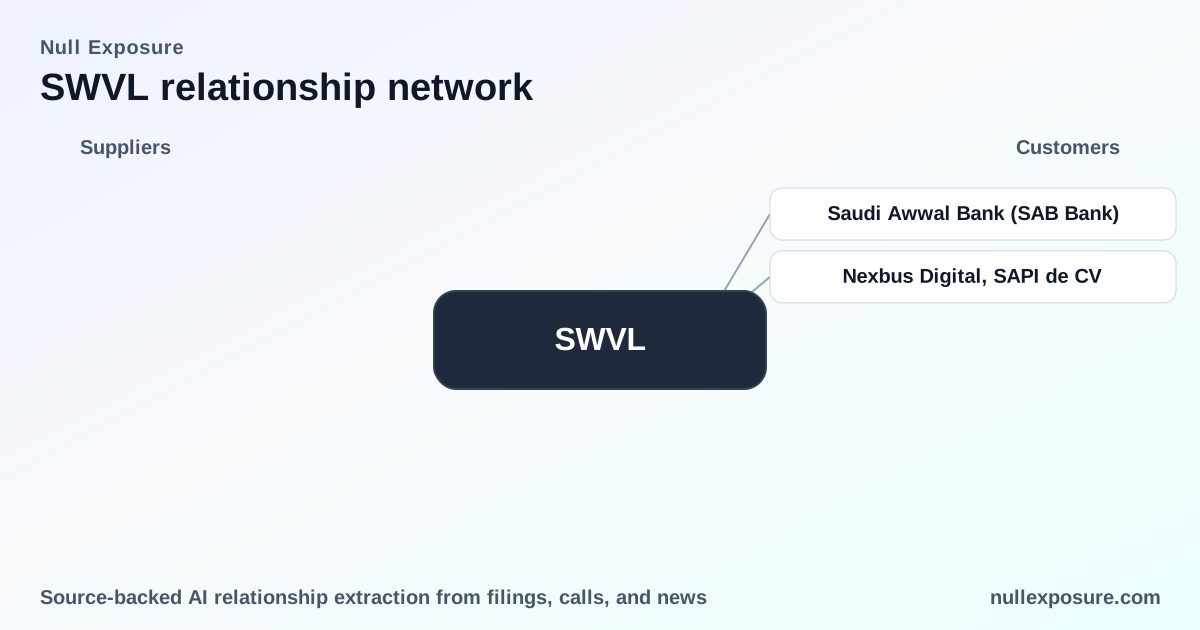
Saudi Awwal Bank (SAB Bank) — Swvl was selected to provide first- and last-mile shuttle services for SAB Bank employees in Riyadh, launching after the Riyadh Metro went into service and positioning Swvl as a corporate shuttle provider in Saudi Arabia. The arrangement was announced in a GlobeNewswire release on December 23, 2024, and covered by FinancialContent in parallel reporting. (GlobeNewswire, Dec 23, 2024; FinancialContent reporting)
-
Bank AlJazira — Swvl and Bank AlJazira jointly recorded over 100,000 bookings in Saudi Arabia since the start of the year, signaling material customer adoption on its enterprise platform and meaningful ride volumes driven by a single institutional partner. This milestone was reported by TipRanks in May 2026 under Swvl’s FY2025 activity reporting. (TipRanks company announcement, May 2026)
-
Nexbus Digital, SAPI de CV / Commute Technologies — Nexbus Digital acquired Commute Technologies, S.A.P.I. de C.V. from Swvl for $12 million, representing a divestiture of a business unit and a cash realization event that simplifies Swvl’s operational scope. This transaction was reported by Simply Wall St in a FY2026 note on corporate dispositions. (SimplyWallSt report, FY2026)
Why these relationships matter for value creation
Swvl’s enterprise partnerships in Saudi Arabia (SAB Bank and Bank AlJazira) demonstrate two critical commercial attributes: 1) the company can win institutional clients with large, recurring commuting needs; and 2) those clients generate high-visibility volume that directly improves route economics. The Bank AlJazira 100,000-booking milestone is evidence of scale at the route and program level rather than anecdotal usage.
The Nexbus acquisition of Commute Technologies represents a net capital event — $12 million into Swvl’s ecosystem through a sale — that reduces operational complexity and clarifies management focus on its core enterprise and government mobility offerings. For investors, that transaction is cash-positive and shifts the company towards a tighter set of commercial priorities.
Operating model constraints and business-model signals
While the data payload contains no explicit contractual constraint snippets, the observable commercial pattern provides company-level signals investors should incorporate:
-
Contracting posture: Swvl operates primarily through B2B and institutional service agreements rather than pure consumer acquisition. This produces stickier revenue when contracts are multi-year and predictable, but requires execution on service-level commitments and route reliability.
-
Concentration and criticality: A relatively small roster of institutional customers delivering large booking volumes implies concentration risk. When a partner like Bank AlJazira accounts for sizeable ridership, the loss or renegotiation of that contract would have outsized revenue and utilization effects.
-
Maturity of relationships: The Saudi wins indicate accelerating commercial maturity in a priority market where public transit investments (Riyadh Metro) create co-benefits for enterprise shuttle solutions. These are not trial pilots; they are scalable programs tied to city mobility infrastructure.
-
Capital and liquidity posture: The $12 million divestiture of Commute Technologies is a liquidity and focus signal — converting non-core assets to cash reduces balance-sheet complexity and provides runway to support enterprise rollouts.
What investors should watch next
-
Retention and expansion: Track renewal terms and the cadence of expanded routes with SAB Bank and Bank AlJazira; contract renewals and volume ramps are the clearest path to improved margins.
-
Revenue concentration metrics: Monitor disclosures that break out top-client revenue; single-client dependence is the primary downside risk to current utilization gains.
-
Use of divestiture proceeds: Evaluate how Swvl deploys the $12 million from the Commute Technologies sale — whether into geographic expansion, technology, or to shore up working capital — as this determines the optionality of the enterprise rollouts.
-
Operating leverage: Watch gross-to-operating margin conversion on successive quarters; consistent movement from negative operating margin to positive is the key valuation inflection.
If you want a consolidated view of Swvl’s counterparty exposures and follow-on transaction coverage, detailed company relationship notes are available at https://nullexposure.com/.
Bottom line
Swvl’s recent corporate customer activity in Saudi Arabia transforms pilot-scale presence into demonstrable enterprise volume, and the $12 million divestiture of Commute Technologies cleans the balance sheet while sharpening strategic focus. For investors, the core thesis is straightforward: enterprise mobility contracts drive utilization and revenue stability, but value realization depends on retention, diversification of counterparties, and sustained operating leverage improvements.