Southwest Gas Holdings (SWX): Customer relationships and commercial signals investors need to know
Southwest Gas Holdings operates as a regulated natural gas utility that purchases, transports and distributes gas to roughly 2.3 million customers across Arizona, Nevada and California, monetizing through regulated tariff sales, a small number of transportation-only contracts, and rate-base investments that produce predictable cash flow and dividend capacity. With a market capitalization near $6.7 billion and trailing revenue of roughly $1.94 billion, the company’s economics are driven by regulated margins, capital investment cycles and a largely captive residential base. For a concise institutional view of counterparty exposures and trade-level disclosures, see NullExposure’s platform at https://nullexposure.com/.
Investment thesis up front
Southwest Gas is a classic regulated-utility compounder: stable cash flows from tariff-based distribution, modest growth through infrastructure replacement, and limited counterparty concentration. The combination of regulated returns, a meaningful dividend yield and historically low beta supports a defensive allocation for income-oriented investors, while continued infrastructure work provides episodic revenue upside tied to capital programs.
What the recent public relationships tell investors
Below I cover every named counterparty relationship surfaced in the records provided and what each transaction or counterparty signal means for SWX’s customer and capital posture.
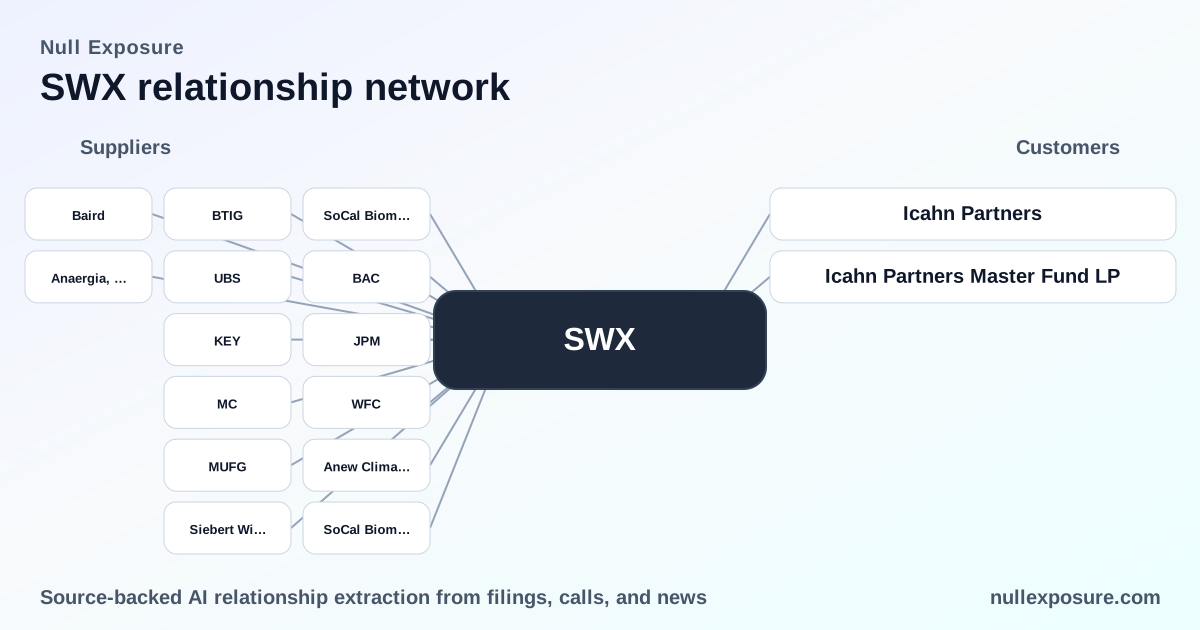
Icahn Partners — direct private placement purchaser
Southwest Gas Holdings sold an allocation of Centuri common stock in connection with a secondary public offering, and Icahn Partners agreed to purchase part of that placement—1,573,500 shares—from Southwest Gas in a concurrent private placement at the same offering price. This is a capital-marketing action, not a utility service contract; it reflects SWX’s disposition of equity in Centuri rather than operational customer revenue. (Quantisnow news report, March 10, 2026: https://www.quantisnow.com/insight/southwest-gas-holdings-announces-pricing-of-secondary-public-offering-of-6155113)
Icahn Partners Master Fund LP — affiliated purchaser in the same placement
An affiliated entity, Icahn Partners Master Fund LP, participated alongside Icahn Partners to acquire part of the 1,573,500-share block of Centuri stock sold by Southwest Gas, signaling institutional demand for that equity and providing SWX with liquidity via an equity disposition. The disclosure is transaction-level and stems from the same March 10, 2026, placement announcement. (Quantisnow news report, March 10, 2026: https://www.quantisnow.com/insight/southwest-gas-holdings-announces-pricing-of-secondary-public-offering-of-6155113)
How these relationships should be interpreted by investors
- These are capital-market transactions, not core customer contracts. The Icahn-related purchases are buyers of equity that SWX offered; they do not change Southwest Gas’s regulated service footprint or materially alter its utility cash flows.
- Liquidity and investor appetite matter. The successful placement alongside institutional buyers suggests SWX can access equity markets to monetize non-core stakes, which supports flexibility for capital allocation and potential de-leveraging or reinvestment into regulated infrastructure.
Company-level operating and commercial constraints (what drives customer economics)
The filings and excerpts provide a compact view of SWX’s operating model and customer dynamics; present as company-level signals rather than tied to the above purchasers unless explicitly named.
- Contracting posture: a hybrid of long-term, short-term and framework agreements. Filings show Centuri (an affiliated or related infrastructure services business) maintains 49 contracts with original duration >1 year, while other work is executed under one-off bid contracts or MSAs that govern future work authorizations. This mix supports both recurring base workloads and episodic project revenue.
- Counterparty mix and criticality: broad-based customer mix from residential to very large enterprise. Tariff sales are predominantly residential and small commercial, but transportation-only service and infrastructure contracting exist for very large customers; the utility is not dependent on a single counterparty. Filings explicitly state the company is not reliant on a few customers such that a loss would materially impair earnings.
- Geographic concentration: primarily North America, concentrated in the U.S. Southwest (Arizona, Nevada, California). Revenue attribution confirms the United States dominates revenues, with small Canadian operations noted in disclosures dated through FY2024–FY2025.
- Segment and role: core distribution plus infrastructure services. Southwest Gas operates as a distributor — purchasing and delivering gas — while affiliated infrastructure activity (Centuri) focuses on installation, replacement and maintenance of gas and electric networks; this creates a complementary revenue mix between regulated distribution and contracting services.
- Maturity and relationship tenure: long-term, stable customer relationships. Average customer-tenure signals (Centuri shows >20 years average) indicate mature commercial relationships that reduce churn risk and support steady backlog visibility for infrastructure services.
- Materiality and concentration risk: low single-customer concentration risk. Filings explicitly state no reliance on a handful of customers, which is a positive for credit and earnings stability.
Each of these constraints is drawn from corporate disclosures covering FY2024–FY2025 and related investor communications.
Financial and commercial implications for investors
- Predictable earnings base: Regulated tariff revenue and a diversified customer base support predictable operating margins and cash available for dividends; SWX’s trailing profit margin and dividend yield reinforce a defensive cash profile.
- Episodic upside from infrastructure programs: The presence of MSAs and long-term contracts in affiliated infrastructure work creates periodic revenue growth tied to pipeline replacement and electrification/utility modernization projects.
- Capital allocation flexibility: The Centuri equity placement indicates SWX can monetize non-core equity positions through public offerings and negotiated private placements with institutional buyers, providing a lever for balance sheet management.
- Moderate credit sensitivity to regulatory cycles: As with all utilities, returns and cash flow are subject to rate-case outcomes and regulatory frameworks in AZ, NV and CA; the company’s geographic concentration focuses regulatory risk into three states.
Key takeaways for investors
- Core utility economics dominate SWX’s risk/return profile — stable, regulated cashflows with modest growth from infrastructure work.
- Counterparty mix is broad and customer concentration is low, reducing single-counterparty exposure.
- Recent equity placement activity (Centuri shares purchased by Icahn-affiliated funds) is a capital-marketing event and signals the company’s ability to transact with institutional buyers for portfolio reshaping.
For a deeper, transaction-level view of SWX’s counterparty disclosures and to monitor evolving relationships in real time, visit NullExposure’s platform at https://nullexposure.com/.
Conclusion: Southwest Gas is a steady regulated utility with a conservative counterparty footprint and sufficient capital-market access to reshape non-core holdings; investors should weigh predictable tariff revenue and dividend stability against the regulatory and capital-cycle dynamics inherent in the utility business.