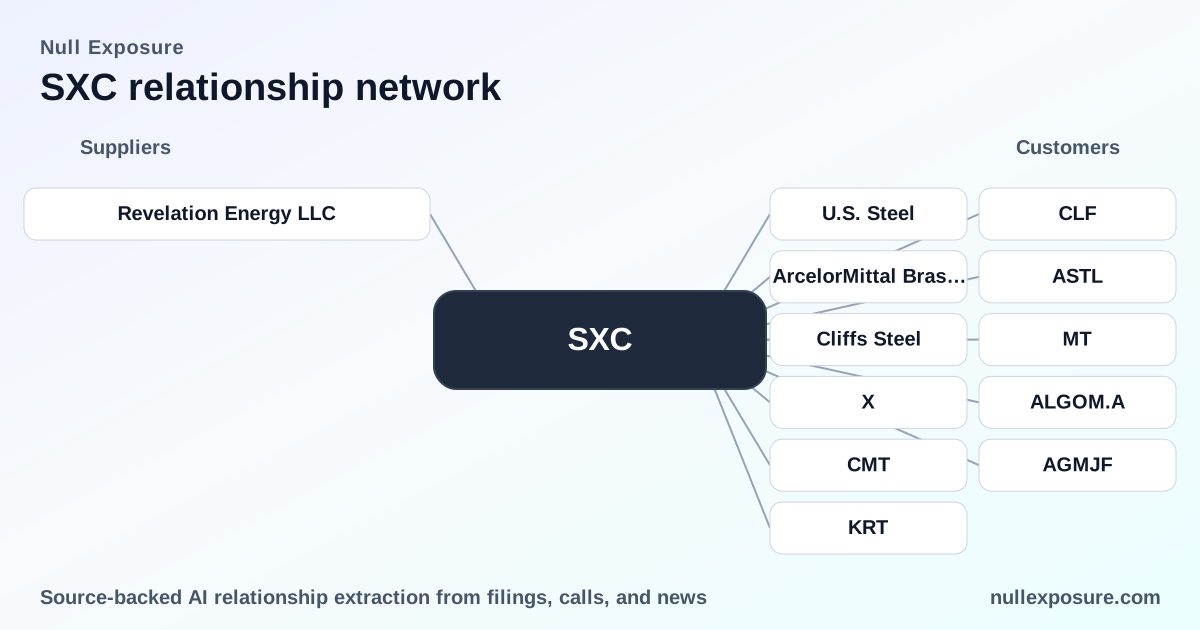
SunCoke Energy (SXC): Customer Map and Contract Signals for Investors
SunCoke Energy operates and monetizes by manufacturing metallurgical coke and selling it primarily under long‑term, take‑or‑pay contracts to integrated steelmakers, while also earning licensing and operating fees for a Brazil cokemaking facility and selling excess capacity into spot and export markets. Revenue is driven by a hybrid model: durable, contracted volumes that stabilize cash flow and higher‑margin—but cyclical—spot and services revenues that amplify earnings volatility. For primary research and contract monitoring visit https://nullexposure.com/.
The high‑level investment thesis in one paragraph
SunCoke is a concentrated industrial counterparty to a small set of large steel producers: long‑dated take‑or‑pay contracts underpin the business, licensing and service fees provide a predictable tail in Brazil, and spot sales create earnings sensitivity to global coke/coal markets. That mix creates defensive cash flow under base contracts but leaves near‑term EBITDA exposed to volume reallocations, contract disputes and commodity price swings.
What the contract architecture tells you about business risk
SunCoke’s disclosures and public commentary reveal a clear operating posture. The company reports that the majority of its blast furnace coke sales come from long‑term, take‑or‑pay agreements, establishing a base of committed volumes and multi‑year visibility on revenue. At the same time, SunCoke runs a Brazil operation under licensing and operating agreements—collecting fees and passing through operating costs—which converts capital intensity into fee income rather than ownership returns. The business also sells excess capacity on the spot market and provides logistics/handling services; those activities create cyclical exposure and link near‑term profitability to export demand and coal market dynamics. Finally, SunCoke reports approximately 19.1 million tons of unsatisfied or partially unsatisfied performance obligations as of December 31, 2024, implying multi‑year contracted backlog and an active relationship book (company 10‑K, FY2024).
The customer ledger — who SunCoke serves and how the relationships work
Below are the counterparties and relationship nodes that appear in SunCoke’s filings, earnings calls and the market press. Each entry is a plain‑English summary with a concise source note.
-
United States Steel (U.S. Steel / X)
SunCoke has an active cokemaking agreement to supply the Granite City facility and extended that Granite City contract through December 2026 on terms described as similar to the prior extension. According to the Q4 2025 earnings call and subsequent press releases, SunCoke and U.S. Steel agreed to the one‑year extension that preserves supply continuity from Granite City (earnings call, 2025Q4; InvestingNews/press release, FY2026). -
Cleveland‑Cliffs (Cliffs Steel / CLF)
Cleveland‑Cliffs is a material long‑term customer: SunCoke extended the Haverhill II take‑or‑pay contract through December 2028, supplying roughly 500,000 tons per year from Haverhill under the renewed agreement. Management stated the extension on the 2025 Q4 call and multiple market notices confirmed the three‑year term (earnings call, 2025Q4; InvestingNews and SteelMarketUpdate, FY2025–FY2026). -
ArcelorMittal Brazil (ArcelorMittal Brasil S.A. / MT)
SunCoke designed and operates a cokemaking facility in Vitória, Brazil under licensing and operating agreements for ArcelorMittal’s Brazilian subsidiary, generating licensing and operating fees and passing through most operating costs. The 2024 10‑K and later investor materials describe fee‑based revenues tied to production levels at the Brazil facility (10‑K, FY2024; Marketscreener/earnings coverage, FY2026). -
Algoma Steel (Algoma / ASTL / AGMJF)
Algoma is a previously contracted customer where SunCoke reported a breach of contract that materially disrupted the Domestic Coke segment, causing lost sales volume and a cash impact disclosed by management (the breach was quantified as a ~$30 million negative cash impact in commentary). The company has publicly discussed the Algoma breach and related facility closures in Q4 2025 reporting (earnings call Q4 2025; The Globe and Mail / AlphaStreet / Investing.com coverage, FY2026). -
KRT (facility/contract node)
KRT is referenced in SunCoke’s remarks as the site of a new take‑or‑pay coal handling agreement that began in 2025, indicating growth of fee‑for‑service and handling revenues in the company’s logistics segment. Market notices and the Q4 2025 transcript cite the KRT contract when discussing segment recovery (press releases/Q4 2025 transcript, FY2026). -
CMT (facility/segment node)
CMT is cited by management in the context of operational performance and segment recovery—SunCoke expects modest recovery across both KRT and CMT, highlighting that these nodes are meaningful to near‑term logistics and export channel economics. The expectation appears in the Q4 2025 earnings transcript and related press (Q4 2025 transcript; FY2026 coverage).
How these relationships translate into value and risk for investors
SunCoke’s customer map creates a distinct risk/return profile:
- Revenue stability from long‑term, take‑or‑pay contracts is the company's primary value driver; evidence in the 10‑K shows most blast furnace coke is sold under such agreements. This limits downside on volumes under normal conditions but raises sensitivity to counterparties exercising contract termination or breaching terms (10‑K, FY2024).
- Service and licensing revenues in Brazil convert capital‑intensive assets into recurring fees, but the structure passes operating cost volatility to SunCoke (and its customer), so margin stability depends on contract design and throughput (10‑K and FY2026 investor materials).
- Spot and export sales create upside and cyclical downside, particularly when major customers reduce third‑party coke demand; the company’s Q4 2025 commentary links spot market weakness to lower domestic coke economics (earnings call Q4 2025).
- Concentration risk is material: a small number of integrated steelmakers account for the majority of contracted volumes, so contract renewals and disputes (e.g., Algoma) are high‑impact events for earnings and cash flow.
Practical investor takeaways
- Contracted backlog is durable but not invulnerable — multi‑year take‑or‑pay agreements provide baseline cash flow, yet breaches and re‑allocations to the spot market have had immediate adverse effects on volumes and liquidity. (10‑K; Q4 2025 earnings commentary.)
- Watch Cleveland‑Cliffs and U.S. Steel renewal cadence—both customers have recently extended contracts, anchoring revenue in the medium term; any early termination or materially worse economics on renewals would be a negative catalyst. (Earnings call Q4 2025; InvestingNews, FY2026.)
- Monitor Algoma litigation/settlement outcomes and Brazil throughput—Algoma’s dispute caused tangible cash impact; Brazil licensing/operator fees are a structural hedge but require stable production to remain accretive. (Q4 2025 transcript; 10‑K FY2024.)
For deeper coverage on counterparty exposures and contract terms, see our company dashboards and relationship analytics at https://nullexposure.com/. If you want alerts on material changes to SXC counterparties or contract expiries, our platform synthesizes public filings and market reports into investor‑grade signals.
Bold, contract‑by‑contract monitoring will determine whether SunCoke’s contracted revenue floor or spot‑driven earnings leverage dominates the P&L in the coming quarters; current disclosures show the contracted floor is meaningful but not sufficient to eliminate headline volatility.