Standex (SXI): Customer relationships, divestitures and what they mean for investors
Standex International operates as a diversified industrial manufacturer, selling engineered components and finished products across five segments (Electronics, Engineering Technologies, Scientific, Engraving and Specialty Solutions). The company monetizes through direct product sales to OEMs and service contracts—mixing point-in-time shipping sales with long-term, over-time contracts for highly customized engineering work—while pursuing portfolio simplification through selective divestitures. For more structured signals on counterparties and transaction types, see reliable primary coverage at https://nullexposure.com/.
Executive summary — portfolio shaping and customer mix
Standex is actively simplifying its portfolio while doubling down on capital allocation toward larger, higher-margin businesses. A notable FY2026 divestiture (Federal Industries) for ~$70 million is a clear example of capital redeployment to core segments, and ongoing customer relationships with major OEMs underscore a business model that sells to large enterprises and institutional buyers across North America, EMEA and APAC. Investors should watch how management balances spot order flows with backlog-driven, long-term engineered contracts—this mix drives revenue visibility and working capital volatility.
If you want the raw relationship signals and transaction feed used in this note, visit https://nullexposure.com/.
Relationship map — who Standex is selling to, and recent deal flow
Below are the customer-relationship items captured in recent press and call coverage. Each entry is a concise, plain-English takeaway with the original reporting cited.
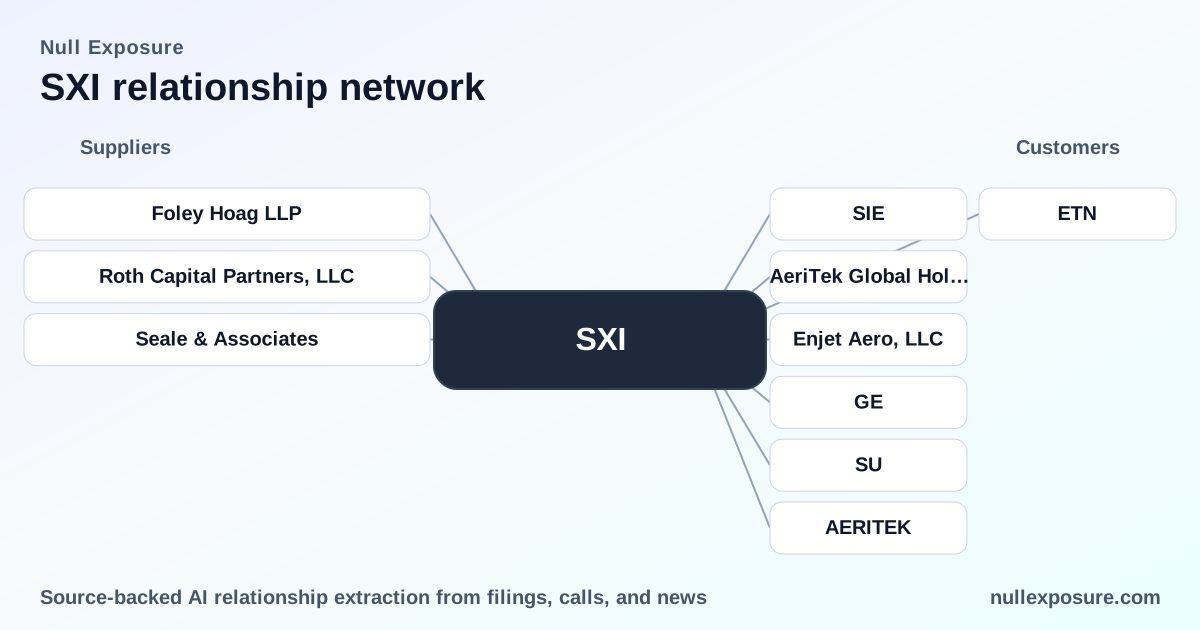
AeriTek Global Holdings LLC / AeriTek / AERITEK
Standex completed the sale of its Federal Industries display merchandising business to AeriTek Global Holdings for an enterprise value of approximately $70 million, a transaction management frames as portfolio simplification to focus on larger, faster-growing units. This divestiture was widely reported in May 2026 by Investing.com, Barchart and other market outlets. (Investing.com, May 4, 2026; Barchart press release coverage, May 2026)
Eaton (ETN)
Eaton is cited by Standex management as one of the large customers that has suggested acquisition targets and represents an OEM-level relationship—one that underscores Standex’s role as an outsourced supplier for electrical equipment. This was mentioned during the FY2026 earnings call transcript coverage reported by Investing.com. (Investing.com transcript, FY2026)
Schneider Electric (SU)
Schneider Electric is referenced alongside other OEMs as a customer that has outsourced low- to medium-voltage transformer engineering to Standex’s Grid operation, illustrating Standex’s position as a strategic engineering partner for global electrical OEMs. The comment appears in earnings-call reporting from March–May 2026. (InsiderMonkey / Investing.com earnings-call coverage, March–May 2026)
Siemens (SIE)
Siemens is listed as an OEM customer that has increasingly outsourced engineering for specific electrical components to Standex’s Grid business, reinforcing exposure to large enterprise procurement cycles in energy and industrial automation markets. This observation is drawn from the same Q2 FY2026 call transcript reporting. (InsiderMonkey / Investing.com earnings-call coverage, March 2026)
General Electric (GE)
GE is similarly identified as an OEM customer that has shifted low- to medium-voltage transformer engineering outwards to suppliers such as Standex, which reflects a broader industry trend of OEMs using specialist suppliers for engineered components. This was noted in earnings-call summaries published in March 2026. (InsiderMonkey earnings-call reporting, March 2026)
Enjet Aero, LLC
In FY2021 Standex divested Enginetics Corporation, its jet engine components unit, to Enjet Aero, LLC for approximately $11.5 million in cash—an earlier example of portfolio pruning consistent with the company’s longer-term strategy. The FY2021 transaction was announced in CityBiz and related regional coverage. (CityBiz, FY2021)
What the constraints tell us about the operating model
The relationship and filing excerpts collectively sketch a company that is commercially diverse, globally placed, and product-focused, with several structural characteristics investors must internalize:
-
Contracting posture — mixed: Standex recognizes the bulk of revenue at the point in time for standard shipped products, but it also books revenue over time on long-term, highly customized engineering contracts in segments such as Engineering Technologies and Engraving. This implies periodic backlog-driven volatility but also higher-margin, stickier revenue where the company has contractually guaranteed recoverability for costs plus margin.
-
Counterparty profile — large enterprise and institutional: The firm sells directly into large space, aviation, defense, energy and medical customers as well as government and academic institutions. This positioning creates commercial resilience but longer procurement cycles.
-
Geographic footprint — global but North America weighted: Reported revenues show significant U.S. exposure with meaningful EMEA and APAC sales, supporting a geographically diversified revenue base while leaving the company sensitive to regional industrial cycles and FX movements.
-
Concentration — diversified customer base: Standex reports no single customer accounting for more than 5% of sales or receivables, which is consistent with low customer concentration risk but increases the importance of aggregate OEM demand trends.
-
Role and segment focus — seller and manufacturer: The company’s primary role is as a seller/manufacturer across five industrial segments, which favors volume and product mix as the primary levers for margin improvement.
Collectively, these constraints indicate a business with moderate revenue visibility, low customer concentration risk, and tactical exposure to OEM procurement shifts rather than single-customer dependency.
Investment implications — positioning and risks
-
Positive: portfolio sharpening and margin focus. The Federal Industries divestiture strengthens management’s credibility on reallocating capital to higher-return areas; that should support margin expansion if redeployed into faster-growing engineered-product lines.
-
Watch: backlog and working capital sensitivity. The mix of spot sales and long-term contracts creates earnings cadence risk—investors should track backlog trends and disclosure on long-term contract timing.
-
Customer-driven growth. Relationships with major OEMs (Siemens, Schneider, Eaton, GE) validate Standex’s role as an outsourced engineering partner; continued demand from these customers underpins growth, but also ties Standex to large-cap industrial capex cycles.
-
Diversification reduces single-counterparty risk. No customer concentration above 5% protects against a single-account shock, but macro-sector slowdowns could still compress revenue across many smaller clients simultaneously.
Bottom line
Standex is executing a disciplined strategy of portfolio rationalization while maintaining a global OEM-facing manufacturing model that combines spot product sales with bespoke contract engineering. The FY2026 divestiture activity and the publicly cited customer relationships position Standex to benefit if global industrial demand recovers, but investors should monitor backlog dynamics and capital redeployment outcomes closely.
For a deeper look at relationship-level reporting and the original press references used in this note, visit https://nullexposure.com/.