60 Degrees Pharmaceuticals (SXTP): Customer Relationships and Commercial Footprint
60 Degrees Pharmaceuticals develops and commercializes infectious-disease therapies and monetizes primarily through product sales of ARAKODA (tafenoquine) and related commercial partnerships that expand access and reduce patient cost barriers. Revenue today is concentrated in a narrow set of commercial channels—traditional pharmaceutical distribution, pharmacy savings partnerships, travel telehealth platforms, and discrete government work—while product commercialization remains the principal cash-generating engine. For a quick look at company signals and relationship mapping, visit https://nullexposure.com/.
How the commercial model actually works for investors
60 Degrees runs a classic small-cap specialty pharma commercial playbook: own a single differentiated product, drive reseller/distributor sales into the U.S. market, supplement with pharmacy savings and telehealth distribution to broaden reach, and capture non-product research or contract revenue from government engagements. That structure produces rapid top-line leverage when demand scales, but creates concentrated counterparty exposure until channel breadth matures.
Key operating characteristics for investors to track:
- Contracting posture: Predominantly distributor/reseller contracts and commercial partnerships (GoodRx, Runway Health), with discrete government contract work recorded as research revenue in recent periods.
- Concentration: The company reports extremely high concentration in a U.S. pharmaceutical distributor that historically accounted for the vast majority of product sales; this is the principal single-party revenue risk.
- Criticality: Arakoda is the company’s core product; therefore distributor and partner channels are critical to topline performance and working-capital dynamics.
- Maturity: Commercialization is early stage—active sales exist, promotional pilots are in progress, and third-party partnerships are being added to accelerate access and affordability.
Customer relationships: who matters and why
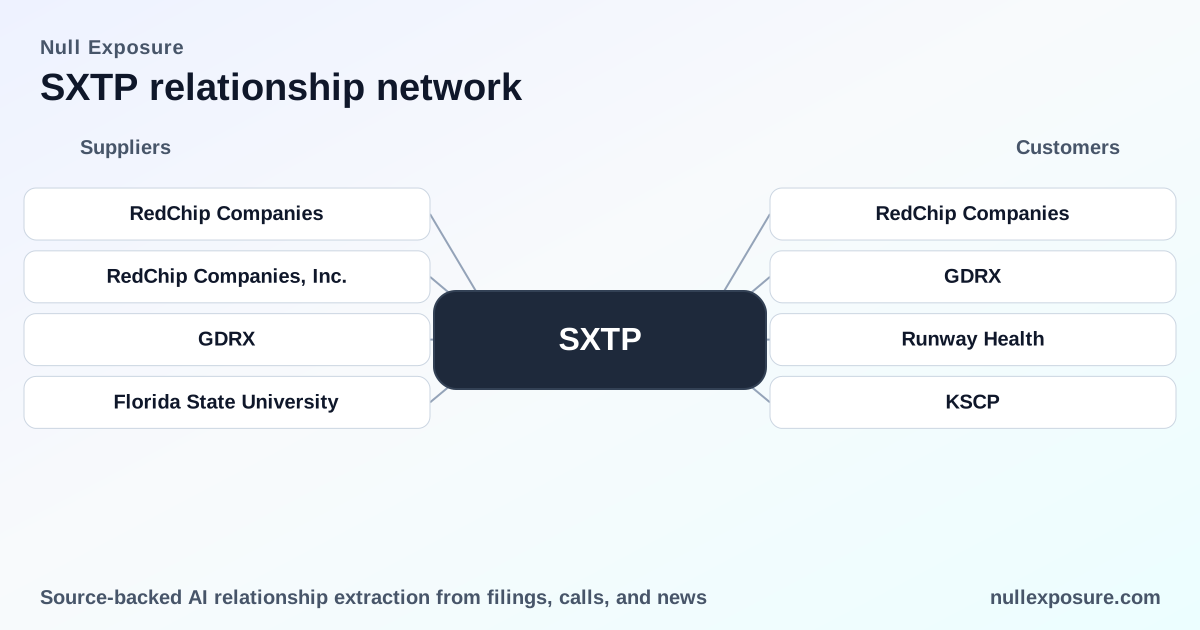
Below are every customer/partner relationship surfaced in public filings and press coverage, with concise plain-English summaries and source attributions.
-
GoodRx (GDRX)
60 Degrees partnered with GoodRx in February 2026 to provide eligible patients savings of up to 30% on ARAKODA and to expand pharmacy access to more than 70,000 locations nationwide, a move designed to remove price barriers for US travelers and at-risk populations. According to a GlobeNewswire press release (Feb. 2, 2026) and reiterated in the company’s FY2025 results announcement (Mar. 31, 2026), the partnership is an explicit commercial channel to boost retail demand. -
Runway Health
The company signed a travel-focused telehealth agreement to make ARAKODA available for pre-departure malaria prevention on Runway Health’s platform, enabling international travelers to obtain prescriptions through a virtual care workflow and expanding direct-to-consumer access. This initiative was reported in multiple outlets including RTTNews and the company’s March 2026 disclosures, with platform launch timing noted in early April 2026 press references. -
RedChip Companies
RedChip Companies functions as an investor relations/media services client for SXTP and related issuers; the engagement included broadcast interviews slated for RedChip’s show on Bloomberg TV, indicating active IR outreach to retail and small-cap institutional audiences. This client relationship was cited in a press report republished by BlufftonToday (Mar. 10, 2026). -
Knight / KSCP
The company’s FY2024 Form 10‑K documents a contingent royalty arrangement tied to a Qualified IPO outcome: upon success of the Qualified IPO, the company will calculate royalty payments to Knight (KSCP) at the end of each calendar quarter. This contractual obligation is recorded in the 2024 filing and creates a contingent cash obligation linked to corporate transaction milestones (sxtp 10‑K filing, FY2024).
What the relationship map implies for revenue and risk
The combination of these relationships produces a clear commercial profile:
- High revenue concentration risk: Company disclosures state a U.S. pharmaceutical distributor accounted for roughly 95% of total net product sales for the year ended Dec. 31, 2024, which makes distributor continuity and terms a material commercial sensitivity.
- Channel diversification underway: Partnerships with GoodRx and Runway Health are tactical expansions that reduce friction at the point of sale and broaden patient access outside of the single large distributor channel—an operational priority for moving beyond concentrated reseller dependence.
- Government work is a separate revenue vector: The company recognized research revenues in 3Q 2024 related to a contract with the U.S. Army Medical Materiel Development Activity (USAMMDA) for Arakoda supply chain upgrade support, indicating non-product contract revenue that does not contribute to Net Sales for certain royalty calculations (company disclosures).
- Contractual encumbrances and contingent obligations: The Knight royalty language in the FY2024 10‑K creates a contingent payment structure that will affect cash flow if the Qualified IPO trigger occurs; investors must monitor milestone progress and royalty calculation mechanics disclosed in periodic filings.
Pilot programs, regional footprint, and international signals
The company’s commercial footprint shows early signs of geographic breadth but limited scale:
- U.S. dominance: North American sales are the heart of current product revenue, with the large U.S. distributor supplying most shipments.
- APAC and EMEA presence: Kodatef (an alternate product designation in certain markets) to an Australian distributor represented approximately 5% of net product sales, and shipments to Scandinavian Biopharma mark initial European traction—both reported in SEC filings and company disclosures.
- Commercial maturity: A nine‑month promotional pilot announced in October 2024 introduced virtual sales representatives to drive co‑pay program awareness—this underscores that salesforce and commercial infrastructure remain in build-out phase.
Investor implications and monitoring checklist
For analysts and operators evaluating SXTP customer exposure, focus on these high-conviction signals:
- Monitor distributor revenue trends and contract terms—a single U.S. distributor drives most product revenue and is the single-largest counterparty risk.
- Track uptake via GoodRx and Runway Health as early indicators that demand can be converted outside traditional reseller channels; subscription-like repeat usage for travel prophylaxis will be particularly informative.
- Watch filings for milestones tied to Knight royalty mechanics and any updated description of how government contract revenues interact with Net Sales definitions and royalty thresholds.
- Assess promotional pilot outcomes and international distributor sales for evidence that commercial maturity is progressing beyond pilot stage.
For further proprietary signals and structured relationship analysis on SXTP, visit https://nullexposure.com/ for access to curated commercial maps and filing-level evidence.
Bottom line
60 Degrees’ commercial strategy is straightforward: scale ARAKODA revenue through a mix of distributor relationships, pharmacy savings partnerships, and telehealth platforms while capturing supplemental contract revenues. The key investor trade-off is the upside from broader access versus the near-term downside from extreme revenue concentration in a single U.S. distributor and contingent royalty liabilities—both of which are clearly visible in filings and press coverage.