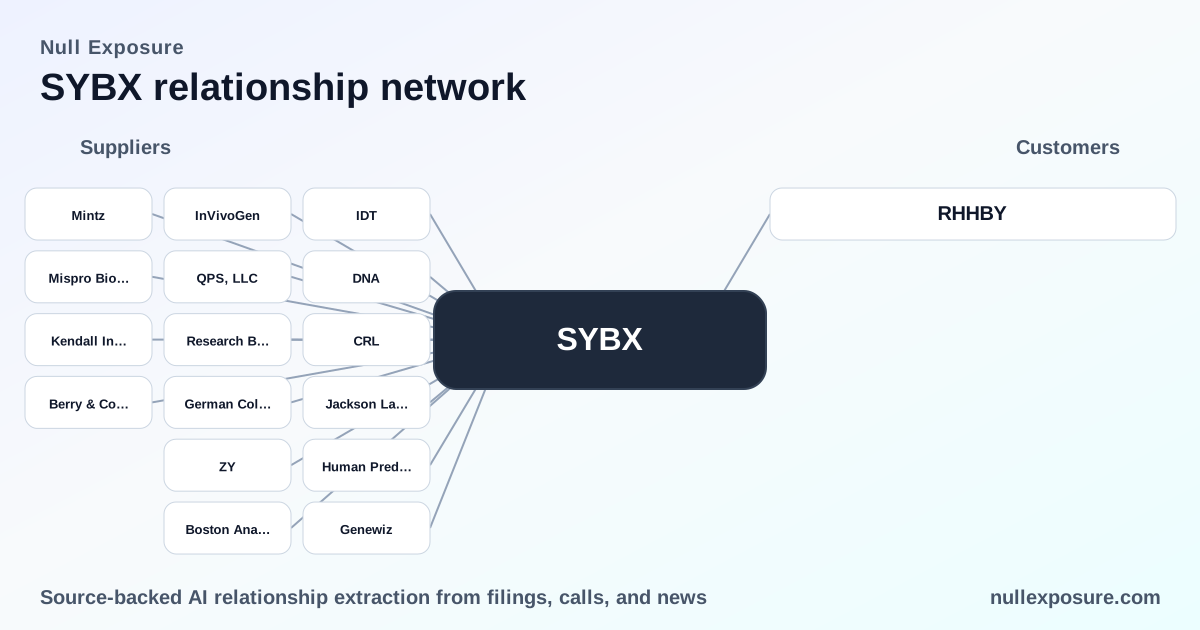
Synlogic (SYBX): Roche as the revenue engine — what investors must know
Synlogic is a clinical‑stage developer of engineered “synthetic biotics” that monetize primarily through partnership economics: upfront technology access fees, milestone payments tied to discovery and development achievements, and — ultimately — licensing or product revenue if programs advance to commercialization. Near-term cash flow for Synlogic has been dominated by its collaboration with Roche (RHHBY), making partner payments the company’s primary revenue lever rather than product sales. For a structured counterparty view and ongoing monitoring, visit https://nullexposure.com/.
How Synlogic runs its business and why partner deals matter
Synlogic’s operating model is built for asset advancement rather than direct commercial execution. The company focuses R&D resources on engineered microbial therapies while relying on large pharmaceutical partners to underwrite discovery costs and validate development pathways. This contracting posture produces highly concentrated, milestone‑driven revenue: payments are discrete and lumpy, tied to scientific or regulatory events rather than steady product sales. That structure compresses cashflow predictability and amplifies the impact of a single counterparty’s decision on Synlogic’s financial profile.
Company‑level signals reinforce this profile: Synlogic flags global commercial and payor risk as a factor that can limit potential returns outside the U.S., and it specifically identifies payor and government cost‑containment as a risk to coverage and reimbursement. These are operating constraints that affect long‑term commercialization economics across all partner programs.
Roche: a defining relationship with clear economic contours
Roche has been Synlogic’s most consequential partner. The engagement combined a technology access fee, defined milestone payments, and an exclusive option to license development rights at the conclusion of the discovery period. The collaboration concluded after Roche did not exercise its exclusive option following milestone completion, which converted the relationship from an open development collaboration into a terminated agreement with one‑time payments realized by Synlogic. This outcome illustrates both the upside (milestones achieved and paid) and the structural downside (no follow‑on license, no downstream royalties).
Synlogic’s filings and press disclosures show the economics: Roche paid a $1.0 million nonrefundable access fee in July 2021 and then paid up to $5.0 million in milestone payments as those criteria were met between September 2021 and October 2023. That $1–6 million band is the material revenue contribution from Roche in the period covered.
Line‑by‑line coverage of every relationship item we find
Below are each of the indexed relationship mentions and what they mean in plain English.
-
CityBiz report (Q2 2022): Revenue in reporting periods was associated with the ongoing Roche research collaboration to discover a Synthetic Biotic for inflammatory bowel disease, confirming Roche’s role as a customer and partner supporting discovery activities. Source: CityBiz Boston financial update (Synlogic Q2 2022) — https://www.citybiz.co/article/306247/synlogic-reports-second-quarter-2022-financial-results-and-provides-business-update/?abkw=citybizboston
-
GlobeNewswire press release (Q1 2024): Synlogic states that revenue for the three months ended March 31, 2024 was related to a material transfer agreement and that revenue in the comparable 2023 period was linked to the prior Roche collaboration, indicating residual contract accounting and one‑off transfers tied to earlier partner work. Source: Synlogic Q1 2024 financial results (GlobeNewswire, May 14, 2024) — https://www.globenewswire.com/fr/news-release/2024/05/14/2881236/0/en/Synlogic-Reports-First-Quarter-2024-Financial-Results.html?utm_s=
-
Simply Wall St note (FY2026): Synlogic received a milestone payment under the Roche pact to discover a synthetic biotic for bowel disease (reported Sep 06), which documents the final milestone cash-in that completed the milestone schedule. Source: Simply Wall St coverage citing the Roche milestone payment (reported in 2026) — https://simplywall.st/stocks/us/pharmaceuticals-biotech/otc-sybx/synlogic
-
Duplicate listing in Simply Wall St (FY2026): The same event — Synlogic’s milestone payment under the Roche discovery agreement — is captured again under the Roche name and RHHBY symbol; this reinforces that the Roche engagement produced discrete milestone receipts in the documented period. Source: Simply Wall St (same reference) — https://simplywall.st/stocks/us/pharmaceuticals-biotech/otc-sybx/synlogic
What constraints and filings tell investors about risk and concentration
Several explicit constraints in Synlogic’s filings and investor communications are material to counterparty analysis:
-
Relationship role and termination (Roche‑specific): Synlogic’s accounting assessment identified Roche as the contract counterparty (customer) under ASC 606, and filings state that the Roche collaboration concluded after the last milestone was achieved in October 2023 when Roche did not exercise its option to license the program. This creates a finite revenue tail from that engagement rather than an ongoing royalty stream.
-
Spend band (Roche‑specific): Roche’s payments to Synlogic were limited in magnitude: a $1.0 million upfront technology access fee plus up to $5.0 million in milestone payments, with all milestones achieved and paid over 2021–2023. This places the Roche relationship in the $1–10 million revenue band and highlights the limited absolute revenue scale from that partnership.
-
Government and payor risk (company‑level): Synlogic identifies governmental and private payor efforts to constrain healthcare costs as a company‑level commercial risk that could limit coverage and reimbursement, which is relevant to any future product economics and partner diligence.
-
Global market risk (company‑level): Filings note that revenue outside the United States may be insufficient to be commercially attractive, signaling an expectation that international commercialization would face structural pricing and access hurdles.
Together these constraints indicate a business that is partner‑dependent, revenue‑lumpy, and exposed to payor and geography‑driven commercialization pressures.
Investment implications: how to weigh upside and downside
-
Concentration risk is high. Roche was the dominant counterparty in Synlogic’s disclosed revenue history; the collaboration’s termination removes a predictable milestone runway and puts pressure on near‑term cash generation.
-
Revenue is finite and event‑driven. The $1–6 million payment band from Roche demonstrates the limited absolute scale of partner receipts to date; investors should not extrapolate recurring revenue from these one‑time payments.
-
Clinical and commercialization uncertainty persists. Synlogic’s value is tied to the progress of its synthetic biotics through clinical proof points and to new partner deals that convert scientific potential into sustained licensing economics.
-
Payor and geography constraints suppress long‑term upside unless priced appropriately. Government and coverage risks require any commercialization strategy to justify access and pricing in major markets.
For a consolidated, ongoing view of Synlogic’s counterparty map and to monitor partner changes in real time, see our coverage hub at https://nullexposure.com/.
Bottom line
Synlogic’s historical revenue story is a case study in partner‑funded discovery: Roche supplied the principal cash injections via a modest upfront fee and a string of milestones, and that collaboration has now closed with paid milestones but no exercised license. Investors should price Synlogic as an R&D‑centric entity whose near‑term cash flows are finite and whose upside depends on new partnerships or successful advancement of proprietary programs into licensing or commercialization agreements.