Sypris Solutions (SYPR): Customer Map and What It Means for Investors
Sypris Solutions monetizes by manufacturing and selling forged, machined and heat-treated steel components for commercial-vehicle and energy markets, and by supplying high-reliability electronics to aerospace and defense customers. Revenue derives from long-term manufacturing contracts and government/large-enterprise supply agreements, with a small set of customers driving the majority of top-line performance. For investors, the combination of concentrated counterparty exposure, long-duration contracts and a split manufacturing/electronics business defines both upside in predictable backlog recognition and downside in customer-specific volatility. For additional deal and counterparty intelligence, see Null Exposure’s portal at https://nullexposure.com/.
Why the customer list matters to valuation
Sypris operates as a contract manufacturer and defense electronics supplier where contracting posture and counterparty mix directly determine revenue visibility and risk. The company reports multi-year, often sole-source contracts and a backlog that is heavily weighted to a handful of customers; management discloses that the top five customers accounted for roughly 70% of net revenue in 2024 and that the largest three represented approximately 23%, 21% and 11% of revenue respectively. That concentration amplifies operational leverage — wins and ramps can rapidly improve margins, while customer delays or program cancellations produce material downside.
Geographically, operations are concentrated in North America (U.S. and Mexico), which supports stability for heavy-vehicle and defense OEM demand but leaves Sypris exposed to North American cyclical patterns in trucking and defense spending. The company also reports $84.3 million of remaining performance obligations concentrated in long-term electronics contracts, with approximately 82% scheduled to be recognized in 2025 — a near-term revenue hedge for the electronics segment. These are company-level operating signals drawn from the 2024 Form 10‑K.
(If you evaluate supplier and counterparty risk for manufacturing or defense portfolios, you can explore Sypris relationship scoring and source documents at https://nullexposure.com/.)
How Sypris’ operating model constrains outcomes
- Contracting posture: Sypris operates mainly under multi-year, sole-source contracts, which increases revenue visibility but concentrates negotiating leverage with few counterparties. Evidence is explicit in the company’s 2024 Form 10‑K disclosures.
- Counterparty mix: The customer base is weighted toward large enterprise OEMs and government/defense primes, producing durability in some segments and dependency risk in others.
- Concentration and materiality: A small group of customers drives a material share of revenue, a structural risk to free cash flow and margin stability if any major program slows.
- Geography and segment: Operations are domiciled in the U.S. and Mexico and focus on manufacturing for heavy vehicles and high-pressure pipeline applications, plus a smaller but higher-margin electronics business serving defense and aerospace.
- Relationship maturity: Contracts include a mix of ramping programs (new production that elevated 2024 revenue) and active long-term performance obligations—notably the electronics backlog scheduled for recognition through 2026.
These characteristics should be treated as structural when modeling Sypris cash flow volatility and contract renewal sensitivity.
The documented customers — one-line investor summaries
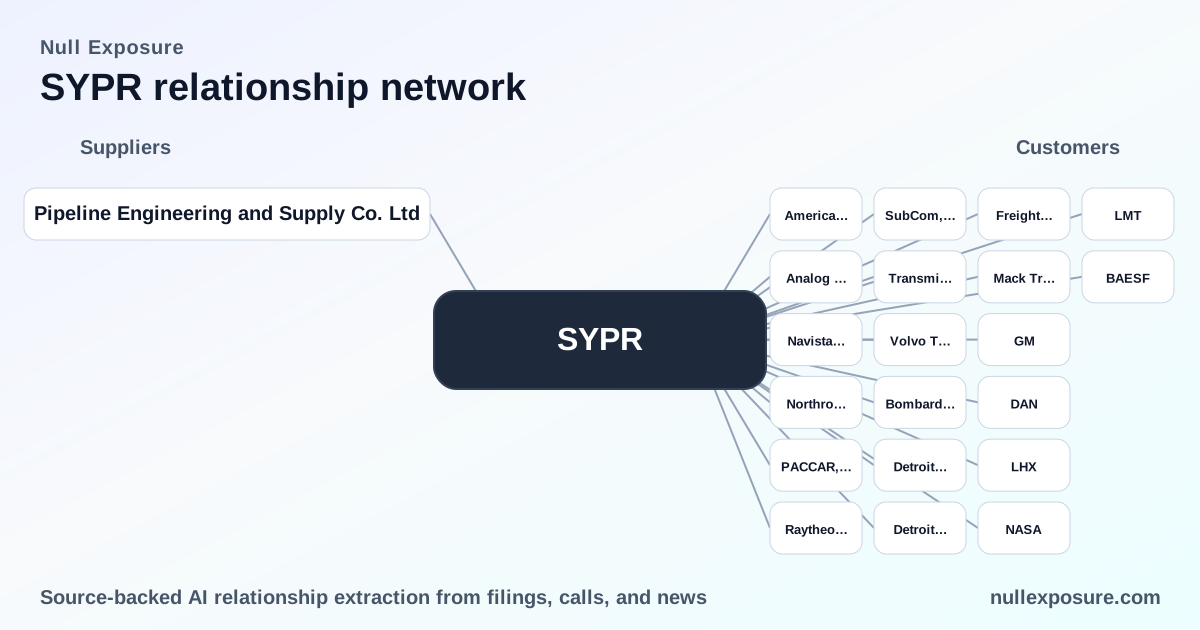
Below I list every customer relationship called out in Sypris’s public records and the cited journalism feed in the provided results. Each entry is tied to the original public mention for quick source follow-up.
- Northrop Grumman Corporation — Sypris lists Northrop Grumman among its aerospace and defense customers, reflecting participation on prime defense supply chains. According to Sypris’s 2024 Form 10‑K, Northrop Grumman is a named customer (FY2024 filing).
- Analog Devices, Inc. (ADI) — ADI is cited as a large aerospace and defense customer in Sypris’s disclosures, indicating electronics or component-level supply relationships (2024 Form 10‑K).
- American Axle & Manufacturing Holdings, Inc. — American Axle appears as a Tier‑1 supplier peer in Sypris’s narrative on OEM supply chains, suggesting Sypris competes or supplies within similar heavy-drivetrain ecosystems (2024 Form 10‑K).
- Volvo Truck Corporation — Sypris states it can produce drivetrain components used by leading truck manufacturers including Volvo, indicating product fit for heavy-truck OEM platforms (2024 Form 10‑K).
- Bombardier Recreational Products (BRP) — Sypris notes capacity to serve recreational vehicle manufacturers such as BRP with drivetrain components (2024 Form 10‑K).
- Detroit Diesel — Detroit Diesel is named among the company’s top customers, and Sypris reports that Detroit Diesel contributed materially to 2024 revenue (2024 Form 10‑K).
- Detroit Diesel Corporation — The company is also referenced in a Tier‑1 context, reinforcing a supplier relationship for drivetrain assemblies (2024 Form 10‑K).
- Freightliner LLC — Freightliner is listed as an ultimate OEM customer for Sypris drivetrain components used in heavy trucks (2024 Form 10‑K).
- Mack Truck — Mack is enumerated among leading truck OEMs that consume Sypris‑produced drivetrain parts (2024 Form 10‑K).
- Navistar International Corporation — Navistar is included in the list of truck manufacturers Sypris serves with drive train components (2024 Form 10‑K).
- Transmisiones y Equipos Mecanicos, S.A. de C.V. (Tremec) — Tremec is cited in the Tier‑1 supplier context, signaling involvement in transmission and drivetrain ecosystems (2024 Form 10‑K).
- SubCom, LLC — SubCom is called out among the five largest customers in 2024, indicating a material revenue relationship (2024 Form 10‑K).
- Raytheon Technologies (including Collins Aerospace Systems) — Sypris lists Raytheon/Collins as an aerospace/defense customer, consistent with its electronics business serving avionics and high‑reliability systems (2024 Form 10‑K).
- PACCAR, Inc. — PACCAR is named among the OEMs that use Sypris‑produced drivetrain components, reflecting exposure to another major truck manufacturer (2024 Form 10‑K).
- General Motors Company (GM) — GM is explicitly noted as an OEM end user of Sypris drivetrain parts, showing exposure to passenger and commercial vehicle platforms (2024 Form 10‑K).
- GM (duplicate entry) — The filing repeats General Motors as an OEM customer (2024 Form 10‑K).
- Dana Corp. (DAN) — TruckingInfo reported in March 2026 that Dana signed a letter of understanding to sell certain Heavy Vehicle Technologies production assets to Sypris and will enter a long‑term supply agreement with Sypris for axle components; follow‑on reporting also noted contract extensions where Sypris supplies components used in final Dana axle assemblies (TruckingInfo, March 2026).
- L3Harris Technologies (LHX) — L3Harris is listed among aerospace and defense customers, aligning with Sypris Electronics’ defense contract portfolio (2024 Form 10‑K).
- NASA — A January 2026 news item reported Sypris secured an expanded follow‑on contract related to NASA’s Artemis program, extending its electronics backlog through 2027 (press coverage, January 2026).
- Lockheed Martin — Lockheed Martin is named among Sypris’s large aerospace and defense customers, supporting defense electronics exposures (2024 Form 10‑K).
- BAE Systems (BAE / BAESF) — BAE Systems is listed as a defense prime customer in Sypris’s disclosures, consistent with high‑reliability aerospace supply relationships (2024 Form 10‑K).
What investors should price in now
- Concentration risk is the dominant valuation lever. With the top five customers representing the bulk of revenue, single‑program shocks produce outsized swings to margins and working capital.
- Backlog and long-term contracts create near-term revenue visibility, particularly in electronics where performance obligations totaling roughly $84.3 million provide 2025/2026 revenue coverage (2024 Form 10‑K).
- Ramping programs can propel recovery but also complicate margin forecasts. Management attributes 2024 revenue increases to new program ramps; investors must model ramp cadence and margin improvement conservatively.
- Strategic optionality from the Dana asset deal (reported March 2026) could increase manufacturing scale and OEM content if the transaction and long‑term supply agreements close and execute as reported.
Bottom line
Sypris’s customer roster reads like a concentrated, defense/transportation supply book: a portfolio that delivers predictable backlog and high program dependency. That profile fits a high-variance small-cap industrial where upside comes from successful program ramps and operational leverage, while downside is driven by customer concentration and OEM cycle exposure. For a deep dive into counterparty-level disclosures and to track any material changes to Sypris’s customer base, visit Null Exposure’s coverage at https://nullexposure.com/.
Key takeaway: Value Sypris as a contract manufacturer with defensible aerospace electronics backlog but with material counterparty concentration risk that should be explicitly modeled in scenario analysis.