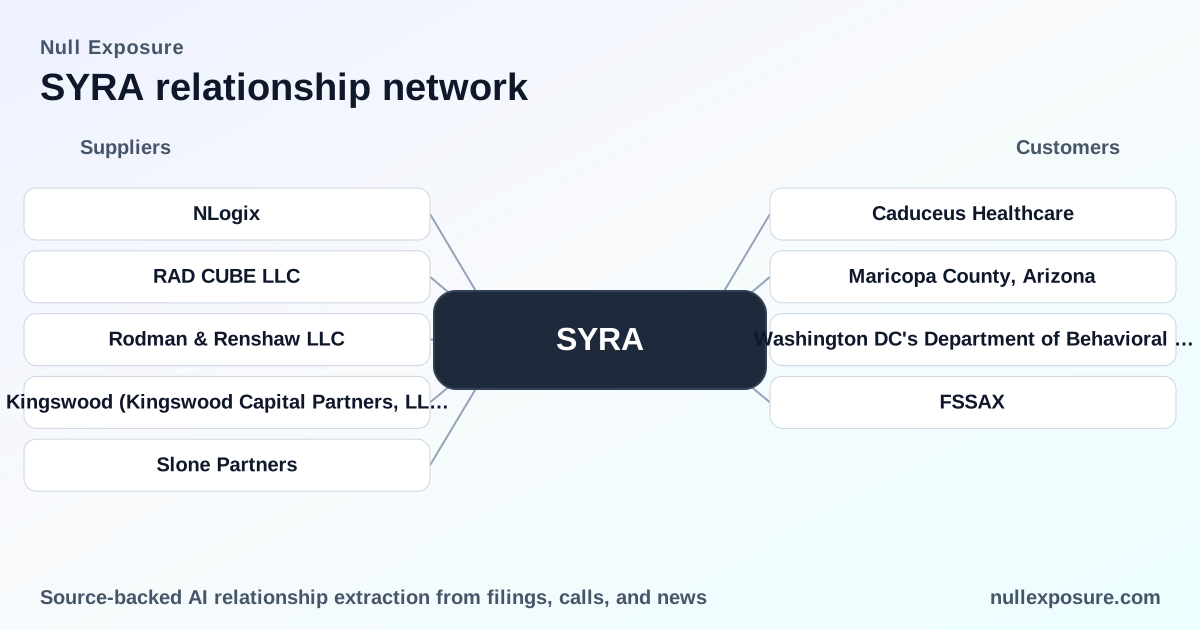
SYRA Customer Landscape: Concentration, Government Exposure, and Where Revenue Really Comes From
Syra Health operates as a healthcare services firm that sells workforce staffing, behavioral health programs, and emerging digital mental-health products; it monetizes through fee-for-service contracts with state and federal agencies, training and workforce placements for healthcare facilities, and nascent SaaS-style revenue from its Syrenity application. The company's revenue profile is heavily skewed toward government health agencies, with one named customer historically contributing the majority of top-line receipts. For deeper diligence on counterparties and contract dynamics, visit https://nullexposure.com/ for structured customer intelligence.
How Syra makes money and why customers matter
Syra is primarily a service provider: it delivers healthcare workforce staffing, behavioral health program management, and health education to public-sector buyers and integrated health systems, while also developing a consumer/professional-facing mental health app launched in 3Q 2024 called Syrenity. Revenue is dominated by long-duration government awards and training contracts, which produces predictable cash flow when contracts are active but creates concentration risk if a major award terminates. Syra’s commercial posture is that of a prime or subcontractor on government-funded programs; cash collection and contract renewals drive near-term valuation more than recurring subscription economics today.
Customer map: named relationships and what they mean for investors
FSSA (State of Indiana divisions) — the single largest revenue driver
FSSA accounted for approximately 61% of revenues in 2024 and 68% in 2023, and represented 56% of accounts receivable in 2024, coming from combined divisions including the NeuroDiagnostic Institute and the Division of Mental Health and Addiction, per Syra’s 2024 Form 10‑K. According to the 10‑K, a new NeuroDiagnostic Institute contract executed has a ceiling value and specific end date, showing both materiality and discrete contract timing that investors must monitor. (Source: Syra Health 2024 Form 10‑K, year ended December 31, 2024.)
FSSAX — duplicate filing name for the same state counterparty
FSSAX is listed in the same 10‑K disclosure and carries the same revenue disclosure metrics as FSSA, effectively reflecting the same governmental customer group that generated the majority of Syra’s revenue in the reported periods. The filing treats FSSA/FSSAX as material counterparties for 2023–2024 revenue and receivables. (Source: Syra Health 2024 Form 10‑K, year ended December 31, 2024.)
Washington DC’s Department of Behavioral Health — a sizeable prior award
Syra reported a $4.75 million contract signed in 2023 with Washington DC’s Department of Behavioral Health to support supported employment and a psychiatric emergency program, reflecting the company’s capability to secure multi-million-dollar municipal and agency awards. This award underscores Syra’s competitiveness for jurisdictional behavioral health programs. (Source: Q4 2023 earnings-call transcript coverage, InsiderMonkey, FY2024 commentary.)
Caduceus Healthcare — subcontracting on a federal HHS award
Syra announced it will serve as a subcontractor to Caduceus Healthcare, which is the prime contractor on an award from the U.S. Department of Health and Human Services, signaling an expansion of Syra’s role into federally funded program delivery under prime/sub setups. This relationship illustrates Syra’s willingness to partner rather than exclusively pursue prime positions for federal work. (Source: Q4 2023 earnings-call transcript coverage, InsiderMonkey, FY2024 commentary.)
Maricopa County, Arizona — repeat training business
Syra reported being awarded its third training engagement by Maricopa County, demonstrating repeatable, jurisdiction-level training revenue in major U.S. counties. Repeat awards like this validate the company’s training product-market fit with county health agencies and provide incremental, mid-size contract revenue. (Source: Q4 2023 earnings-call transcript coverage, InsiderMonkey, FY2024 commentary.)
What the constraints tell investors about Syra’s operating model
- Government-centric customer base and counterparty type: Syra primarily sells to state health and social service agencies and universities, which creates structural dependency on public procurement cycles and budgetary appropriations. (Company-level signal.)
- Revenue concentration and criticality: The FSSA relationship is material and critical, driving the majority of revenue and a disproportionate share of receivables, which amplifies downside risk if contract awards are not renewed or if payment timing shifts. (Explicitly named in the 10‑K.)
- Service-first business with a software adjunct: Syra’s core segment is healthcare services (workforce, training, program management); Syrenity represents an extension into software-based preventive mental health, but services remain the dominant revenue stream. (Company-level signal.)
- Contract lifecycle signals: Filings note both a newly executed NeuroDiagnostic Institute contract (ceiling and end date through mid‑2025) and commentary that contract completion in January 2025 will reduce healthcare workforce revenue, indicating pockets of renewal activity and also winding‑down exposure across client engagements. (Company-level signal with explicit FSSA mention.)
- Geography: The company is a U.S. corporation with revenue primarily from North American public authorities while signaling strategic intent to enter global markets for digital products over time. (Company-level signal.)
- Typical contract size: Several disclosed contracts fall into the $1M–$10M scale, which matches the company’s stated spend band for healthcare workforce revenue and suggests mid-market, agency-level engagements rather than enterprise-scale multi-year prime contracts.
Investment implications and risk/reward summary
Syra’s profile is straightforward: high customer concentration, government procurement exposure, and an emergent digital product line. For investors and operators evaluating SYRA customer risk:
- Key upside drivers: expansion of Syrenity into new markets and steady renewal of government workforce and training contracts; subcontracting relationships open federal program access without prime-bid burdens.
- Key risks: FSSA concentration creates single-counterparty risk; contract end-dates and project completion announcements create near-term revenue cliffs; revenue and margin recovery depend on contract wins and timely collections.
- Operational considerations: collections discipline, diversification of public-sector clients, and successful commercialization of Syrenity are the levers that convert backlog and contract wins into durable valuation.
Primary risk drivers to watch:
- Heavy dependency on the FSSA relationship and the timing of its contract renewals.
- Contract pipeline conversion from subcontracting roles to prime awards or repeat renewals.
- Adoption and monetization trajectory for Syrenity outside of grant/award-funded deployments.
For a compact package of customer-focused signals and ongoing updates useful to analysts and operators evaluating counterparties, see our coverage hub at https://nullexposure.com/. For engagement-level due diligence, prioritize contract end-dates, accounts-receivable aging against major government payors, and the cadence of training renewals in county and municipal partners.
Bold takeaway: Syra is a services-first healthcare contractor whose valuation and near-term revenue volatility are driven by a single, material state customer and a small set of repeat public-sector engagements — growth depends on diversifying contracts and scaling Syrenity beyond grant-funded pilots.