SYT: How Syla Commercializes Crowdfunded Real Estate and Why a BlackRock Tie Changes the Risk Equation
Syla Technologies Co., Ltd. operates as a Japan-based, Nasdaq-listed real estate developer that uses a crowd-investment model to originate, develop, and monetize residential condominium projects—most notably its Syforme portfolio—by selling units and securing institutional capital for scale. The company monetizes through property sales, development fees and by syndicating assets to institutional partners, a model that converts retail capital into project liquidity and then increasingly relies on wholesale investors for scale. Learn more about our coverage at https://nullexposure.com/.
What the business actually does and how it earns cash
Syla combines retail crowdfunding for real-estate projects with traditional development economics: it sources land, develops mid-sized condominium projects under the Syforme brand, sells units to end-buyers and offers investment stakes to retail participants. Revenue drivers are transaction-based—unit sales and development margins—augmented by capital-raising fees and syndicated-investor placement, which together explain why institutional interest materially alters cost of capital and balance-sheet risk. The company reports meaningful revenue (Revenue TTM: 30,872,023,000) and positive operating margins (Operating Margin TTM: 0.104), indicating established project economics at current scale.
BlackRock partnership: institutional capital arrives
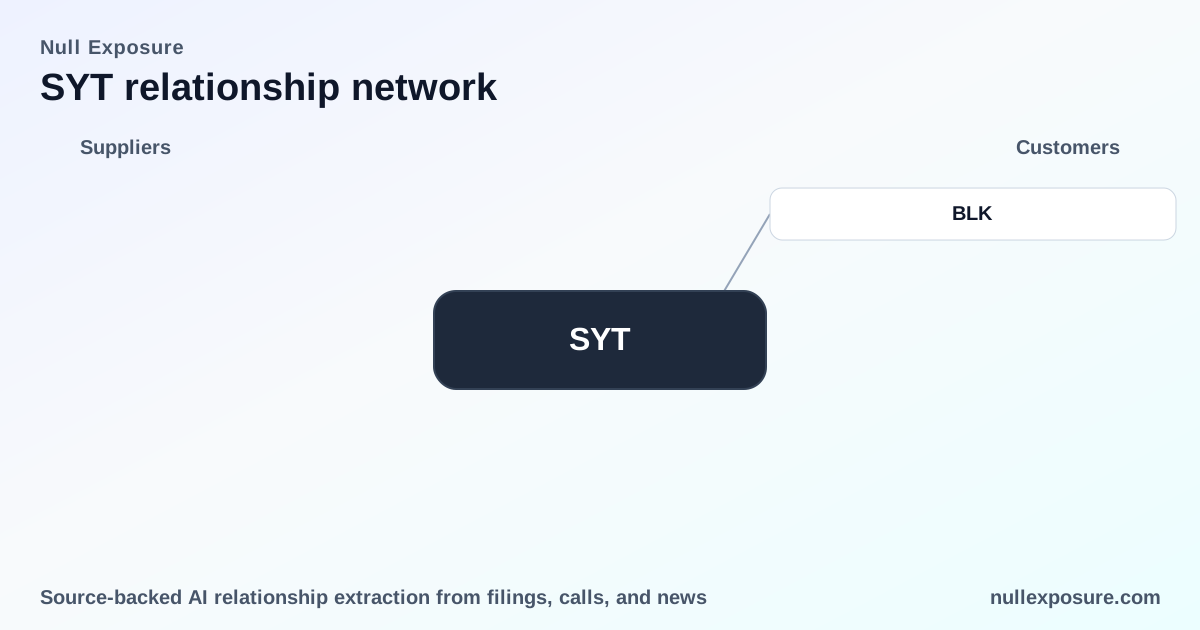
Syla announced a partnership that gives a BlackRock-managed private real-estate fund the opportunity to invest in Syla’s properties, explicitly targeting the Syforme condominium portfolio. This is a validation of Syla’s asset quality and a structural shift in financing—moving from retail syndication toward institutional capital deployment. According to a Mingtiandi report published March 10, 2026, the deal offers a private fund managed by BlackRock’s real estate business the chance to invest directly in Syla properties (Mingtiandi, 2026-03-10).
BlackRock (BLK) — entry #1 in the record
Syla’s press release and subsequent coverage describe a partnership that opens Syla’s project pipeline to a BlackRock real-estate fund, focusing on the Syforme condominium series and enabling larger-scale capital injections. According to Mingtiandi (March 10, 2026), the arrangement gives BlackRock’s real-estate business the opportunity to invest in Syla properties, signaling institutional validation and potential balance-sheet relief.
BLK — duplicate entry (same underlying agreement)
The second relationship entry in the results mirrors the first: the BlackRock-managed private fund is positioned to invest in Syla’s Syforme projects. The same Mingtiandi article (March 10, 2026) documents the announcement and its strategic focus on Syforme condominiums, underscoring that multiple sources catalog the single partnership event.
Why this relationship matters to investors and operators
- Lowered refinancing and execution risk: Institutional capital from a firm of BlackRock’s scale materially reduces reliance on retail-sourced funding and can shorten time-to-sale on projects by providing bulk liquidity. The partnership therefore directly improves the company’s financing profile.
- Validation of underwriting and asset quality: BlackRock’s willingness to consider Syla inventory reflects positively on Syla’s project economics and location selection—an important signal for valuation multiples in a thin institutional-followed name.
- Concentration and dependency risk: At present, the public record lists one major institutional partner in the customer/ investor ledger; that concentration is a double-edged sword—it reduces funding fragility but raises counterparty reliance if BlackRock becomes a dominant purchaser.
Operating model signals and business-model constraints
Syla’s model demonstrates a hybrid contracting posture: transactional retail contracts for individual unit buyers combined with negotiated, larger-scale capital placements with institutional funds. This hybrid creates measurable characteristics:
- Contracting posture: project-by-project transactional sales plus negotiated syndication agreements with institutions.
- Concentration: public data shows limited institutional partners identified, amplifying the materiality of a single large partner like BlackRock.
- Criticality: institutional capital is critical for scaling development cadence and reducing balance-sheet carry; access to such capital changes project economics materially.
- Maturity: financials show positive operating margin and scale (Revenue TTM: 30,872,023,000; Operating Margin TTM: 0.104), indicating project-level maturity in execution, while institutional relationships are early-stage and developing.
No explicit operational constraints were flagged in our relationship feed, which should be interpreted as a company-level signal of either limited public constraint disclosures or a clean slate in the monitored fields.
Financial posture and governance considerations worth watching
Syla’s market capitalization (60,158,000 USD) and leverage dynamics should be reviewed in light of the BlackRock relationship: institutional investment can reduce short-term liquidity risk but also concentrates counterparty exposure. Key metrics to monitor in subsequent filings and announcements:
- Volume and structure of BlackRock investments (equity co-investment, purchase agreements, preferred structures).
- Any exclusivity or right-of-first-refusal clauses that could limit Syla’s ability to source alternative capital.
- Impact on margins when institutional placements replace retail-unit sales: bulk purchases can compress or expand realized margins depending on the negotiating power on either side.
Practical implications for investors and operators
For investors: this BlackRock tie materially de-risks the funding profile and improves the realism of growth assumptions tied to faster project turnover and lower financing costs. For operators and counterparties: access to institutional buyers increases negotiating leverage on land purchases and JV structures—translate that into tighter development timelines and improved working-capital metrics.
Final read and action points
- Primary takeaway: The BlackRock partnership transitions Syla from a predominantly retail-funded developer toward an institutional-grade financing mix, materially altering funding risk and growth scalability. (Mingtiandi, March 10, 2026).
- Monitor: subsequent filings for deal size, commitment terms, and whether the relationship expands beyond the Syforme portfolio.
- If you need continuous coverage of capital relationships in small-cap real estate and development names, visit https://nullexposure.com/ for updated signals and analyst briefings.
Sources
- Mingtiandi, “BlackRock partnering with crowdfunded developer Syla in Japan,” March 10, 2026 — reporting that Syla announced a partnership offering a BlackRock real-estate private fund the opportunity to invest in Syla’s properties, focusing on the Syforme condominium portfolio (https://www.mingtiandi.com/real-estate/finance/blackrock-partnering-with-crowdfunded-developer-syla-in-japan/).