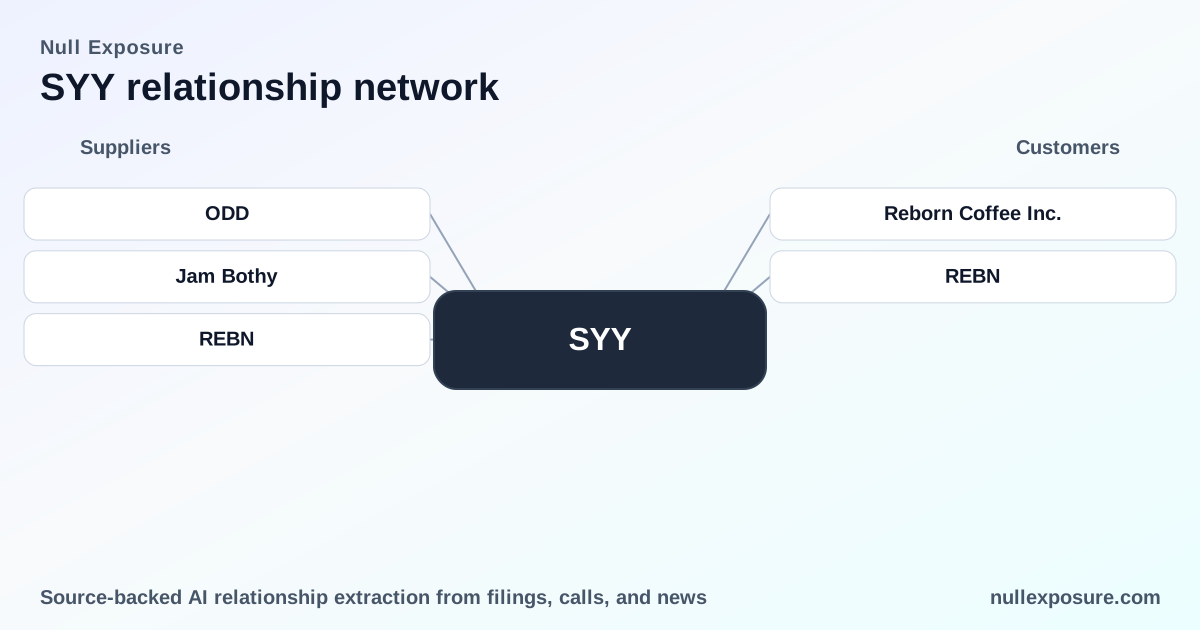
Sysco (SYY) — Customer Relationships That Drive Scale and Margin
Sysco is the largest global foodservice distributor: it monetizes through high-volume distribution, private-label and branded product sales, and logistics services to restaurants, institutions and large foodservice operators. Revenue comes from recurring purchase flows and service fees across a broad base of customers; Sysco’s network economics and inventory scale convert procurement advantages into margin. For a point-in-time view of Sysco’s client footprint and relationship dynamics, explore the company-level map at https://nullexposure.com/.
Why customers matter for Sysco’s investment case
Sysco’s economics are built on repeat, high-frequency purchasing and embedded logistics — customers drive predictable consumption patterns and permit operating leverage across warehouses, transportation and private-label sourcing. The company’s risk posture is shaped by broad customer diversification (no single customer >10% of sales), heavy North American concentration, and long-standing contractual relationships with large institutional buyers. Those characteristics make Sysco a defensive revenue engine with margin upside tied to efficiency in distribution and case growth.
Operating model constraints and what they imply for investors
- Contracting posture — long-term orientation. Sysco reports long-standing relationships and agreements with many customers, which supports stable reorder behavior and reduces churn risk while increasing the importance of execution and service reliability.
- Customer concentration — diffuse but strategically important. No single customer accounted for 10%+ of total sales (FY2025), which reduces counterparty risk but keeps Sysco exposed to sector-wide demand swings in restaurants and institutions.
- Customer criticality and maturity. Sysco acts primarily as a distributor/seller to restaurants, healthcare, education and lodging clients; relationships range from mature, institutional buyers to nascent franchise rollouts that lean on Sysco’s logistics.
- Geography — North America first, global reach. Primary operations sit in North America and Europe, with the U.S. comprising the large majority of revenue; this regional tilt concentrates macro exposure to U.S. foodservice trends.
- Operational scale — active and broad. Sysco served ~730,000 customer locations in FY2025, indicating a deep, active footprint that underpins recurring revenue and supply-chain leverage.
If you want the complete relationship network and the raw items behind these signals, visit https://nullexposure.com/ for a full view.
Client roster — direct relationship notes (each backed by public reporting)
Restaurant Depot
Restaurant Depot will access Sysco-branded products and Sysco’s supply chain resources as part of their arrangement, preserving Restaurant Depot’s standalone model while expanding product options. Source: Restaurant Business Online, May 4, 2026 (https://www.restaurantbusinessonline.com/financing/sysco-ceo-we-will-absolutely-not-be-raising-prices-restaurant-depot) and Spectrum Local News, Apr 24, 2026 (https://spectrumlocalnews.com/nys/central-ny/politics/2026/04/24/sysco-corporation-restaurant-depot).
Reborn Coffee Inc. (REBN)
Reborn Coffee signed a nationwide distribution partnership with Sysco to support rapid franchise expansion, leveraging Sysco’s logistics, ordering systems and fulfillment capabilities to improve reliability across the roll‑out. Source: Reborn Coffee press release / GlobeNewswire and multiple trade reports, February–March 2026 (e.g., https://www.comunicaffe.com/reborn-coffee-announces-strategic-distribution-partnership-with-sysco-to-support-national-franchise-expansion/).
BRCB (Black Rifle Coffee / BlackRock Coffee Bar filing context)
BRCB’s SEC disclosure shows a highly concentrated supplier mix in its coffee purchasing, with Sysco accounting for a material share of purchases in FY2024–FY2025 (e.g., 78–89% of purchases from a small set of suppliers including Sysco), indicating Sysco is a dominant supplier for certain specialty coffee operators. Source: BRCB SEC filing and related reporting, FY2025 (https://www.sec.gov/Archives/edgar/data/2068577/000162828025041431/blackrockcoffee-sx1a.htm) and summary filings March 2026.
KFC (YUM Brands references in market coverage)
Public market coverage of Sysco’s outlook referenced KFC among notable branded quick-service customers benefiting from Sysco distribution, reflecting Sysco’s role as a supplier to national quick-service chains. Source: Finviz news aggregation citing Benzinga coverage, May 2026 (https://finviz.com/quote?t=SYY).
Burger King
Market reports that lifted Sysco’s profit outlook explicitly named Burger King as a large quick‑service customer in the mix, underscoring Sysco’s supply relationships with national franchise operators. Source: Finviz news aggregation citing Benzinga, May 2026 (https://finviz.com/quote?t=SYY).
Subway
Analyst and market commentary on Sysco’s guidance referenced Subway alongside other national chains, signalling ongoing supply agreements with major sandwich operators. Source: Finviz news aggregation citing Benzinga, May 2026 (https://finviz.com/quote?t=SYY).
MAMA (Mama’s Creations)
Mama’s Creations disclosed the acquisition of the Crown I Enterprises business from Sysco for $17.5 million, indicating Sysco’s active divestiture of select manufacturing assets and movement of certain value-added protein operations into third-party ownership. Source: GlobeNewswire press release, December 8, 2025 (https://www.globenewswire.com/news-release/2025/12/08/3201968/0/en/Mama-s-Creations-Reports-Third-Quarter-Fiscal-2026-Financial-Results.html).
ARMK (Aramark)
Aramark’s FY2025 10‑K states that Sysco distributed approximately 43% of Aramark’s U.S. and Canada food and non‑food purchases by dollars, highlighting Sysco’s scale as a primary distributor to large institutional foodservice management companies. Source: Aramark 2025 10‑K filing (filed Oct 3, 2025).
What this customer picture means for investors
- Scale-driven defensibility. Sysco’s relationships with national chains and institutional buyers create a high barrier to entry for competitors on logistics and national service agreements. Distribution economics and private-label sourcing are core margin levers.
- Demand cyclicality remains the main macro risk. Despite diversification, Sysco’s revenue is tightly correlated with restaurant and institutional foot traffic; an economic slowdown can compress volumes faster than pricing. No single customer is critical enough to threaten total sales, but sector-wide downturns will pressure throughput and margin.
- Portfolio mix offers optionality. Deals with fast‑growing franchise rollouts (e.g., Reborn Coffee) and continued supply to national quick‑service chains suggest a mix of stable volume and growth trajectories; asset sales like the Crown 1 divestiture show active portfolio management.
- Execution is the differentiator. Long-term relationships and high-reliability service commitments make operational execution — delivery, order accuracy, and product availability — decisive for retention and incremental margin.
Bottom line and next steps
Sysco’s customer relationships combine broad diversification with deep penetration of critical foodservice channels; the company’s value is driven by logistics scale and recurring purchase behavior, not single large contracts. For a deeper, interactive assessment of counterparties, contract types and relationship maturity, visit https://nullexposure.com/ to view the full relationship map and underlying sources.