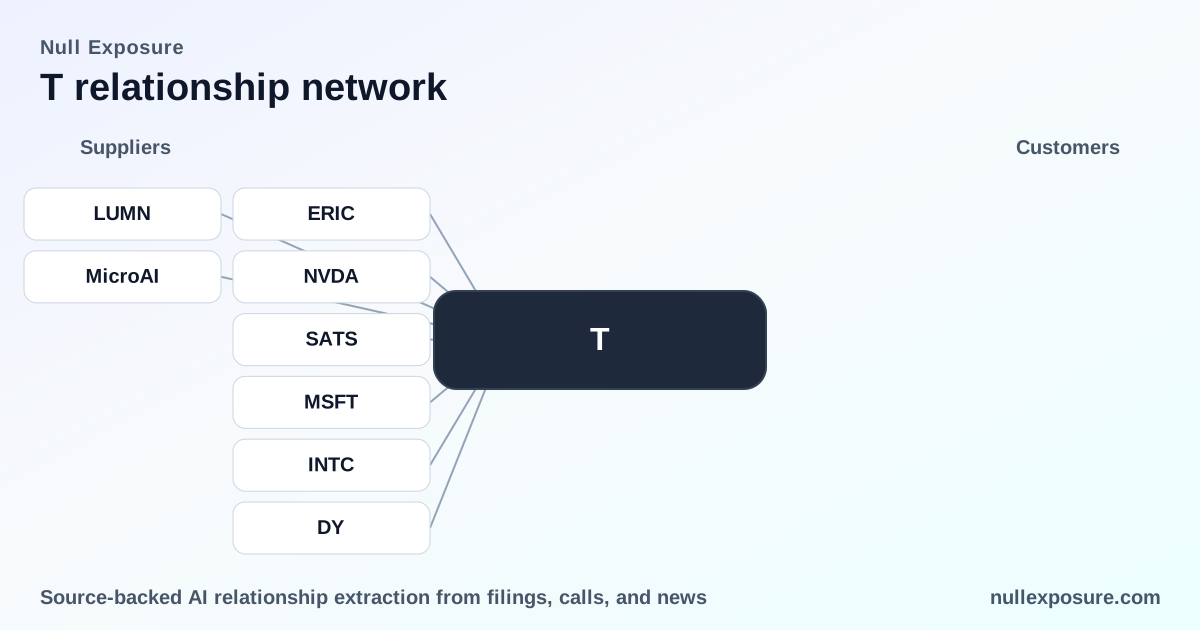
AT&T’s customer web: predictable revenue anchored by network access and wholesale relationships
AT&T operates as a vertically integrated telecommunications conglomerate that monetizes through wireless and wireline subscriptions, enterprise services, equipment sales and wholesale network access — including long-term spectrum and FirstNet arrangements and transactional partnerships such as wholesale MVNO or retail reseller deals. The Communications segment drives the business: it accounted for roughly 97% of segment operating revenues in 2025, making customer relationships with carriers, device vendors and enterprise partners strategically critical to cash flow and capital allocation. For a concise view of platform exposure and ongoing customer linkages, visit https://nullexposure.com/.
How to read AT&T’s customer relationships
AT&T’s value is generated at the intersection of scale (retail subscribers and enterprise contracts), access (spectrum, towers and roaming) and distribution (resellers, MVNOs and device OEMs). That model produces a mix of long-duration, high-criticality contracts alongside shorter-term commercial arrangements and licensing. Below are the current, documented customer and partner relationships from public filings and news coverage; each entry includes a plain-English summary and the primary source.
Relationship map — direct links that matter
American Airlines (AAL)
AT&T sponsors free high‑speed satellite Wi‑Fi for AAdvantage members, integrating AT&T network services into the in‑flight customer experience and broadening brand reach. According to American Airlines press releases (Q1 2026) and industry news, the service rollout is explicitly sponsored by AT&T (news.aa.com; stockstotrade, March–May 2026).
Verizon (VZ) — via Synchronoss references
Industry reporting on Synchronoss notes the firm provided products and services to both AT&T and Verizon, illustrating AT&T’s supplier/partner overlap with other major carriers in backend software and device provisioning. This linkage was covered in a May 2026 investigation summary (hannahhowell.com, May 2026).
Liberty Latin America (LILA / LILAK)
Liberty Latin America completed purchases of AT&T wireless and wireline assets in Puerto Rico and the U.S. Virgin Islands in a transaction valued at about $1.95 billion, representing asset monetization and regional retreat/transfer of customer relationships. Coverage of the asset sale and subsequent leadership commentary is documented by NextTV and Yahoo Finance (NextTV, Oct 31 2020; Yahoo Finance, 2025–2026).
Twilio (TWLO)
Twilio has established direct connections with major U.S. carriers for 10‑digit long code messaging, including AT&T, enabling Twilio’s SMS and messaging traffic to flow over carrier-grade links. This interoperability was noted in multiple investing news items in May 2026 (Investing.com, May 2026).
ScanSource (SCSC)
ScanSource’s filings and earnings commentary list AT&T among approximately 500 vendors and partners, highlighting AT&T’s role as a key supplier and reseller partner to distribution channels that serve enterprise customers. See ScanSource filings and call transcripts (FY2025 10‑K and earnings, June 2025).
Sezzle (SEZL)
Sezzle Mobile launched an unlimited 5G plan running on AT&T’s network and powered by Gigs, positioning Sezzle as a retail MVNO/reseller of AT&T connectivity at disruptive price points. The launch and marketing materials are reported in GlobeNewswire and related coverage (GlobeNewswire; Finviz, Feb–Apr 2026).
U.S. Cellular (UZD)
U.S. Cellular maintains agreements with AT&T (and Verizon) for network deployments and spectrum band access, indicating wholesale partnerships or roaming/coverage arrangements that extend service reach. AndroidCentral’s network partnership coverage documents this relationship (AndroidCentral, 2019 reference; cited in later summaries).
SurgePays / SURG
SurgePays completed integration with the AT&T network to strengthen performance and service quality, signaling a commercial onboarding of AT&T connectivity into its payments/merchant services offering. The integration is noted in corporate releases (GlobeNewswire; Bitget coverage, 2026).
Toyota (TM)
Toyota’s Wi‑Fi Connect trial enabling 4G hotspot capability for vehicles uses AT&T connectivity, demonstrating AT&T’s role as an automotive connectivity provider for OEM telematics and in‑car internet services. This was reported in automotive coverage (Finviz, March 2026).
NextNav (NN)
NextNav extended network operations support with AT&T for a further two years, which evidences multi‑year operational commitments where AT&T provides network operations or backhaul services. The extension was reported in market coverage (Finviz, March 2026).
Sonim (SONM)
Sonim devices integrate with AT&T’s Enhanced Push‑to‑Talk (EPTT) platform for FirstNet public safety deployments, underscoring AT&T’s specialized public‑safety product stack and device certification relationships. Product and integration details are in device coverage (AndroidPolice, 2018 noted).
Napco Security (NSSC)
Napco’s StarLink radios operate on AT&T (and other carriers), positioning AT&T as a connectivity backbone for security and IoT hardware in commercial and residential deployments. This point appears in Napco earnings call transcripts and coverage (InsiderMonkey, FY2025–FY2026).
EchoStar / SATS
EchoStar commentary references Boost Mobile and wholesale relationships with AT&T as strategic telecom synergies, suggesting AT&T’s wholesale footprint benefits satellite‑adjacent competitors and wholesale partners. Market analysis mentions this dynamic (TradingKey; May 2026).
AST Space (ASTS)
AST LLC received purchase orders from AT&T to support planned commercial service, indicating direct procurement of network equipment and deployment capex from AT&T. The purchase order reference is found in ASTS filings (10‑K, FY2024).
TPG (DIRECTV transaction)
TPG completed acquisition of the remaining 70% stake in DIRECTV from AT&T, a deal that removed a legacy content/consumer relationship and monetized a previously integrated asset. The TPG transaction coverage is in investing press (Investing.com, May 2026).
Telefónica (TEF)
Public commentary around Telefónica’s strategic moves references MVNO-like arrangements and acquisition behavior tied to regional operators, with reports noting Telefónica’s interactions in markets where AT&T has transferred operations — a signal of AT&T’s role in enabling third‑party MVNO or host‑network arrangements. See analyst commentary (InsiderMonkey, May 2026).
Operational constraints and what they imply
AT&T’s customer relationships are shaped by contract types, counterparty mix and geography. Public disclosures and evidence excerpts show:
- Contracts skew long‑term for core infrastructure (tower subleases and spectrum/FirstNet arrangements reference 20–25 year terms), supporting predictable long‑run cash flows but locking capital deployment and operational commitments.
- A mix of short‑term and licensing arrangements exists for certain commercial services and IP, enabling flexibility for retail/enterprise offerings.
- Counterparty diversity ranges from government (FirstNet) and individual consumers (10.4M fiber broadband customers at year‑end 2025) to mid‑market and small business enterprise customers, limiting single‑customer concentration (no customer >10% of revenues).
- Geographic exposure is primarily North America with targeted LATAM exposure via prior asset sales and legacy operations in Mexico and the Caribbean — LATAM contributed a small share of revenue historically.
- Materiality is concentrated: the Communications segment is critical to operating income, while Latin America is immaterial by comparison.
- Role diversity: AT&T functions as seller, reseller, service provider and buyer (receivables arrangements), reflecting a complex contracting posture across retail, wholesale and enterprise channels.
- Business mix includes both hardware sales (device installment programs) and services (wireless, wireline, managed services).
Investment implications and next steps
- Revenue visibility is strong where long‑term network and spectrum contracts exist; capital intensity and regulatory exposure remain primary risk vectors.
- Wholesale and MVNO relationships (Sezzle, U.S. Cellular, Twilio) expand reach with low incremental capex, while asset sales (Liberty Latin America, DIRECTV) demonstrate active portfolio pruning.
- For deeper counterparty analysis and ongoing monitoring of AT&T’s evolving partner ecosystem visit https://nullexposure.com/ for structured relationship signals and context.
Bold takeaway: AT&T’s customer profile combines durable infrastructure contracts with a broad set of wholesale and reseller relationships that protect scale but keep capital allocation and regulatory exposure central to downside risk.