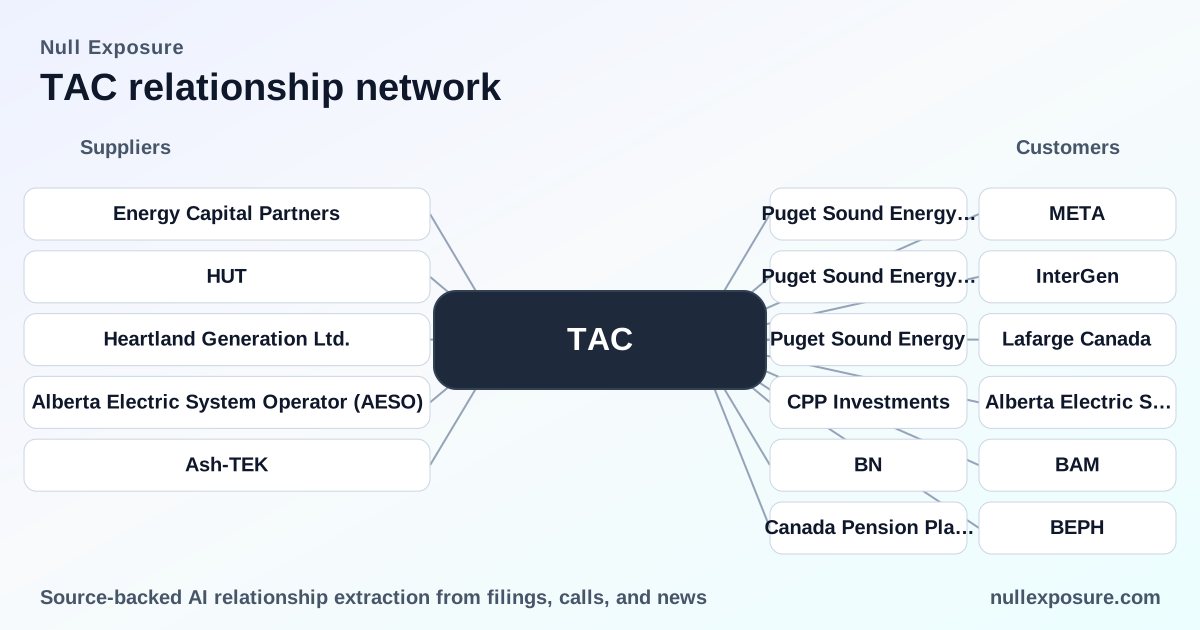
TransAlta (TAC): Customer relationships driving power sales, PPAs and site-exclusivity for new data-center demand
TransAlta operates and monetizes a diversified fleet of power generation assets across Canada, the United States and Australia, selling electricity, long-term power purchase agreements (PPAs), tolling agreements and environmental attributes while also monetizing real‑estate and by‑products. The company’s recent customer activity centers on long-term tolling and PPA contracts (including a major gas conversion/tolling deal), an exclusive site and power role for a planned Alberta data‑centre with institutional investors, a corporate renewable off‑take with Meta, and selective asset disposals—each transaction reinforcing recurring contracted cash flow and one‑off balance‑sheet events. Learn more at https://nullexposure.com/.
How the customer pipeline shapes TransAlta’s commercial posture
TransAlta’s customer relationships show a blend of traditional utility contracting and opportunistic commercial development. The company pursues long-term, credit‑worthy counterparties (utilities and large corporates) for PPAs and tolling agreements while leveraging site ownership to provide exclusive power and land supply for third‑party developments such as data centres. This combination produces:
- Stable contracted revenue through multi‑decade PPAs and tolling agreements that underpin valuation multiples.
- Concentration toward large counterparties (utilities, institutional owners and hyperscalers) which increases counterparty credit significance but improves overall revenue visibility.
- Commercial optionality and non‑power monetization, including sale of environmental attributes and by‑product reuse (cement substitution), creating incremental margin lines.
There are no explicit constraints reported in the available relationship feed; that absence itself is a company‑level signal that the data set contains transactional news and disclosures rather than formal customer‑imposed constraints.
Customer relationships and what they mean for investors
Below I cover every customer relationship referenced in the recent reporting. Each entry is a concise, plain‑English summary with a source noted.
Puget Sound Energy (PSE)
TransAlta signed a long‑term tolling agreement with Puget Sound Energy to convert and redeploy the Centralia facility from coal to natural gas, creating a contracted supply stream into PSE’s system through long‑dated delivery arrangements. This agreement underpins TransAlta’s U.S. generation redeployment strategy and reduces merchant exposure at that asset. — Yahoo Finance / March 2026.
Canada Pension Plan Investment Board (CPP Investments)
TransAlta entered an MOU with CPP Investments to develop a data‑centre site in Alberta where TransAlta will be the exclusive site and power provider; the project includes an initial long‑term PPA of roughly 230 MW with potential expansion to around 1,000 MW. The arrangement positions TransAlta to capture high‑margin, long‑duration offtake tied to large institutional capital. — Canada ConstructConnect & The Globe and Mail / March–May 2026.
Brookfield / Brookfield Asset Management (and related Brookfield entities)
Brookfield is a co‑developer/investor with CPP Investments on the Alberta data‑centre project; TransAlta’s MOU names it alongside CPP as the industrial partner with exclusivity at the Keephills site and the same initial power commitment (~230 MW). This ties TransAlta to a global asset manager whose scale supports project financing and execution. — The Globe and Mail & Richmond News / March 2026.
Meta (META)
Meta contracted to purchase electricity and environmental attributes from TransAlta’s 200 MW Horizon Hill wind project in Oklahoma, securing both renewable energy and associated credits as part of its corporate renewables strategy. This is a classic corporates‑offtake deal that converts generation into predictable revenue and attribute sales. — Reccessary / March 2026.
Lafarge Canada
TransAlta and Lafarge Canada agreed to repurpose landfilled coal fly ash for use as a cement substitute—replacing up to 25% of cement in concrete—creating a by‑product monetization stream and improving sustainability metrics for both parties. This highlights TransAlta’s ability to extract value from legacy residues. — Power Engineering / FY2023 (reported).
InterGen
TransAlta completed the sale of its Mexican business to InterGen for US$303.5 million, representing a strategic divestiture that generated one‑time cash proceeds and reduced geographic exposure while tightening the company’s operational focus. — RTT News / March 2026.
Alberta Electric System Operator (AESO)
The AESO selected TransAlta as one of two providers for the first phase of Alberta’s government data‑centre push, reinforcing TransAlta’s regulatory positioning and its role as a large‑scale local supplier in provincial planning for new load. AESO selection increases the probability of incremental contracted volumes in the Alberta market. — The Globe and Mail / March 2026.
Commercial and financial implications for investors
TransAlta’s customer activity demonstrates a deliberate tilt toward contracted, long‑dated cash flows with deep‑pocket counterparties (utilities, pension investment boards, global asset managers, and hyperscalers). Key implications:
- Revenue quality: Tolling agreements and PPAs materially improve predictability and reduce merchant volatility; the PSE tolling deal and Alberta data‑centre PPAs are the most consequential in scale.
- Counterparty mix and concentration: Large counterparties reduce credit risk but increase exposure to a few major contracts; execution and contract terms determine earnings sensitivity.
- Capital intensity and execution risk: Exclusive site commitments and retooling of assets (e.g., gas conversion) require capital and regulatory approvals; successful delivery will unlock multi‑decade cash flows but failed execution would be costly.
- Non‑core monetization: Asset sales (InterGen) and by‑product reuse (Lafarge) provide balance‑sheet flexibility and incremental margin sources.
- Regulatory and grid dynamics: AESO engagement shows TransAlta is integrated with local policy priorities; that alignment reduces regulatory friction for data‑centre growth but increases dependence on provincial planning outcomes.
Key takeaway: TransAlta is transforming asset mix and customer relationships to emphasize contracted revenues and institutional partnerships, which de‑riscales earnings but concentrates execution risk around several large projects.
Risks and what to watch next
Investors should monitor:
- Contract execution milestones and final PPA terms for the Alberta data‑centre project (counterparty credit, take‑or‑pay structure, escalation clauses).
- Progress on the Centralia gas conversion/tolling agreement with Puget Sound Energy and associated regulatory approvals.
- Of‑take commencement and attribute sales timing for Horizon Hill (Meta) and the treatment of related operating costs.
- Use of proceeds from the InterGen sale and capital allocation toward the development pipeline versus dividends or debt reduction.
For a deeper examination of how these customer contracts reshape TransAlta’s cash flow profile and valuation sensitivity, review the company disclosures and ongoing press coverage at https://nullexposure.com/.
Bottom line
TransAlta’s recent customer activity pivots the company toward larger, long‑dated counterparties and site‑driven development opportunities, reducing pure merchant exposure and creating a portfolio of contracted cash flows complemented by strategic asset disposal and by‑product monetization. Investors should value the company on a mix of contracted EBITDA growth and project execution success, watching the data‑centre and tolling conversions as the primary catalysts.
Explore more TransAlta relationship intelligence and related analysis at https://nullexposure.com/.