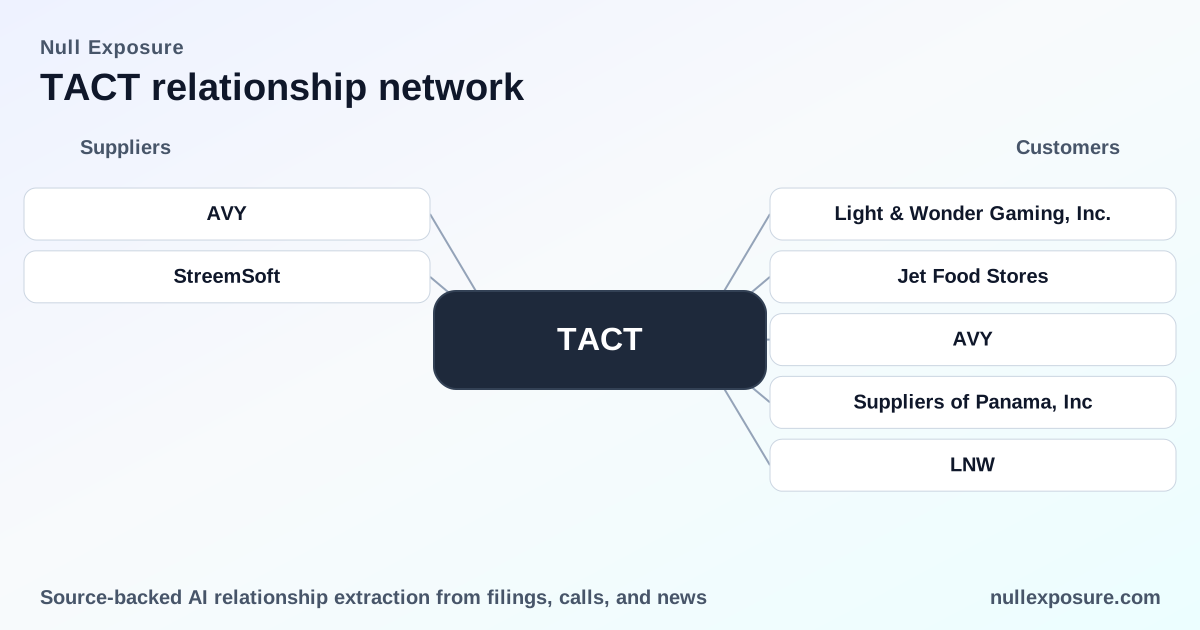
TransAct (TACT) — Customer Map and Strategic Implications
TransAct Technologies designs and sells specialized printers, terminals and complementary software (BOHA! and EPICENTRAL) to gaming operators, quick‑service and food retailers, and value‑added resellers. The company monetizes through hardware sales, recurring software subscriptions, consumables and service contracts, and recognized software licensing fees tied to installations — a hybrid hardware + recurring revenue model that concentrates risk around a handful of large accounts while offering higher‑margin annuity streams.
For a concise dossier on counterparties and how they drive TransAct’s commercial profile, visit the NullExposure homepage: https://nullexposure.com/
What the customer list tells investors — headline takeaways
TransAct’s commercial footprint is global but concentrated: international sales account for a meaningful minority of revenue while one large gaming customer represents a material share of net sales. The company operates as a manufacturer and seller that also functions through distributors and resellers while increasingly capturing service and subscription revenue tied to its BOHA! platform. These dynamics produce a mix of growth optionality from software recurring revenue and downside from customer concentration and license‑based counterparty risk.
Customer roll call — every reported relationship
Light & Wonder / LNW (casino and gaming)
TransAct identifies Light & Wonder as its most significant customer, primarily buying casino and gaming printers; casino and gaming sales to Light & Wonder represent a material percentage of net sales. According to TransAct’s 2024 Form 10‑K, the company explicitly warns that loss or order reductions from this customer could materially affect revenue. (Source: TransAct 2024 Form 10‑K)
Jet Food Stores (BOHA! Terminal 2 rollout)
Jet Food Stores selected TransAct’s BOHA! Terminal 2 to streamline fresh‑food operations at its retail locations and installed Terminal 2 units across its estate. Two industry press items reported the rollout and adoption at multiple sites, underscoring early commercial traction for food‑service terminal deployments. (Sources: CSNews, May 2026; CSPDailyNews, March 2026)
Avery Dennison (AVY) — terminated licensing relationship
TransAct announced termination of multiple licensing agreements with Avery Dennison, listed as a Master License Agreement counterparty in a March 2026 notice. The termination highlights the company’s exposure to third‑party licensing counterparty dynamics and potential churn in legacy license relationships. (Source: TradingView news summary, March 2026)
7‑Eleven (loss of label business referenced)
TransAct’s food‑service technology segment is described as growing despite the loss of 7‑Eleven’s label business, indicating prior commercial ties that were significant enough to warrant disclosure and that the company is in active pursuit of replacement customers. (Source: GGRAsia report, May 2026)
McDonald’s (early BOHA! engagement)
TransAct reported early traction for the BOHA! T2 platform with engagements that include major customers such as McDonald’s, suggesting meetings or pilot deployments with global quick‑service operators as part of the company’s go‑to‑market for its food‑service solutions. (Source: MarketScreener summary, May 2026)
Suppliers of Panama, Inc. (regional partnership for EPIC line)
TransAct inked a strategic partnership with Suppliers of Panama, Inc. to support sales and service of its EPIC gaming products across Panama, improving local distribution and after‑sales coverage in that market. This indicates a strategy of using regional partners to extend reach for its gaming hardware. (Source: asgam.com, November 2024)
Operating model and contract posture — company‑level signals
- Long‑term contracts exist for BOHA! — TransAct first recorded contract assets in 2020 with the start of a long‑term BOHA! contract, indicating multi‑period revenue recognition tied to extended arrangements rather than purely transactional hardware sales.
- Recurring subscription revenue is core to the model. BOHA! generates recurring revenue from software subscriptions that are typically charged annually on a per‑application basis, alongside recurring sales of labels, extended warranties, maintenance and technical support.
- Licensing revenue is recognized on installation/acceptance. EPICENTRAL and other software licenses are recognized when control transfers on installation and formal customer acceptance, creating single‑event revenue points alongside annuity streams.
- Global distribution with regional concentrations. TransAct reports sales to the U.S. as the largest geographic bucket and material international exposure across EMEA and APAC; Europe accounted for more than half of international sales in 2024 while the Pacific Rim contributed roughly a third. The company’s product distribution spans the Americas, EMEA, Asia and the South Pacific.
- Channel mix — manufacturer, reseller and distributor roles. TransAct sells through OEMs, value‑added resellers and select distributors as well as directly to end users, reflecting a blended go‑to‑market that dilutes single‑channel risk but can compress margins.
- Business segments are integrated. The company manages a single operating segment that combines hardware, software and services, meaning performance in one area (for example, hardware ASPs) flows directly into consolidated results.
Investment implications — risks and opportunities
- Concentration risk is real and measurable. The explicit identification of Light & Wonder as the “most significant customer” and a material revenue source creates measurable downside if orders decline; investors should model scenario impacts given the small absolute revenue base.
- Recurring revenue offers margin improvement potential. BOHA! subscriptions, maintenance and consumables create a pathway to higher gross margins and better revenue visibility versus one‑time printer sales. Success hinges on converting pilot engagements (e.g., McDonald’s, Jet Food Stores) into scale.
- Licensing churn and partner terminations matter. The Avery Dennison termination shows license counterparties can create volatile revenue recognition events; future filings and press releases should be monitored for additional license changes.
- Geographic exposure provides diversification but also execution complexity. EMEA and APAC represent material shares of international sales; regional partnerships like Suppliers of Panama illustrate a pragmatic approach to localized distribution and service.
- Channel complexity requires careful margin analysis. Selling through OEMs and resellers expands reach but erodes per‑unit economics; the company’s ability to grow subscriptions offsets that compression only if attachment rates increase.
For a deeper counterparty mapping and investor‑grade summaries, explore NullExposure’s coverage hub: https://nullexposure.com/
Bottom line
TransAct sits at a strategic inflection — hardware sales underpin cashflow while BOHA! and EPIC software offer recurring revenue upside. The investment case balances growth in software and food‑service terminals against tangible concentration and licensing risks. Active monitoring of order flows from Light & Wonder, commercial rollouts with quick‑service customers, and any further licensing terminations will determine whether the company transitions from a hardware provider to a durable hybrid software‑and‑services vendor.