Takeda (TAK): Licensing, divestitures and the downstream partners that monetize its R&D
Takeda operates as a research-driven global pharmaceutical group that monetizes through product sales in core markets and systematic licensing or asset transfers of non-core or regionally redundant assets. The company keeps marketed franchises in major territories (notably Japan and parts of Asia/Latin America for vonoprazan) while selling or licensing development and commercialization rights to specialty biotechs and regional generics players, generating upfront payments, milestone potential and royalty streams. For investors tracking revenue durability and optionality, Takeda’s customer relationships are a direct signal of how the company extracts value from its pipeline and portfolio. Learn more at https://nullexposure.com/.
The customer roll call: who Takeda sells and licenses to
Below I cover every customer relationship captured in public reporting and news for the relevant periods. Each relationship is summarized in plain English with a direct source reference.
Axsome Therapeutics (AXSM)
Axsome executed an asset purchase agreement to obtain exclusive global rights to TAK‑063 (balipodect), a selective PDE10A inhibitor, taking worldwide development, manufacturing and commercialization responsibilities for the asset. This transfer was widely announced in early April 2026 via company press releases and market coverage. Source: Axsome press release distributed on April 1, 2026 via GlobeNewswire and subsequent coverage (April–May 2026).
Ovid Therapeutics (OVID)
A neurotherapeutic molecule originated in Takeda’s labs and was licensed to Ovid in 2017, illustrating Takeda’s long-running strategy of out‑licensing earlier-stage assets to specialty biotechs for focused development. Source: MedCityNews coverage referencing the 2017 license (reported January 2022).
Lupin Limited (LUPIN)
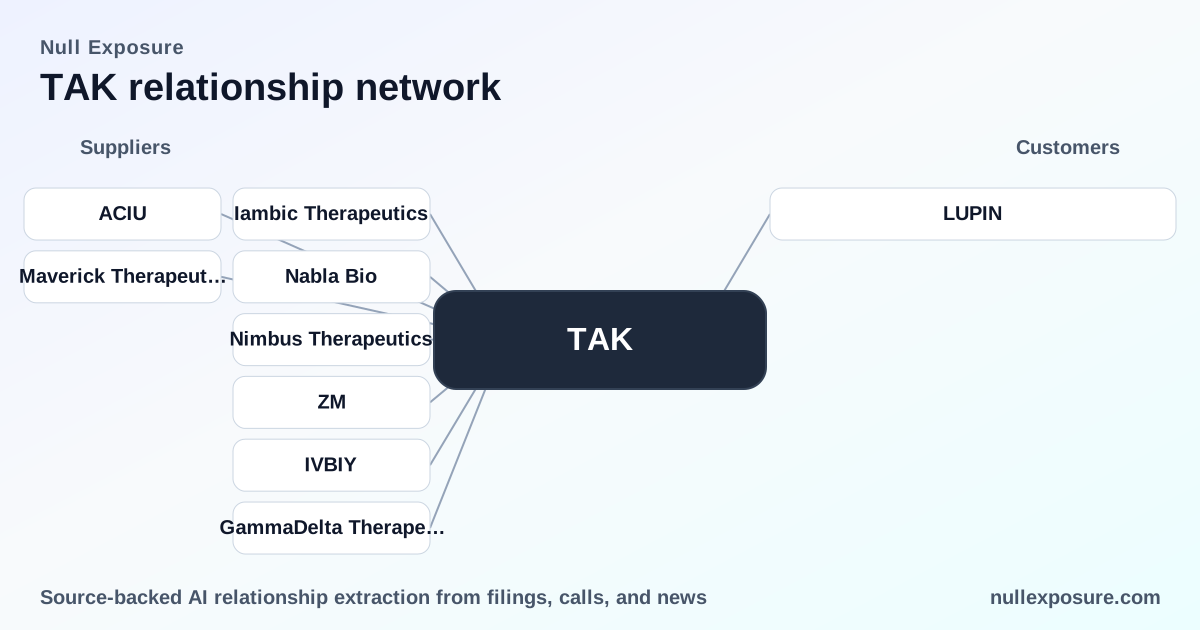
Takeda granted Lupin non‑exclusive patent licensing rights to commercialize vonoprazan in India, enabling a regional generic/brand partner to commercialize the product locally while Takeda retains other territorial rights. Source: Lupin corporate press release (March 10, 2026).
Puma Biotechnology (PBYI)
Puma in‑licensed global development and commercialization rights to alisertib—an aurora kinase A inhibitor—from Takeda in 2022, reflecting a pattern of Takeda out‑licensing oncology candidates to specialized developers. Source: TradingView summary citing Zacks/market reports (March 10, 2026).
Recursion Pharmaceuticals (RXRX)
Recursion in‑licensed REC‑4881 from Takeda after initial evaluation at Takeda, repositioning the program into a fibroblast activation protein (FAP) indication as part of Recursion’s discovery efforts. This is an example of Takeda providing early candidates that smaller biotech firms re‑route into new clinical hypotheses. Source: Finviz/TS2 Tech reporting of Recursion’s program history (December 2025–March 2026).
Phathom Pharmaceuticals (PHAT)
Phathom in‑licensed the rights to vonoprazan for the U.S., Europe and Canada from Takeda, while Takeda continues to market vonoprazan in Japan and multiple Asian and Latin American markets; Phathom’s filings explicitly warn that termination of the license by Takeda would significantly impair Phathom’s business. Source: Phathom press releases and financial reports via GlobeNewswire (January–April 2026).
Dawn Therapeutics / Related biotech (DAWN)
A biotech program that became the basis for later assets (including Ojemda) traces back to an acquisition from Takeda; DAWN’s build-out around that program underscores how Takeda’s divestitures seed new biotech platforms. Source: BioSpace coverage of the legacy program and downstream sale (March 2026).
What the deal flow reveals about Takeda’s operating model
Takeda demonstrates a consistent contracting posture of selectively retaining core geographic commercialization while licensing or selling non‑core rights. The pattern across these relationships shows:
- Concentration and breadth: Takeda works with a broad set of counter‑parties—global specialty biotechs (Axsome, Phathom), regional generics (Lupin) and platform companies (Recursion)—rather than relying on a small number of customers, reducing single‑counterparty concentration risk.
- Commercial criticality to partners: Several licensees (notably Phathom) describe their Takeda agreements as central to their business models, meaning Takeda controls optionality that can be material to partners’ revenue trajectories.
- Maturity mix: Relationships span marketed products (vonoprazan) and late‑stage or earlier pipeline assets (TAK‑063, alisertib, REC‑4881), indicating Takeda converts internal R&D into a stream of monetizable assets across the maturity curve.
- Contracting posture: Takeda’s use of exclusive global transfers (asset sales) and non‑exclusive regional licensing reflects a deliberate strategy to extract value while reallocating development or commercialization risk to specialized partners.
These are company‑level signals reflecting Takeda’s business model rather than attributes of a single counterparty.
Investment implications: upside and risks for TAK holders
Takeda’s downstream relationships create revenue optionality and risk transfer. Key takeaways for investors:
- Positive: recurring optionality and de‑risking — By licensing or selling assets, Takeda converts R&D investment into near‑term cash and potential royalties, preserving balance sheet flexibility while concentrating R&D in priority areas.
- Risk: dependence of small partners on Takeda contracts — Licensees that build businesses around Takeda assets expose Takeda to reputational and enforcement dimensions; disputes or terminations could attract scrutiny and create knock‑on business effects for counterparties (e.g., Phathom’s explicit warning about termination risk).
- Portfolio balance — The mix of marketed revenue (vonoprazan in Japan/Asia/Latin America), and out‑licensed assets globally reduces single‑asset exposure while creating contingent royalty streams if partners commercialize successfully.
Takeda’s public financial profile corroborates a large, revenue‑generating platform with significant pipeline monetization options: market cap roughly USD 52.3B and trailing revenues in the multi‑trillion JPY range, supporting an ability to pursue both in‑house development and carve‑out monetization tactics.
For a structured view of Takeda’s partner ecosystem and how these customer relationships map to potential royalty and milestone pools, explore our full coverage at https://nullexposure.com/.
Final read: what investors should track next
Investors should watch three lines of evidence to value these customer relationships effectively: (1) partner clinical progress and regulatory milestones—outsourced assets like TAK‑063 will create contingent payments; (2) royalty and milestone disclosures in Takeda’s filings—that will convert qualitative deal headlines into quantifiable cash flow; and (3) territorial commercialization dynamics—vonoprazan’s split regional strategy demonstrates how Takeda extracts regional premiums while delegating local execution.
Overall, Takeda’s customer engagements are strategic levers that reduce development risk, generate non‑linear upside, and create counterparty dependencies that are material for some licensees. Investors should price Takeda not only as a product company but as a portfolio manager of assets that it selectively sells, licenses, and retains.