Talkspace (TALK): Customer relationships that determine the exit value
Talkspace is a virtual behavioral-health provider that monetizes through a mix of consumer subscriptions and enterprise/payor contracts, selling therapy and psychiatric services on monthly membership plans and per-member-per-month (PMPM) or paid-per-use terms to employers, payors and institutions. Its commercial strategy is dual‑track: direct-to-consumer recurring revenue plus scalable enterprise and payor agreements that drive higher average contract value and volume. For a concise relationship intelligence package, visit https://nullexposure.com/.
The investment thesis in one paragraph
Talkspace’s revenue mix — subscription cashflows from consumers plus usage-based enterprise and payor contracts — creates predictable recurring top line with upside from enterprise penetration and public-sector programs. The company’s customer map includes large institutional partners and municipal contracts that validate product-market fit in population-level mental health programs, while the announced acquisition by Universal Health Services crystallizes a strategic exit and supports an earnings‑accretive thesis for the acquirer. Investors should value Talkspace for its contracted monetization and channel diversification, while monitoring concentration and U.S.-centric risk.
Key takeaways investors need to remember
- Revenue model: Hybrid subscription and usage-based billing supports recurring revenue with variable upside from PMPM/PPU enterprise deals.
- Concentration risk: Company-level disclosures identify that three customers accounted for ≥10% of revenue in 2024 — a material concentration that increases counterparty risk.
- Geography: Revenues are U.S.-centric, which simplifies regulatory exposure but concentrates political and reimbursement risk.
- Exit dynamics: Multiple reports document a UHS acquisition at
$5.25 per share ($835–880M enterprise), which is now the dominant near-term liquidity event for shareholders.
How the company’s constraints explain its operating model
Talkspace’s contract posture is a hybrid commercial structure: consumer subscriptions provide base recurring cash; enterprise/payor contracts are predominantly PMPM or paid‑per‑use, which scales with utilization. That structure produces predictable baseline ARR and variable incremental revenue tied to clinical engagement. The firm serves both individuals and institutional payors — including government-linked programs — meaning its customer book mixes retail stickiness with large buyers that negotiate pricing and outcomes. The company’s disclosure that three customers made up ≥10% of revenue in 2024 signals material concentration, so client retention and contract renewals are critical determinants of near‑term revenue risk. Finally, the company operates largely in the U.S., and the product set spans services and software elements — a commercialized telehealth service built on a software delivery model — which creates operational dependencies on clinician supply, payer relationships, and integration with institutional workflows.
Relationship roll‑call: every named partner and what it means
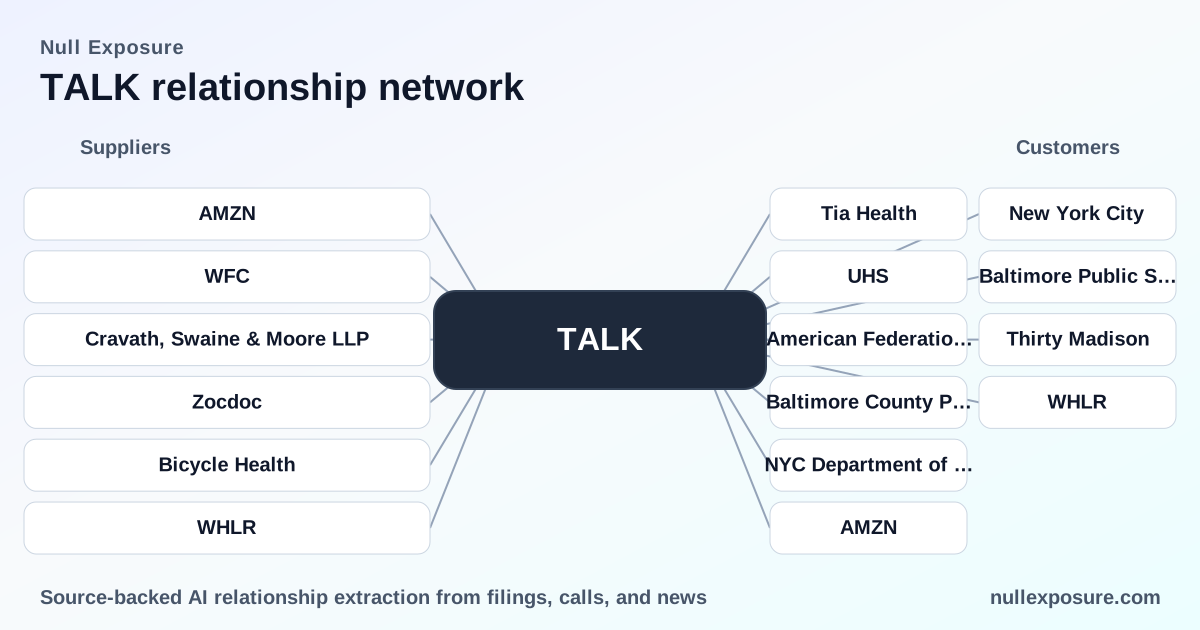
Below I cover every relationship item in the source results. Each entry is a concise, investor‑oriented read with the reporting source.
-
Tia Health — Talkspace is Tia’s primary therapy and psychiatric services partner, integrating virtual behavioral care into Tia’s women’s health offering to give members access to Talkspace services. Source: FemTech Insider / MedCity News (FY2025) — https://medcitynews.com/2025/07/talkspace-tia-women-mental-health/ and https://femtechinsider.com/talkspace-partners-with-tia-to-integrate-mental-health-services-into-womens-primary-care/.
-
Universal Health Services Inc. (UHS) — Multiple outlets report UHS entered a definitive agreement to acquire Talkspace for approximately $5.25 per share, valuing the deal in the $835–880 million range and framing Talkspace as an immediate strategic extension of UHS’s behavioral-health continuum. Source: DotMed, Intellectia, HitConsultant, SimplyWallSt, SAHM Capital, MarketBeat (FY2026) — see https://www.dotmed.com/news/story/66105; https://intellectia.ai/en/stock/TALK/news; https://hitconsultant.net/2026/03/09/uhs-acquires-talkspace-835m-behavioral-health-continuum/; https://simplywall.st/stocks/us/healthcare/nasdaq-talk/talkspace/future; https://www.sahmcapital.com/news/content/shareholder-alert-the-ma-class-action-firm-announces-an-investigation-of-talkspace-inc-nasdaq-talk-2026-03-10; https://www.marketbeat.com/instant-alerts/talkspace-nasdaqtalk-upgraded-by-wall-street-zen-to-strong-buy-rating-2026-02-28/.
-
Investor‑rights firms / Litigation monitors (Halper Sadeh, MA Class Action Firm) — Legal advisers have publicly signaled investigations into the fairness of the UHS acquisition price, highlighting standard fiduciary‑review activism in M&A. Source: Aijourn, SAHM Capital (FY2026) — https://aijourn.com/talk-stock-alert-halper-sadeh-llc-is-investigating-whether-talkspace-inc-is-obtaining-a-fair-price-for-its-shareholders/; https://www.sahmcapital.com/news/content/are-fora-grtx-wbs-talk-obtaining-fair-deals-for-their-shareholders-2026-04-21.
-
American Federation of Teachers — The union signed a partnership giving its 1.7 million members discounted access to Talkspace therapy and mental-health resources, a large affinity channel that validates enterprise distribution to professional groups. Source: Fierce Healthcare (FY2024) — https://www.fiercehealthcare.com/health-tech/talkspace-targets-strong-revenue-growth-2024-it-doubles-down-payer-enterprise-strategy.
-
Baltimore County Public Schools / Baltimore Public Schools — Talkspace provides free, unlimited teletherapy to BCPS high-school students (13+), a population-level contract that signals the company’s capability to deliver municipal education‑system programs. Source: Fierce Healthcare / BH Business (FY2024) — https://www.fiercehealthcare.com/health-tech/talkspace-targets-strong-revenue-growth-2024-it-doubles-down-payer-enterprise-strategy; https://bhbusiness.com/2024/05/07/talkspace-achieves-profitability-reveals-medicare-push/.
-
New York City / NYC Department of Health and Mental Hygiene (TeenSpace contract) — Talkspace secured a $26 million, three‑year contract to operate TeenSpace, demonstrating capability to manage multi‑year public health programs and to scale adolescent mental‑health services. Source: Fierce Healthcare (FY2024) — https://www.fiercehealthcare.com/health-tech/talkspace-targets-strong-revenue-growth-2024-it-doubles-down-payer-enterprise-strategy.
-
Amazon Health Services (AMZN) — Talkspace integrated with Amazon Health Services to let customers check eligibility and enroll in Talkspace offerings, expanding distribution through a major technology platform and increasing potential member acquisition channels. Source: MobiHealthNews (FY2024) — https://www.mobihealthnews.com/news/talkspace-be-added-amazon-health-services.
-
Thirty Madison — Talkspace collaborated with Thirty Madison to launch mental‑health services across reproductive health platform Nurx and migraine offering Cove, reflecting partnerships that embed behavioral care into specialty telehealth verticals. Source: MobiHealthNews (FY2024) — https://www.mobihealthnews.com/news/talkspace-be-added-amazon-health-services.
-
Wheel (WHLR) — Telehealth platform Wheel added Talkspace to its virtual care lineup, enabling referrals and platform integration that broaden enterprise reach into clinician networks and partner marketplaces. Source: MobiHealthNews (FY2024) — https://www.mobihealthnews.com/news/talkspace-be-added-amazon-health-services.
-
Publicis Health — Publicis Health and Talkspace partnered to integrate Wisdo Health peer-support and guided group coaching into patient engagement strategies, aiming to improve treatment adherence and sustained engagement through community and coaching layers. Source: Publicis Health release reported by SAHM Capital (FY2026) — https://www.sahmcapital.com/news/content/publicis-health-and-talkspace-partner-to-improve-treatment-adherence-by-addressing-gaps-in-social-health-and-peer-support-2026-03-23.
-
Health‑E Commerce / FSA Store / HSA Store — Health‑E Commerce announced a collaboration allowing consumers to purchase Talkspace services with FSA and HSA funds via FSA Store and HSA Store, unlocking an additional direct-pay channel and making therapy purchases tax-advantaged for end users. Source: QuantisNow (FY2026) — https://quantisnow.com/insight/health-e-commerce-collaborates-with-talkspace-to-expand-mental-health-services-6515955.
What this customer map signals for value and risk
- Value drivers: Enterprise and public‑sector contracts (NYC, school systems, large unions) validate high‑volume use cases and create predictable revenue corridors; distribution partnerships with Amazon, Wheel and FSA/HSA channels expand acquisition pathways.
- Near‑term risk: Material customer concentration (three customers ≥10% revenue in 2024) and U.S.-only revenue create downside from contract loss or reimbursement changes.
- Strategic outcome: The UHS acquisition consolidates the company’s exit value and provides an integration path to convert Talkspace’s virtual provider network into higher‑acuity, closed‑loop services inside a large health system.
For deeper relationship analytics and to monitor how these partner contracts evolve through the integration with UHS, see our coverage at https://nullexposure.com/.
Conclusion: Talkspace’s customer relationships are a mix of platform distribution, institutional public programs and payer/enterprise contracts that together justify the strategic rationale of the UHS acquisition, while leaving concentration and U.S. reimbursement exposure as the principal investor risks. Under the announced deal, the company’s enterprise reach and municipal program expertise become the lever for near‑term accretion and medium‑term product expansion.