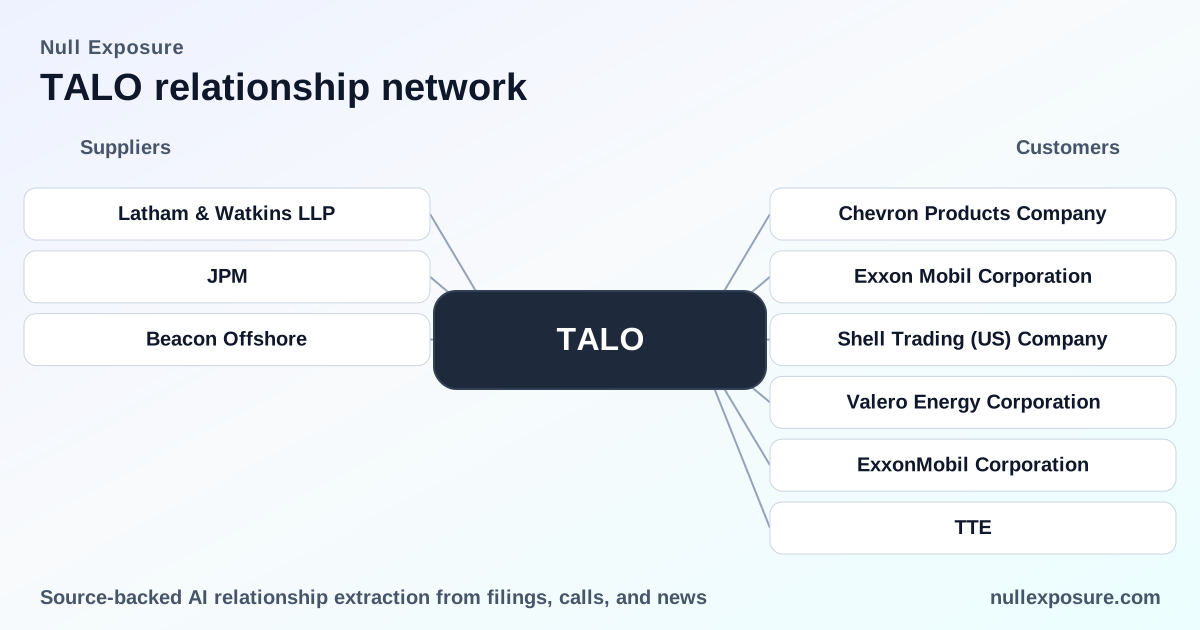
Talos Energy (TALO) — Customer Relationships and Commercial Implications
Talos Energy is an upstream E&P that monetizes producing oil, natural gas and NGL volumes by selling commodity production into the U.S. spot market and short‑term contracts, with the majority of revenue concentrated among a handful of major refiners and trading houses. Revenue flows are dominated by commodity sales rather than long‑term offtake contracts; counterparty concentration and U.S. Gulf geographic exposure are the primary commercial dynamics that drive cash flow volatility and counterparty risk. For a transaction and counterparty intelligence feed built for investors, see NullExposure: https://nullexposure.com/.
Investment thesis, compact
Talos generates cash by producing and marketing hydrocarbons from Gulf of Mexico assets and selling those barrels and molecules into the spot market and short‑term contracts to large energy companies and trading affiliates. The operating model is high‑volume, asset‑backed commodity sales to a small set of large counterparties, which amplifies price exposure but simplifies credit relationships—until a concentrated counterparty changes behavior.
How the customer book is structured
Talos markets the majority of its output into the U.S. marketplace and records sales when title transfers under short‑term arrangements. The company’s 2024 Form 10‑K shows a clear pattern: large energy companies and refiners provide the bulk of revenue, and sales are overwhelmingly spot or market‑based. This structure produces strong revenue visibility when prices are stable, but concentrated counterparty exposures create single‑buyer risk dynamics that investors must price into valuation models.
Second CTA mid‑article: If you want a consolidated view of counterparties and concentration risk across energy firms, visit NullExposure: https://nullexposure.com/.
Major customer relationships (what the filings and press releases show)
Shell Trading (US) Company
Shell Trading (US) accounted for 48% of Talos’ oil, natural gas and NGL revenues for the year ended December 31, 2024, down from 54% in 2023 and 44% in 2022, making Shell the single largest buyer of Talos production. According to Talos’ 2024 Form 10‑K, Shell’s share represents the principal concentration risk in the company’s sales mix (FY2024 Form 10‑K).
Exxon Mobil Corporation / ExxonMobil Corporation
Exxon Mobil represented 17% of oil, natural gas and NGL revenues in 2024, making it the second material counterparty in Talos’ customer list as reported in the 2024 Form 10‑K. Talos explicitly identifies the loss of larger customers such as Exxon as a potential material adverse effect on revenue and operations (FY2024 Form 10‑K).
Chevron Products Company
Chevron Products Company is listed in Talos’ customer concentration disclosures; Chevron was reported at 11% in 2022, while the 2024 table uses a redaction marker (shown as “**”) for years where a single customer did not meet the 10% disclosure threshold or where the company withheld the precise percentage. Talos’ 2024 Form 10‑K contains this sales‑by‑customer schedule (FY2024 Form 10‑K).
Valero Energy Corporation
Valero Energy appears in Talos’ customer concentration table with 23% in 2022 and 21% in 2023, while the 2024 line is redacted (“**”). The Form 10‑K lists Valero among customers that historically represented a material portion of hydrocarbon revenues (FY2024 Form 10‑K).
TotalEnergies E&P USA, Inc. (TTE)
A March 2024 industry announcement by Latham & Watkins reported that Talos entered into an agreement to sell its wholly owned subsidiary Talos Low Carbon Solutions LLC (TLCS) to TotalEnergies E&P USA, Inc., establishing a formal commercial transaction between Talos and the TotalEnergies affiliate for the divestiture of a low‑carbon business unit (Latham & Watkins announcement, March 2024).
What the constraints tell investors about Talos’ commercial posture
The disclosures generate a coherent picture of operating constraints that matter for valuation and risk:
- Contracting posture: short‑term and spot — The majority of production is sold under contracts shorter than 12 months or on the spot market, and Talos itself states that substantially all sales are priced to spot market benchmarks (company disclosures, 2024 Form 10‑K). This produces direct exposure to oil and gas price cycles and limits revenue hedging through long‑dated fixed‑price offtakes.
- Counterparty profile: large enterprise buyers — Customers consist primarily of major oil and gas companies, refiners and trading affiliates; the 10‑K explicitly names Shell and Exxon as large buyers. That concentration centralizes credit and operational counterparty risk in a small set of highly capable but commercially powerful buyers.
- Geographic concentration: U.S. Gulf focus — Talos’ revenues are attributable to the United States and operations are concentrated in the U.S. Gulf of Mexico, which concentrates both market settlement and operational risk (FY2024 Form 10‑K).
- Materiality and concentration risk — The filing warns that the loss of a major customer could have a material adverse effect on near‑term revenue, a signal investors must incorporate when stress‑testing cash flow (FY2024 Form 10‑K).
- Commercial role: seller of core product — Talos’ revenue is derived from direct sale of produced oil, natural gas and extracted NGLs, confirming that customer relationships are transactional and volume‑driven rather than long‑term strategic offtakes (FY2024 Form 10‑K).
- Relationship stage: active — Sales are current and recorded on delivery under market pricing; these are ongoing, active commercial relationships rather than legacy contracts (FY2024 Form 10‑K).
Investment implications and risk framing
- Concentration is the dominant operational risk. Shell’s 48% share in 2024 creates a single‑counterparty sensitivity that affects both pricing power and payment timing. Loss or renegotiation of volumes with Shell would materially alter revenue under short notice.
- Spot exposure amplifies price cycles. Because sales are largely spot and short‑term, Talos’ EBITDA will move closely with commodity prices; downside price shocks translate to immediate revenue compression, while upside accrues quickly.
- Counterparty credit is binary but concentrated. Large counterparties reduce small‑counterparty credit risk but concentrate systemic exposure—credit events at a single large buyer would be material.
- Strategic simplification: divestiture of TLCS. The sale of Talos Low Carbon Solutions to TotalEnergies (per Latham & Watkins, March 2024) removes a non‑core low‑carbon unit and formalizes a corporate transaction with a major energy group; that transaction reorients the company around core hydrocarbon sales and reduces diversification into low‑carbon services.
Bottom line for investors
Talos is an asset‑centric seller of hydrocarbons whose revenue profile is dominated by a few large counterparties and short‑term, spot‑linked sales. That structure provides straightforward cash generation at favorable prices but concentrates counterparty and price risk—Shell and Exxon are explicit material concentrations in the 2024 filing. Risk management for TALO should focus on counterparty monitoring, scenario analysis for large‑buyer status changes, and sensitivity to U.S. Gulf operational disruption.
For a consolidated, comparison‑grade view of counterparty concentration and customer risk across energy issuers, visit NullExposure: https://nullexposure.com/.