TANNI customer relationships: what investors should know
Thesis: TANNI operates a network of travel-center properties that monetizes through branded food and restaurant partnerships, franchise agreements, and ancillary site revenues (fuel, retail, services). The company drives traffic and recurring cash flows by hosting national and regional restaurant brands as in-store partners and franchised operators, converting branded foot traffic into higher per-site profitability. For a concise gateway to our coverage, visit https://nullexposure.com/.
The business model in one paragraph: branded partners as revenue multipliers
TANNI’s economics rely on a platform model for travel centers: lease and franchise income from restaurant operators plus on-site retail and fuel margin compound site-level revenue. National quick-service and full-service restaurant partners provide predictable traffic and operational leverage while franchise arrangements extend growth without proportional capital intensity. RestaurantDive’s reporting on TA’s partner network underscores that branded food franchises are an integral monetization channel (Restaurant Dive, May 4, 2026).
Customer relationships: brand-by-brand readout
Below is a concise, evidence-based readout of every partner and counterparty flagged in the collected results.
Starbucks
Starbucks is listed among nearly 20 fast-food and café partners operating within TANNI travel centers, positioning the brand as a high-frequency beverage anchor that supports daily traffic flow. (Restaurant Dive, May 4, 2026)
R Place Restaurant
R Place Restaurant is part of TANNI’s full-service restaurant roster, representing a regional full-service option that diversifies on-site dining beyond quick-service anchors. (Restaurant Dive, May 4, 2026)
Subway
Subway appears among the fast-food partners inside TA locations, contributing quick-service sandwich demand and lowered operating complexity for on-site food offerings. (Restaurant Dive, May 4, 2026)
Black Bear Diner
Black Bear Diner is included in the full-service network, offering a sit-down dining alternative that enhances dwell time and average ticket per customer at certain sites. (Restaurant Dive, May 4, 2026)
Arby’s
Arby’s is named as one of the fast-food partners integrated into TA locations, bringing branded quick-serve demand to complement other national chains on-site. (Restaurant Dive, May 4, 2026)
Boston Market
Boston Market features in the full-service line-up in TA facilities, supplying a homestyle meal option that broadens the consumer mix within the travel center ecosystem. (Restaurant Dive, May 4, 2026)
Burger King
Burger King is cited among nearly 20 fast-food partners anchoring TA sites, providing a national quick-service brand that supports consistent customer conversion. (Restaurant Dive, May 4, 2026)
Taco Bell
Taco Bell is identified as a fast-food partner in TANNI locations, contributing late-night and value-oriented demand segments to site throughput. (Restaurant Dive, May 4, 2026)
IHOP
IHOP is specifically mentioned in expansion plans tied to TA’s restaurant strategy, signaling growth of full-service breakfast and family-dining options within the travel-center footprint. (Restaurant Dive, May 4, 2026)
Popeyes
Popeyes is included among TA’s quick-service partners, adding to portfolio variety and attracting a distinct chicken-focused customer cohort. (Restaurant Dive, May 4, 2026)
Johnson’s Corner
Johnson’s Corner is listed in the full-service network, contributing local or regional dining identity to TA’s broader brand mix. (Restaurant Dive, May 4, 2026)
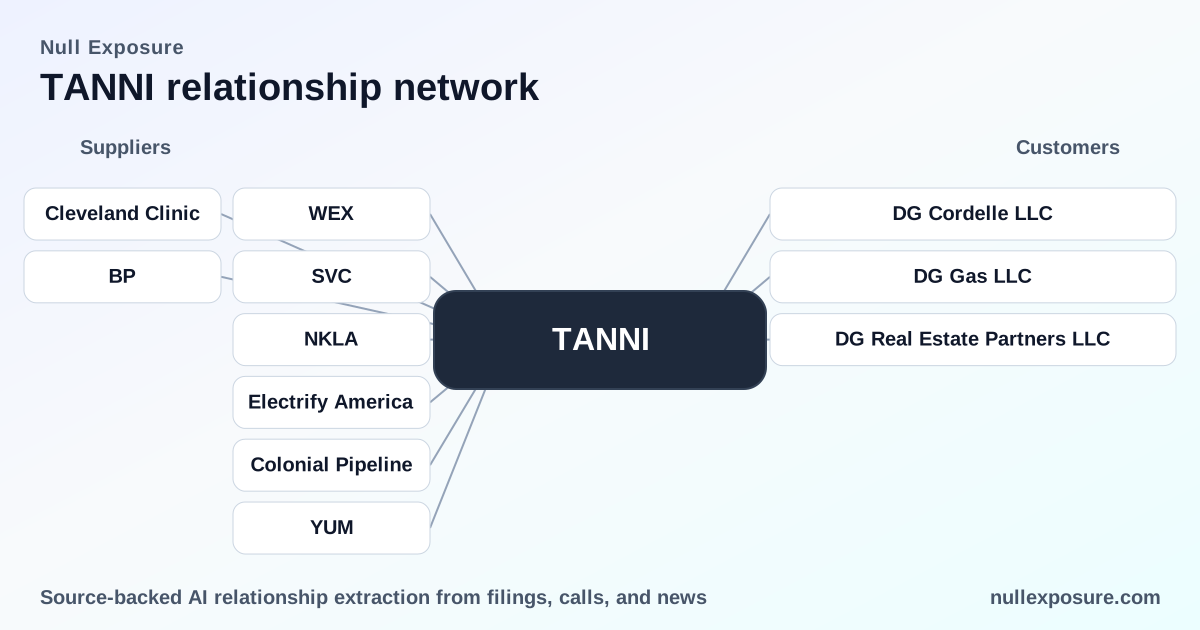
DG Cordelle LLC
DG Cordelle LLC is one of the plaintiffs in a reported $300 million franchise termination lawsuit filed against TA Franchise Systems LLC and TA Operating LLC, representing direct legal and counterparty risk related to franchise agreements. (CSP Daily News, March 10, 2026)
DG Gas LLC
DG Gas LLC joined the suit against TA entities alleging wrongful franchise termination after plans to develop multiple TA Express locations, signaling a dispute over franchise performance and termination remedies. (CSP Daily News, March 10, 2026)
DG Real Estate Partners LLC
DG Real Estate Partners LLC is named in the same $300 million claim, asserting planned development of 25 TA Express sites and contributing a real-estate-based counterparty dimension to the litigation. (CSP Daily News, March 10, 2026)
Bob Evans
Bob Evans is reported as part of TA’s full-service restaurant network, offering family-dining options that enhance the in-center menu breadth. (Restaurant Dive, May 4, 2026)
Fuddruckers
Fuddruckers appears in TA’s full-service list and contributes casual-dining burger franchising to the on-site restaurant mix. (Restaurant Dive, May 4, 2026)
What the relationships collectively imply for investors
- Diversified partner mix: The presence of both national quick-service brands (Starbucks, Burger King, Taco Bell, Subway, Popeyes, Arby’s) and full-service names (IHOP, Bob Evans, Black Bear Diner, Boston Market, Fuddruckers) signals a deliberate strategy to capture multiple customer segments and dayparts, smoothing revenue volatility across fuel, food, and retail sales. (Restaurant Dive, May 4, 2026)
- Asset-light growth via franchising: The growth of branded footprints through franchise operators and third-party tenants enables expansion of restaurant coverage without proportional capital deployment by TANNI, consistent with franchise-driven monetization. (Restaurant Dive, May 4, 2026)
- Counterparty and legal risk is real: The $300 million franchise termination lawsuit lodged by DG entities represents a material legal exposure tied to franchise agreements and termination practices, creating downside operational and reputational risk if contested in court. (CSP Daily News, March 10, 2026)
- Traffic capture is critical: Branded restaurant anchors function as foot-traffic multipliers for fuel and in-store sales; loss or deterioration of key national partners would have an outsized impact on site economics.
For an at-a-glance monitoring tool of partner developments and legal notices, see our homepage: https://nullexposure.com/.
Operating posture and company-level signals (constraints)
No explicit constraint records were extracted in the reviewed material, which is a company-level signal: the public record provided here does not include structured constraint flags on concentration, contract length, or supplier maturity. In practical terms, investors should interpret that existing public reporting focuses on partner composition and discrete legal actions rather than on contract tenure or supplier concentration metrics; contract-related risks are therefore best monitored through subsequent filings, franchise disclosures, and legal dockets.
Investment implications and closing view
TANNI’s partnership roster demonstrates a strategic reliance on national and regional restaurant brands to drive site-level revenue, reducing capex intensity via franchising while creating operational leverage. The DG-related litigation underscores that franchise governance and termination practices are a principal near-term risk that can affect cash flow and governance focus. Investors should watch quarterly disclosures for updates on litigation, franchise renewal terms, and any material changes to anchor-tenant composition.
For ongoing coverage, data feeds, and relationship monitoring of TANNI and similar travel-center operators, visit https://nullexposure.com/.