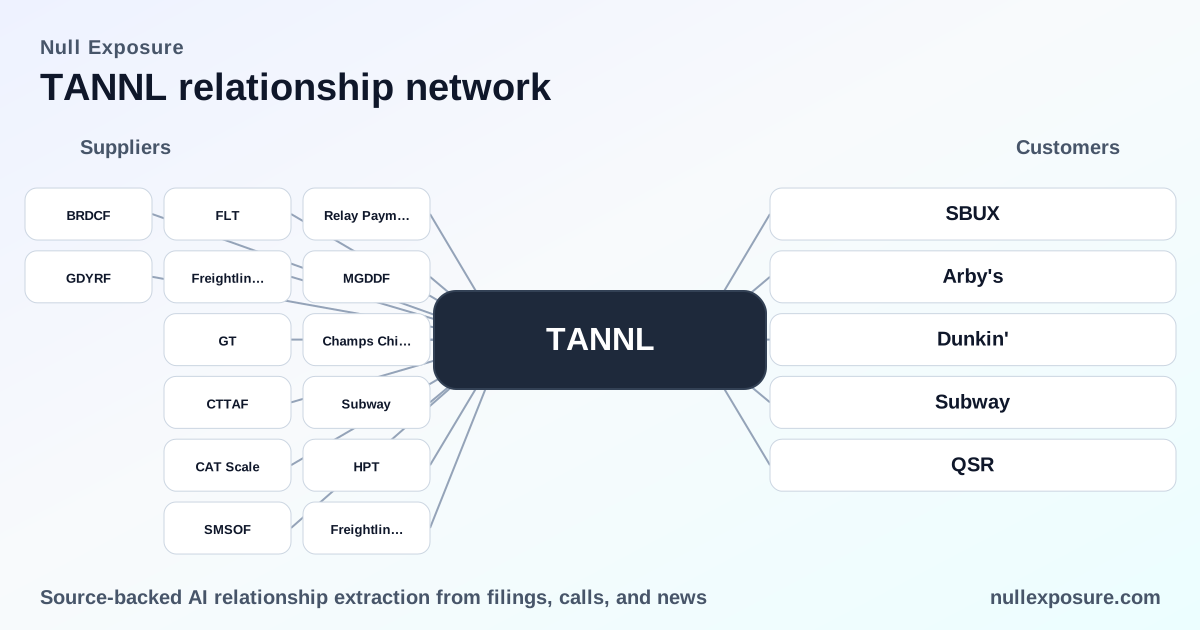
TANNL customer relationships: roadside foodservice footprint and what it means for revenue durability
TANNL supplies services and commercial relationships to operators embedded in travel-center and quick-service restaurant (QSR) ecosystems, generating revenue through commercial placement agreements, recurring service contracts, and tenant-support fees tied to multi-tenant travel center builds and remodels. For investors, the near-term growth vector is concentration in travel-stop food courts and express-convenience anchors where incremental retail openings directly lift billed services; the risk vector is the same — reliance on incremental lease-ups and franchise rollouts to convert booked capacity into sustained cash flow.
Learn more about coverage and data context at https://nullexposure.com/.
What the customer roster reveals about the business
The customer list is dominated by quick-service brands and mall-style food-court tenants operating inside TA/TA Express locations. That profile implies a transactional, portfolio-based contracting posture: multiple small-to-medium franchise tenants under common site contracts rather than a few large exclusive enterprise relationships. From a revenue-quality perspective, this is diversified at the tenant level but concentrated at the channel level (travel centers and highway retail) — the company’s fortunes move with travel-stop construction and rebuild cycles.
Relationship breakdown — every customer callout from the compiled results
Starbucks (entry 1)
Starbucks is scheduled to open at the rebuilt TA New Haven site in mid-September as part of the facility’s food-court and retail mix, signaling TANNL’s presence in higher-profile national coffee placements within travel centers (TruckingInfo, March 2026 — https://www.truckinginfo.com/news/ta-rebuilds-facility-in-new-haven).
SBUX (duplicate entry reflecting the same Starbucks placement)
The dataset also lists SBUX as a separate match for the same TruckingInfo report referencing the mid-September Starbucks opening, confirming multiple entity-matching instances for the same national coffee tenant (TruckingInfo, March 2026 — https://www.truckinginfo.com/news/ta-rebuilds-facility-in-new-haven).
Subway
Subway is cited as a food-court tenant at the TA New Haven site where customers can choose Subway sandwiches among other options, underscoring TANNL’s exposure to legacy fast-casual franchise brands occupying food-court footprints (TruckingInfo, March 2026 — https://www.truckinginfo.com/news/ta-rebuilds-facility-in-new-haven).
Dunkin'
A new TA Express location advertised features a Dunkin’ outpost alongside other quick-serve brands, pointing to TANNL’s participation in express-format rollouts on interstate interchange sites where high-frequency coffee and breakfast traffic drives throughput (Dubois County Free Press, reported March 2026 — https://duboiscountyfreepress.com/ta-express-arbys-dunkin-opening-in-dale/).
Arby’s
Arby’s is named as a co-tenant in the TA Express opening near I-64, illustrating the mix of sandwich and fried-protein concepts TANNL serves within travel-centered retail developments (Dubois County Free Press, reported March 2026 — https://duboiscountyfreepress.com/ta-express-arbys-dunkin-opening-in-dale/).
QSR (generic quick-service classification)
A QSR designation appears tied to the TruckingInfo article describing the TA New Haven food-court options; this label aggregates non-branded quick-service placements such as Popeye’s and Subway and signals exposure to the broader quick-service sector rather than single-brand dependency (TruckingInfo, March 2026 — https://www.truckinginfo.com/news/ta-rebuilds-facility-in-new-haven).
Popeye’s Chicken & Biscuits
Popeye’s is listed as an option at the TA New Haven food court alongside Subway, reinforcing the pattern of classic quick-service chicken and sandwich brands occupying compact food-court footprints that drive daytime and travel-period sales (TruckingInfo, March 2026 — https://www.truckinginfo.com/news/ta-rebuilds-facility-in-new-haven).
What the relationship set implies for contracting, concentration, and criticality
- Contracting posture: The customer mix suggests TANNL operates primarily under site- or project-level commercial agreements with travel-center operators and franchisees, rather than a small number of master enterprise contracts. That creates a portfolio billing model where many mid-ticket relationships aggregate into revenue.
- Concentration: Tenant-level exposure is diverse (multiple QSR brands) but channel-concentrated: travel centers and TA/TA Express redevelopment cycles will materially affect utilization of TANNL’s services. This channel concentration is the primary concentration risk.
- Criticality: For tenants, TANNL’s services are supportive and enabling (site build-outs, tenant services, placements) rather than mission-critical to brand corporates; however, at the site level TANNL is critical to on-time openings that drive cash flows for both landlords and tenants.
- Maturity and cadence: The roster reflects repeatable, franchise-driven openings and rebuilds rather than one-off enterprise rollouts, so revenue recognition and cash collection will follow construction and franchise opening timetables.
No explicit contractual constraints or special-covenant items were returned in the compiled relationship constraints; that absence should be read as a company-level signal that no targeted exclusivity, concentration covenant, or other restrictive contractual flag was detected in the relationship set.
Explore the platform that surfaces these customer relationships at https://nullexposure.com/.
Investment implications — upside, risks, and near-term indicators to watch
- Upside: Growth tied to travel-center rebuilds and TA/TA Express expansion yields scalable, repeatable revenue as more multi-tenant sites come online; national brands like Starbucks and Dunkin’ accelerate tenancy velocity and visibility.
- Risk: Channel concentration in travel-stop retail creates sensitivity to highway traffic trends, fuel-cycle economics, and site-level construction timing. Tenant churn in low-margin QSRs or slower-than-expected franchise openings will compress utilization of TANNL’s installed capacity.
- Execution metrics to monitor: cadence of TA/TA Express openings, time-to-activation for new tenants, revenue per site, and the split between one-time build revenues and recurring service fees. These operational metrics determine whether portfolio diversification at the tenant-level translates into stable recurring cash flow.
Bottom line
The customer list positions TANNL as a specialist provider to the travel-center and QSR ecosystem, with diversified tenant exposure across recognizable national brands but a single-channel concentration that governs risk-return dynamics. For investors and operators, due diligence should focus on the company’s contract terms, the mix between recurring and project revenue, and the pipeline of travel-center rebuilds and express rollouts that convert placement opportunities into sustained income.