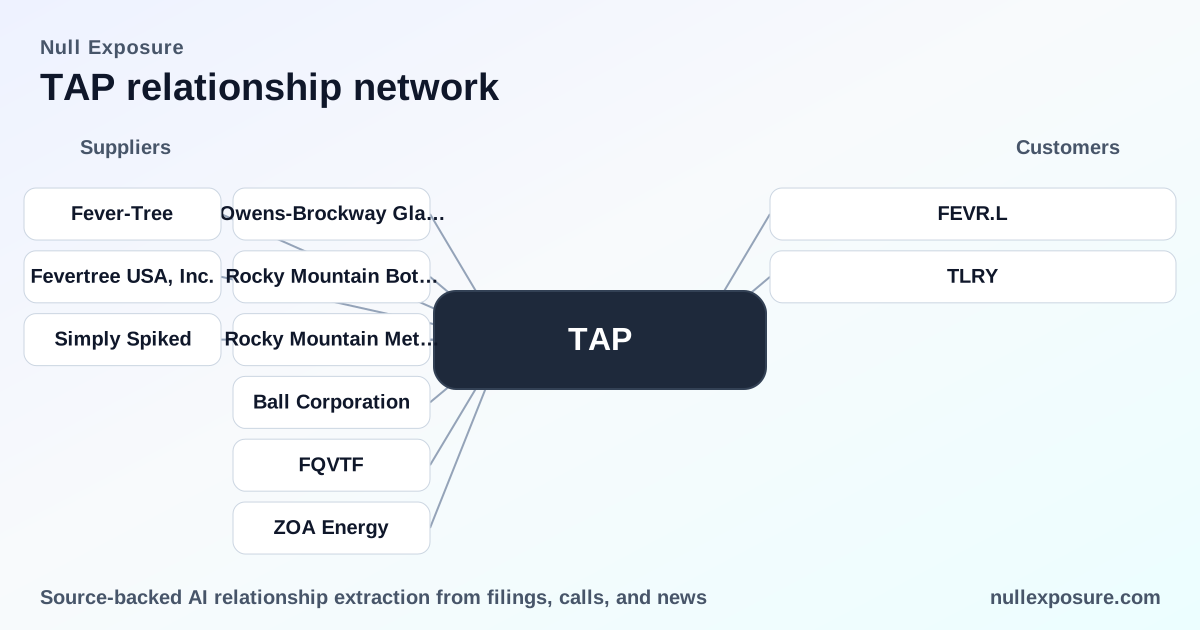
TAP (Molson Coors) — Customer Relationships and Commercial Implications for Investors
Thesis: Molson Coors (TAP) operates as a global brewer that monetizes through branded beverage sales sold largely via independent distributors and on-/off‑premise channels, with an increasingly diversified portfolio that includes non‑alcoholic and craft assets. Its revenue model is driven by wholesale distribution, licensed partnerships and selective brand divestitures, producing stable cash flow characteristics moderated by cyclical consumer demand and portfolio reshaping. For direct access to more relationship intelligence and ongoing tracking, visit https://nullexposure.com/.
How Molson Coors sells and why customer relationships matter
Molson Coors sells finished beer and beverage products primarily to independent distributors (U.S.) and a mix of retail and on‑premise customers internationally, capturing margin at the wholesale level and relying on distributor and retail execution for consumer-facing volume. The company reports that no single customer exceeded 10% of consolidated net sales in recent years, which supports a low customer concentration profile. Geographic exposure is concentrated in North America and EMEA, with the U.K. accounting for the largest share of EMEA net sales. Contracting is transactional and distribution‑driven rather than long‑term captive supply contracts, meaning revenue stability depends on brand strength, trade relationships and category placement rather than bespoke contractual lock‑ins.
- Operating posture: Distributor/reseller orientation; Molson Coors captures value upstream and relies on channel partners downstream.
- Concentration: Company-level signals indicate immaterial single‑customer dependency, reducing counterparty concentration risk.
- Geographic footprint: Material exposure to NA (U.S.) and EMEA (U.K. and central Europe)—important for macro and FX sensitivity.
- Criticality & maturity: Core beer brands remain mission‑critical to trade partners; newer non‑alcoholic and craft partnerships are in growth or portfolio‑transition phases.
For additional commercial mapping and to monitor how these relationships evolve, see https://nullexposure.com/.
Relationship ledger — what the evidence shows
Below I list every relationship record found in the review set and provide a concise investor‑oriented takeaway with source attribution.
TAP-A (Batch 002 collaboration)
Molson Coors released a limited Batch 002 blend bottled in partnership with Bardstown Bourbon Company that uses Imperial Porter barrels from AC Golden Brewing and Rocky Mountain water, highlighting the company’s use of collaborative, experiential products to extend brand reach beyond mainstream beer. Source: Fred Minnick article on the Batch 002 release (online coverage of FY2022 batch details) — https://www.fredminnick.com/2022/09/08/molson-coors-releases-five-trail-batch-002/.
RRGB — Red Robin promotional placement (sahmcapital press)
Molson Coors products (Coors Light) are being featured in Red Robin’s promotional menu, illustrating ongoing on‑premise volume and promotional placements that support beer sales through casual dining channels. Source: SahmCapital press story on Red Robin value menu (FY2026) — https://www.sahmcapital.com/news/content/red-robin-introduces-new-big-yummm-deals-value-menu-starting-at-999-2026-01-21.
RRGB — Red Robin corporate release
An official Red Robin press release confirms Coors Light pint promotions tied to new menu offerings, reinforcing the practical trade activation and promotional calendar that supports near‑term volume in the U.S. casual dining segment. Source: Red Robin investor/press release (FY2026) — https://ir.redrobin.com/news-events/press-releases/detail/721/red-robin-introduces-new-big-yummm-deals-value-menu.
TLRY — Tilray reference in craft portfolio coverage (BeverageDaily)
Coverage of Tilray’s acquisitions mentions that Molson Coors sold certain craft assets (e.g., Revolver, Atwater) prior to Tilray’s consolidation moves, signaling the company’s strategic portfolio pruning of craft brands to focus on core scale operations. Source: BeverageDaily article on Tilray Brands acquisition coverage (FY2026) — https://www.beveragedaily.com/Article/2026/03/02/tilray-brands-acquires-brewdog/.
TLRY — Tilray acquisition note (VinePair)
A VinePair article references Molson Coors’ divestiture of its craft portfolio in 2024 as part of the background to Tilray’s dealmaking, which underscores Molson Coors’ preference for monetizing non-core assets and simplifying brand mix. Source: VinePair news on Tilray’s acquisition activities (FY2026) — https://vinepair.com/booze-news/tilray-acquires-brewdog-for-44-million/.
Tilray Brands — repeat mention in industry consolidation coverage
Industry reporting again links Molson Coors to prior craft brand transactions that feed into Tilray’s aggregation strategy, reinforcing that Molson Coors has executed disposals rather than investment in certain craft segments. Source: BeverageDaily (same coverage thread on FY2026 consolidation) — https://www.beveragedaily.com/Article/2026/03/02/tilray-brands-acquires-brewdog/.
HEXO — 2019/2021 CBD beverage partnership reference
Historical coverage notes Molson Coors partnered with HEXO to enter the U.S. CBD beverage market (Colorado launch), demonstrating the company’s experimentation with adjacent beverage categories and licensing partnerships to test new growth vectors. Source: MuggleHead coverage referencing the Molson Coors–HEXO collaboration (context cites FY2021 activity) — https://mugglehead.com/hexo-touts-q2-earnings-eyes-ma/.
Fever‑Tree (FEVR.L) — earnings‑call partnership disclosure
Molson Coors’ 2025 Q3 earnings call highlights a U.S. partnership with Fever‑Tree to build non‑alcoholic and mixer offerings, signaling explicit strategic intent to expand non‑alcoholic portfolio via third‑party partnerships and leverage Fever‑Tree’s premium mixer positioning. Source: TAP 2025 Q3 earnings call transcript (2025Q3).
FEVR.L — repeated earnings‑call mention
The earnings call reiterates that the Fever‑Tree partnership provides a base for growing non‑alcoholic SKUs and trade placements, emphasizing management’s prioritization of the total non‑alcohol portfolio as a growth channel. Source: TAP 2025 Q3 earnings call transcript (2025Q3).
What investors should take away — strategic implications and risks
- Channel dependency but low single‑counterparty risk: Molson Coors relies on independent distributors and on/off‑premise accounts for volume, but the company reports no single customer over 10% of sales, implying diversified exposure across trade partners.
- Portfolio reshaping via divestitures: The multiple mentions of craft asset transfers to buyers like Tilray reflect a deliberate simplification of the brand portfolio, which converts non‑core brands into capital or partnership mandates and reduces managerial complexity.
- Active pursuit of adjacent growth: Partnerships (HEXO for CBD history; Fever‑Tree for mixers and non‑alc expansion) show a multi-pronged approach to product adjacencies rather than reliance on organic brand extensions alone.
- Trade activation matters for volumes: Promotional placements with restaurant chains such as Red Robin validate that trade promotions and on‑premise programs remain key levers for short‑term volume and seasonal demand management.
Final assessment
Molson Coors’ customer relationships are broad, transactional and distribution‑centric, with strategic use of partnerships and disposals to sharpen portfolio focus and capture non‑alcoholic growth opportunities. These characteristics produce stable wholesale economics, moderate counterparty risk and the need for continued trade execution to protect volume. For ongoing, structured monitoring of TAP’s commercial relationships and how they influence revenue composition, visit https://nullexposure.com/.