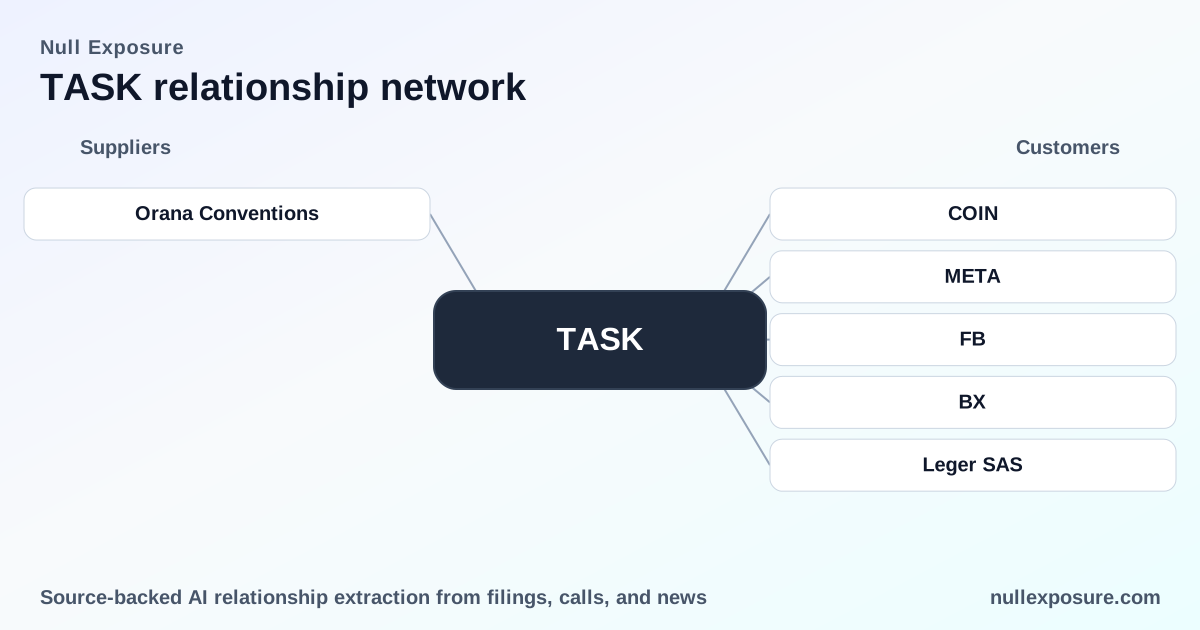
TaskUs customer map: what investors need to know about TASK’s client relationships
Thesis: TaskUs is a service-led outsourcer that monetizes by selling short-term, enterprise-grade customer support, trust & safety and AI services to large digital platforms and technology companies; revenue comes from multi-channel contracts and global delivery, while margins and cash flow are sensitive to client concentration and service mix.
If you want a concise, investor-ready dossier on TaskUs customer risk and opportunity, visit https://nullexposure.com/ for the full analytics suite.
Market-facing model and where the dollars come from TaskUs operates as a third-party service provider: it sells labor and platform-enabled services (Digital CX, Trust & Safety, and AI Services) to enterprise customers and invoices on contract terms. Revenue is driven by seat-based and per-service arrangements delivered from a global footprint with significant capacity in APAC (notably the Philippines) and the United States. The company’s public financials show meaningful scale—over $1.18 billion revenue TTM—and a mix of high-growth service lines offset by material client concentration, which amplifies both upside in large wins and downside when a large customer reduces spend.
How TaskUs contracts and how that shapes risk TaskUs’s client contracts are typically one- to three-year agreements with automatic renewal provisions, creating a contracting posture that is operationally flexible for buyers and creates recurring revenue but limited long-term lock-in. The company targets enterprise-class clients and continues to expand that cohort, yet public disclosures also show the top ten customers account for a large share of revenue and the single largest client has contributed a mid‑teens to low‑twenties percent share of service revenue in recent years—a structural concentration risk that affects valuation multiple and cash-flow sensitivity. Global delivery capability—APAC plus North America—reduces pure single-market dependence but keeps the business exposed to cross-border labor and regulatory dynamics.
Client roster and headline relationships investors should track Below I cover every client relationship cited in the public record set available to us. For each, I provide a short plain-English summary with the original source cited in narrative form.
Meta / Facebook TaskUs historically derived significant revenue and volumes from Facebook (Meta), and multiple investor alerts and analyst notes flagged strained dynamics between TaskUs and its largest social-media customer, with potential margin and cash-flow pressure. According to investor alerts published via GlobeNewswire and related market notices in 2024–2026, independent research firms and shareholder notices have highlighted tension and the risk of contract repricing or lower volumes from Meta. (GlobeNewswire, various investor alerts, 2024–2026)
Coinbase / COIN TaskUs provided customer support personnel to Coinbase beginning in 2017, which the company received in SEC filings and press coverage as a cost-saving outsourcing arrangement; following a customer data breach, class-action litigation targeted TaskUs as a third-party provider and Coinbase subsequently ended the relationship and publicly offered a reward for information. Fortune reported in May 2025 that TaskUs provided customer service staff to Coinbase since 2017, and later reports (Infosecurity Magazine, Yahoo Finance, Blockworks, 2026) documented litigation and Coinbase’s decision to terminate the arrangement after the breach. (Fortune, May 29, 2025; Infosecurity Magazine; Yahoo Finance; Blockworks, 2026)
Leger SAS TaskUs appeared in litigation threads connected to a 2020 breach involving Ledger (Leger SAS), which contracted third-party vendors to process customer personal information; legal analyses cite TaskUs as one of the vendors tied to remediation and litigation. The National Law Review documented the Ledger wallet breach and noted TaskUs among third-party processors engaged by affected vendors. (National Law Review, litigation summary, referenced 2026)
Blackstone / BX (transactional context) Public shareholder notices and solicitation materials referenced a proposed sale of TaskUs to an affiliate associated with Blackstone and a buyer group including TaskUs founders; these notices have generated investor scrutiny and investigations by shareholder-advice firms. A GlobeNewswire shareholder notice from May 2025 described the transaction context involving a Blackstone affiliate and the TaskUs buyer group. (GlobeNewswire shareholder notice, May 30, 2025)
How these relationships translate into operational constraints
- Contracting posture: TaskUs’s one- to three-year contracts with automatic renewal create recurring revenue but limited long-term lock-in, which requires continuous sales and price negotiations and increases cyclicality in margins when large clients shift volumes.
- Client type and concentration: The company explicitly targets enterprise-class customers; this opens higher ARPU opportunities but also concentrates risk—Top-ten client shares and a single largest client contributing ~20% of service revenue represent a material dependency on a small set of buyers.
- Geographic delivery model: TaskUs runs a global delivery network with heavy APAC presence—Philippines revenue lines are highlighted in company disclosures—while the majority of revenue is from U.S.-based customers, creating a cross-border operational profile that benefits scale but exposes TaskUs to labor, regulatory and geopolitical tail risks.
- Service mix and criticality: The business sells Digital CX, Trust & Safety and AI services; these services are mission-critical for platform and fintech customers, which supports high switching costs for some engagements but does not eliminate the risk of termination for convenience in short-term contracts.
- Relationship maturity: TaskUs lists roughly 200 active clients across established and emerging sectors, indicating a diversified roster in count but concentrated in economic impact; the relationship stage is active and growing in AI services, suggesting an ongoing shift in revenue mix.
Risk and valuation implications for investors and operators
- Concentration risk is the principal valuation lever. With a materially large single client and a high top‑ten share, a reduction in volumes or a contract repricing from one large buyer compresses margins rapidly given TaskUs’s cost structure.
- Operational execution and compliance matter more than ever. Security incidents involving third-party vendors (Coinbase litigation; Ledger breach references) convert into legal exposure and client attrition risk—an outcome already reflected in public terminations and lawsuits.
- Growth vectors exist in AI services and the secular trend toward outsourcing digital moderation and customer experience; however, growth must translate into diversified revenue to reset the company’s risk premium.
Middle-of-article action: for a deeper, quantitative breakdown of TaskUs’s client concentration trends and scenario stress-testing, see our analytics at https://nullexposure.com/.
Bottom line TaskUs is a profitable, services-led operator with clear monetization through enterprise outsourcing and strategic exposure to AI and trust & safety demand. The investment case is a trade-off between outsized client concentration risk and scalable, high-demand service lines. Monitoring litigation outcomes, client terminations (notably with Coinbase), and any contract developments with major buyers such as Meta will materially influence TaskUs’s near-term cash flow and valuation multiple.
If you need a tailored risk memo or modeled scenarios for TaskUs’s revenue sensitivity to top-client churn, contact our research team via the homepage at https://nullexposure.com/.
Key takeaway: TaskUs’s global delivery and enterprise focus provide scale and growth optionality, but concentration and third-party security exposures are the decisive risks for investors and operators evaluating TASK customer relationships.