TAT Technologies: OEM agreements that convert engineering into recurring aftermarket cash
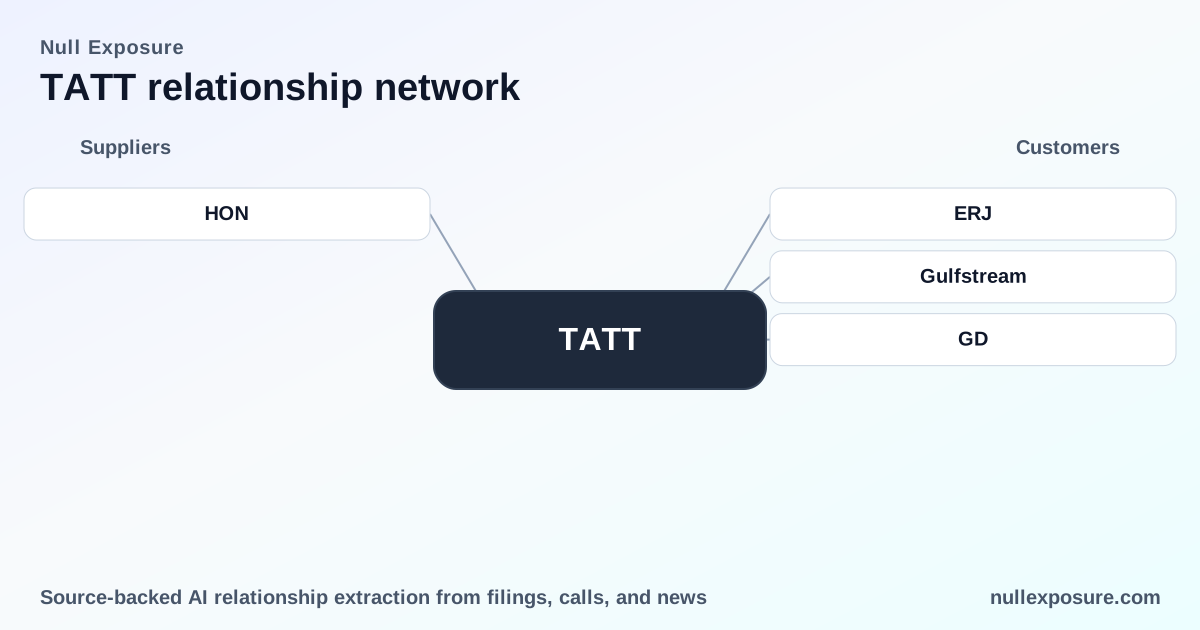
TAT Technologies supplies thermal management, repair and modification services to commercial and military aerospace customers and monetizes through long-term OEM agreements, aftermarket parts and service contracts, and certification-driven recurring work. For investors, the company’s value hinges on the durability of strategic partnerships with aircraft manufacturers — contracts that shift TATT from one-off engineering revenue to predictable aftermarket streams and higher lifetime margins. Explore more detail and source evidence at https://nullexposure.com/.
Why customer relationships matter for TATT’s valuation
TAT’s commercial model is driven by two structural realities: intensive technical certification cycles and aftermarket durability. When an OEM signs a strategic agreement with TAT for a specific aircraft model, that contract often leads to long-tail service, parts sales, and recurring MRO work as fleets are operated and maintained. This converts engineering know‑how into repeatable revenue. Investors should treat OEM agreements as high-quality revenue anchors that increase revenue visibility, but also concentrate counterparty exposure and tie results to aircraft production and retrofit cycles.
Company-level signals from the available relationship data emphasize a contracting posture that is strategic and program-specific, not transactional. There are no explicit relationship-level constraints disclosed in the examined sources — that absence itself is a signal: current reporting shows partnership announcements without identified legal, supply, or exclusivity constraints. Given TAT’s client mix and contract style, expect moderate concentration risk, high criticality of its technical services to selected aircraft platforms, and mature sales execution reflected in OEM acceptance and certification activity.
Confirmed mentions: Embraer (E170 / E175) — multiple citations
According to an InsiderMonkey post on March 10, 2026, TAT already has two strategic agreements in place with Embraer covering the E170 and E175; the write-up highlights those deals as evidence of TAT’s market positioning in regional jets. Source: InsiderMonkey, March 10, 2026 — https://www.insidermonkey.com/blog/jim-cramer-on-tat-technologies-tatt-i-think-that-that-is-exactly-where-to-be-1692617/?amp=1.
The same InsiderMonkey item is also indexed under the ticker shorthand ERJ in the collection of mentions; the piece repeats that Engagements with Embraer on the E170 / E175 constitute strategic agreements that create aftermarket potential. Source: InsiderMonkey (indexed as ERJ), March 10, 2026 — https://www.insidermonkey.com/blog/jim-cramer-on-tat-technologies-tatt-i-think-that-that-is-exactly-where-to-be-1692617/?amp=1.
Finviz carried the same March 10, 2026 news summary noting two strategic agreements with Embraer on the E170 and E175, reinforcing media coverage of OEM-level deals and signaling investor interest around the same programs. Source: Finviz news aggregate, March 10, 2026 — https://finviz.com/news/305677/jim-cramer-on-tat-technologies-tatt-i-think-that-that-is-exactly-where-to-be.
That Finviz item is also recorded under the ERJ shorthand in the dataset, again restating that Embraer agreements target the E170 and E175 platforms and contribute to TAT’s program pipeline. Source: Finviz (indexed as ERJ), March 10, 2026 — https://finviz.com/news/305677/jim-cramer-on-tat-technologies-tatt-i-think-that-that-is-exactly-where-to-be.
Confirmed mentions: Gulfstream (G400 / G500) — multiple citations
Finviz reported on March 10, 2026 that TAT maintains a strategic agreement with Gulfstream to support G400 and G500 business jets, positioning the company in the high-end business-jet aftermarket where margins and service revenue per airframe are elevated. Source: Finviz news aggregate, March 10, 2026 — https://finviz.com/news/305677/jim-cramer-on-tat-technologies-tatt-i-think-that-that-is-exactly-where-to-be.
InsiderMonkey’s March 10, 2026 coverage likewise lists Gulfstream among the strategic partners, referencing agreements on the G400 and G500 platforms and underscoring the dual focus on both regional/commercial and business-jet segments. Source: InsiderMonkey, March 10, 2026 — https://www.insidermonkey.com/blog/jim-cramer-on-tat-technologies-tatt-i-think-that-that-is-exactly-where-to-be-1692617/?amp=1.
What the relationship map means for revenue durability and risk
- Revenue durability: Strategic agreements with Embraer and Gulfstream convert engineering projects into aftermarket service streams and parts sales, increasing predictability across TAT’s revenue base. OEM program support often extends for years and includes recurring certification and retrofit activity that feeds MRO revenue.
- Concentration risk: The disclosed relationships are program-specific (E170/E175, G400/G500) and therefore introduce concentration by platform. TAT’s financial performance will correlate with the operational health, production cadence and retrofit cycles of those specific aircraft lines.
- Contracting posture: The evidence signals strategic, program-level agreements rather than one-off sales, suggesting negotiated terms, certification work and recurring service commitments rather than spot transactions.
- Strategic criticality: Supplying thermal and modification solutions to OEMs denotes high technical criticality; OEM acceptance increases switching costs for customers and strengthens TAT’s pricing leverage on aftermarket parts and services.
- Maturity: Multiple independent media reports (InsiderMonkey and Finviz, March 10, 2026) reference the same program agreements, indicating mature market recognition and corroboration across outlets.
Key takeaways for investors
- TAT converts engineering IP into recurring aftermarket cash through strategic OEM agreements on named platforms (E170/E175, G400/G500).
- Counterparty relationships are concentrated by platform, creating both upside in revenue visibility and downside tied to production or fleet cycles.
- No explicit constraints were disclosed in the reviewed relationship references, which leaves operational risks to be evaluated through direct filings and contract language rather than media summaries.
If you want a deeper, contract-level review of TAT’s customer exposures and how they interact with supply-chain and certification risk, see our platform coverage at https://nullexposure.com/.
This article synthesizes the public media references captured on March 10, 2026 and focuses on customer relationships and their implications for revenue, risk and valuation.