The Bancorp (TBBK) — the fintech bank behind the rails and what its customers tell investors
The Bancorp is a financial holding company that monetizes banking services for fintech and branded partners by acting as the bank sponsor, card issuer and deposit custodian while capturing fee income, interchange and deposit funding. Its economics combine low-cost, small-balance deposit float from partner-run accounts, fee revenue from payments and card programs, and incremental lending income from specialty and fintech consumer loans. For investors evaluating customer risk, the most important facts are concentration in fintech partners, a mix of long- and short-duration arrangements, and clear evidence that several partner relationships are material to revenue and balance sheet growth. Learn more about the dataset behind these customer mappings at https://nullexposure.com/.
How to read TBBK’s operating model in plain English
The company’s business model is service‑provider centric: The Bancorp supplies regulated banking infrastructure to brands and fintechs that focus on front-end UX and distribution. Key operating characteristics are:
- Revenue mix driven by fintech deposits and interchange — the fintech segment generates the majority of deposits and non‑interest income.
- Contracting posture is mixed — filings show both multi‑year, affinity-based relationships and short‑term, demand-style credit products; the bank manages one portfolio with both long-term stability and short-term, call-able exposures.
- Counterparty footprint spans individuals to small businesses — product lines include SBLOCs to individuals, SBA-style small business lending, and mid-market specialty loans.
- Geography is national US-focused, with operations and partner accounts deployed across the United States.
- Materiality and concentration are real — certain loan categories aggregate into multi‑billion dollar balances and the loss of major clients would materially affect revenue.
These signals make The Bancorp a strategic infrastructure play for brand-led fintechs while exposing the bank to partner concentration and product-mix volatility as fintech programs ramp.
Who TBBK serves — a relationship-by-relationship map
Below are the customer relationships surfaced in available reporting. Each entry gives a concise plain‑English take and a direct source reference.
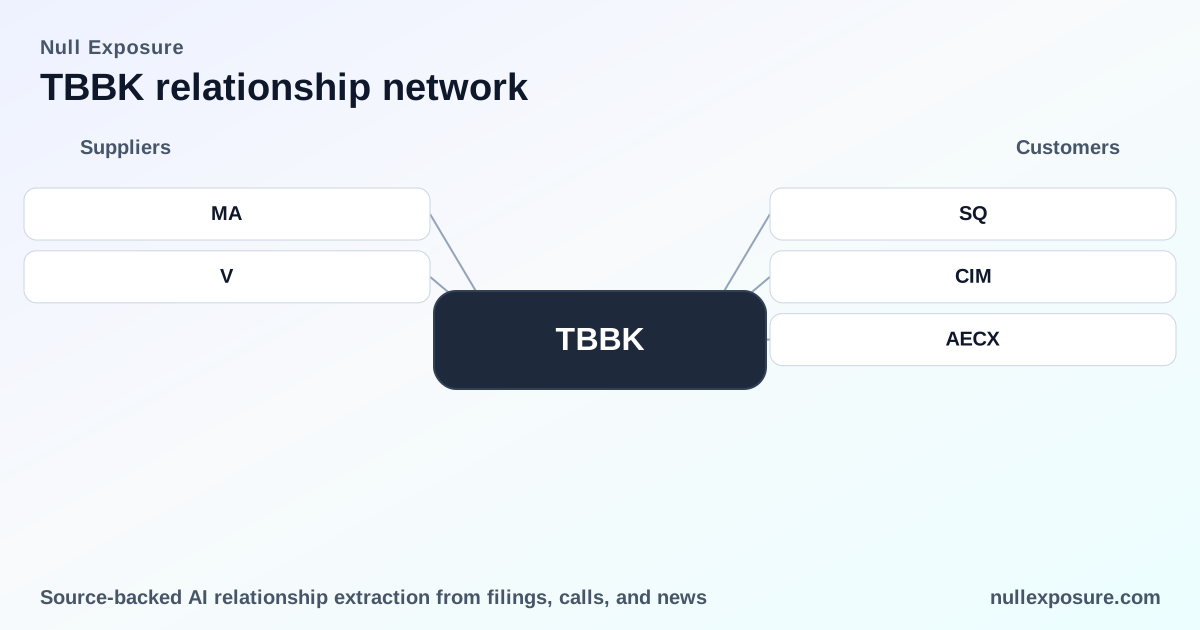
SQ (Square) — strategic fintech card and lending partner
The Bancorp referenced Square’s Cash App as the largest new program on the company’s roadmap, expected to drive meaningful growth in both gross dollar volume (GDV) and fee revenue in 2026 and beyond. This linkage positions The Bancorp as a payments and issuance partner for one of the largest consumer fintech wallets. Source: InsiderMonkey transcript of The Bancorp’s Q4 2025 earnings call (published Mar 10, 2026).
Cash App — program-level growth engine
Executives stated that Cash App is a primary program and that new product implementations tied to Cash App are on track, including lending products discussed on the Q1 2026 call; management listed Cash App alongside Chime as a core program. Source: InsiderMonkey transcript of The Bancorp’s Q1 2026 earnings call (published May 4, 2026).
CHYM (Chime Financial, ticker CHYM) — bank sponsor for a major neo‑bank
Multiple press items and analyst notes confirm that Chime’s consumer banking services are provided through The Bancorp Bank and Stride Bank, placing The Bancorp squarely in the operational stack for Chime’s deposits and card issuance. Source: MarketBeat analyst alert (Oct 14, 2025) and SahmCapital research (Jan–Feb 2026).
Chime (CIM) — deep, multi‑product relationship
Management has described the Chime relationship as deep and multi-year, covering card issuance, new product launches and lending programs; the company highlighted strong visibility on Chime’s pipeline during earnings calls. Source: InsiderMonkey transcript of The Bancorp’s Q4 2025 and Q1 2026 earnings calls (Mar–May 2026).
CIM (ticker CIM) — earnings commentary referencing Chime
Earnings-call excerpts referenced CIM as a key partner and noted that the on‑ramp of new partners will determine future growth, underscoring that Chime-related flows are a measurable revenue driver for the bank. Source: InsiderMonkey coverage of the Q4 2025 earnings call (Mar 10, 2026).
ZEPP (Zepp Pay / Amazfit US) — marketplace/embedded payments relationship
A technology press report listed The Bancorp Bank, N.A. as the financial institution associated with Zepp Pay in the U.S., indicating a role as the issuing or settlement bank for an embedded‑payments feature. This is an example of TBBK’s placement inside device and wearable payments ecosystems. Source: Gadgets & Wearables article on Zepp Pay (Dec 2025).
Current (AECX) — back‑end banking and card issuing sponsorship (historic)
A 2021 report confirmed that The Bancorp Bank began providing back‑end banking services and card issuing sponsorship for Current, demonstrating the bank’s recurring role as infrastructure provider for challenger banks. Source: TheFR coverage of Current’s partnership announcement (Aug 5, 2021).
What the relationship map implies for investors
The customer list and management commentary establish a clear pattern: The Bancorp operates as the bank‑of‑record for large consumer fintechs and branded accounts. That positioning creates durable deposit franchises and fee streams but concentrates commercial exposure in a relatively narrow partner set.
Key investment implications:
- Concentration risk is material. Filings show loan categories in the billions and management acknowledges materially impactful clients; the fintech segment supplies the majority of deposits and non‑interest income.
- Contract mix blends stability and optionality. The company holds multi‑year affinity partnerships that anchor deposits while simultaneously underwriting short-term consumer fintech loans and demand-style SBLOCs that can be volatile.
- Growth is product- and partner-dependent. Management’s timeline references (Cash App, Chime and new lending programs) show that near‑term upside is tied to partner program launches and on‑ramp velocity.
- U.S. focus reduces geographic diversification. The Bancorp’s operations and partner accounts are national in scope, concentrating regulatory and deposit risk inside U.S. markets.
- Funding model benefits from insured retail balances. Management notes millions of small transaction-based balances, the bulk FDIC-insured, which supports low-cost funding and creates a defensible deposit base.
Risks, catalysts and a short checklist for diligencing TBBK
- Watch partner onboarding and GDV trends (Cash App and Chime implementations). Positive GDV conversion will amplify fee revenue; slow on‑ramp will compress growth.
- Monitor loan portfolio composition and the size of specialty lending buckets (REBL, SBLOC/IBLOC) since these are reported in the billions and drive credit sensitivity.
- Track regulatory and capital metrics tied to single‑counterparty lending limits and unused credit commitments; these determine the bank’s ability to scale specific partner programs.
For a concise, investor-ready feed of customer relationship signals and primary-source links, visit https://nullexposure.com/ and explore the TBBK customer mapping.