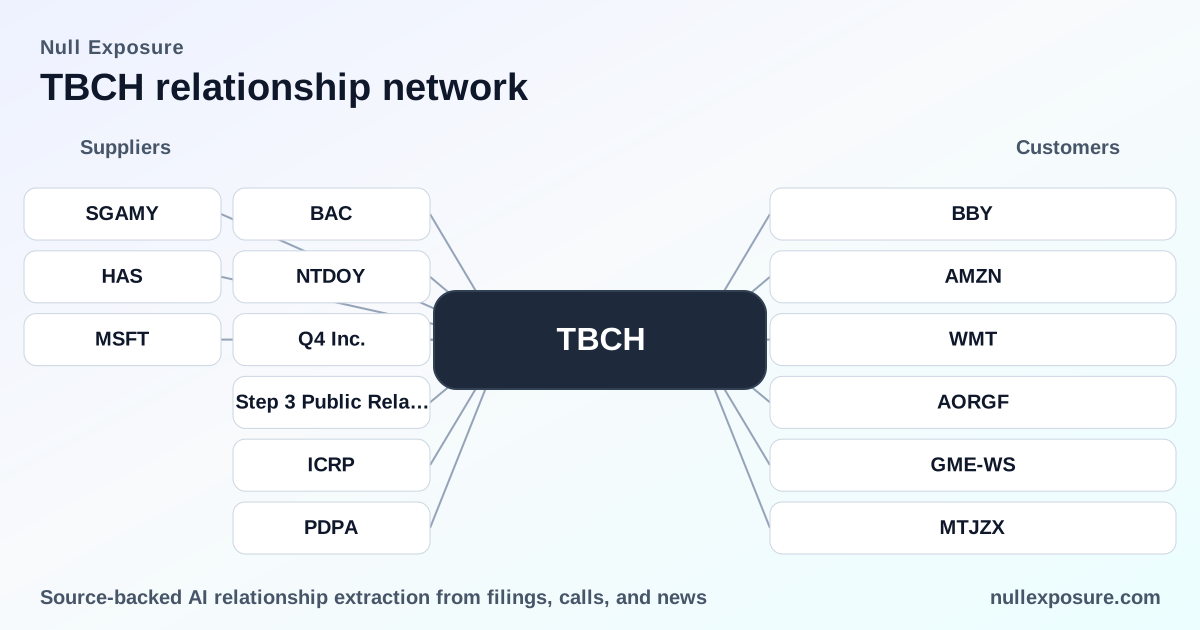
Turtle Beach (TBCH) — Customer Footprint and Counterparty Risk
Turtle Beach sells gaming headsets, mice, keyboards and related accessories through a dual channel model: direct-to-consumer at turtlebeach.com and wholesale distribution to large retailers and distributors worldwide. The company monetizes primarily by selling hardware at scale to a concentrated set of large retail customers, supplemented by cooperative marketing reimbursements that reduce net revenue. This customer-first revenue profile drives both operating leverage and concentrated counterparty exposure — the central investor thesis for evaluating TBCH customer relationships. For full coverage and comparable counterparty analytics visit https://nullexposure.com/.
How Turtle Beach’s selling model shapes counterparty risk
Turtle Beach operates with a transactional, retail-focused contracting posture: the company sells hardware into retail and wholesale channels and records cooperative advertising as reductions of net revenue. The 2024 filing and contemporaneous corporate communications deliver several clear operating signals:
- Contracts are short-term and purchase-order driven; Turtle Beach does not maintain long-term binding purchase commitments with major buyers.
- Revenue is concentrated: the five largest customers accounted for approximately 69% of gross sales in 2024, signaling material customer concentration and single-buyer sensitivity.
- Counterparties are large enterprise retailers and distributors, not small specialty partners, which concentrates negotiating power with a handful of buyers.
- Global distribution with North America dominance: the company reports North America as the largest customer geography, with material EMEA and smaller APAC sales.
- Cooperative advertising is meaningful: Turtle Beach recorded approximately $9.4 million in cooperative advertising reimbursements in 2024, which reduces reported net revenue and represents a recurring working-capital and margin dynamic.
These are company-level constraints and strategic characteristics, not attributes limited to any single buyer. For a deeper dataset of counterparties and contract signals, visit https://nullexposure.com/ (overview and comparative tools).
Customer relationships — what the record shows
The source set includes both the 2024 Form 10‑K and a 2025 product launch press release; the items below cover each relationship listed in those results with a concise plain-English summary and source note.
Best Buy — retail launch partner (press release, 2025)
Turtle Beach announced the Vulcan II TKL keyboard pre-order was available exclusively at turtlebeach.com and Best Buy in North America, signaling an active retail distribution and product launch partnership for FY2025. This is direct confirmation of Best Buy as a go-to-market retail channel for new PC peripherals. (Turtle Beach press release, 2025)
BBY — listed among largest customers (10‑K, FY2024)
Best Buy (BBY) is also cited in Turtle Beach’s 2024 Form 10‑K as one of the Company’s largest customers, each of the top three—Amazon, Walmart, Best Buy—accounting for between 10% and 25% of consolidated gross sales in 2024. This confirms Best Buy’s materiality to Turtle Beach’s gross sales. (TBCH Form 10‑K, FY2024)
Amazon — top-three wholesale buyer (10‑K, FY2024)
Amazon is identified in the 2024 10‑K as one of the company’s three largest customers, contributing between 10% and 25% of consolidated gross sales in 2024, making it a core wholesale and online retail channel for Turtle Beach hardware. (TBCH Form 10‑K, FY2024)
AMZN — duplicate record for Amazon (10‑K, FY2024)
The dataset includes a second entry labeled AMZN tied to the same 2024 disclosure that Amazon ranks among the three largest customers (10–25% of consolidated gross sales). This reinforces Amazon’s status as a material, enterprise-scale counterparty in FY2024. (TBCH Form 10‑K, FY2024)
Walmart — top-three retail customer (10‑K, FY2024)
Walmart is likewise disclosed as one of the three largest customers, with 10–25% of consolidated gross sales in 2024, underscoring reliance on big-box retail distribution. (TBCH Form 10‑K, FY2024)
Argos — named retail distributor in global footprint (10‑K, FY2024)
Argos is listed among the thousands of storefronts that distribute Turtle Beach gaming accessories globally, indicating the company’s penetration into UK retail channels and franchise-style distribution partners. (TBCH Form 10‑K, FY2024)
AORGF — duplicate record for Argos (10‑K, FY2024)
A second record labels Argos under the ticker AORGF and repeats the 10‑K mention that Turtle Beach products are sold through major retailers including Argos, confirming the retailer’s inclusion in the company’s global retail list. (TBCH Form 10‑K, FY2024)
GameStop — retail channel presence (10‑K, FY2024)
GameStop is named alongside other major storefronts, marking Turtle Beach’s continued distribution through specialty gaming retailers and channel partners focused on consoles and accessories. (TBCH Form 10‑K, FY2024)
Target — mass-market retail placement (10‑K, FY2024)
Target appears in the 10‑K as part of the broad retail network carrying Turtle Beach products, signaling exposure to mass-market department-store inventory cycles and promotional calendars. (TBCH Form 10‑K, FY2024)
What these relationships mean for investors
The combined evidence defines a wholesale-first revenue model: Turtle Beach sells hardware to large retailers and distributors that account for a highly concentrated share of gross sales, while preserving flexibility through short-term, purchase-order style agreements. Key investor implications:
- Concentration risk is high. The top five buyers represented ~69% of gross sales in 2024, creating meaningful exposure to buyer-specific volume and promotional strategies. (TBCH Form 10‑K, FY2024)
- Contracting posture reduces predictability. The company’s lack of long-term purchase commitments with significant customers limits revenue visibility and increases sensitivity to retailer assortment decisions and inventory resets.
- Marketing reimbursements are non-trivial. Roughly $9.4M in cooperative advertising in 2024 is recorded as a reduction in net revenue, which affects gross-to-net dynamics and effective margins. (TBCH Form 10‑K, FY2024)
- Geographic footprint is global but North America dominant. Reported revenue allocation highlights North America as the principal market with meaningful EMEA sales and smaller APAC contribution—this shapes FX, logistics, and retailer concentration risk. (TBCH Form 10‑K, FY2024)
Bottom line and recommendation
Turtle Beach demonstrates strong retail channel penetration with material relationships among large enterprise buyers, but its dependence on a handful of major retailers and short-term purchase order contracts creates concentrated counterparty risk and earnings sensitivity to retail demand and promotional cadence. Investors looking to assess downside exposure should model scenarios that stress top-customer volumes and cooperative advertising normalization against the company’s reported TTM revenue of $319.9M and operating margin profile. (Company financials, latest reported)
For actionable counterparty intelligence and to benchmark TBCH against peers, explore the full coverage at https://nullexposure.com/.