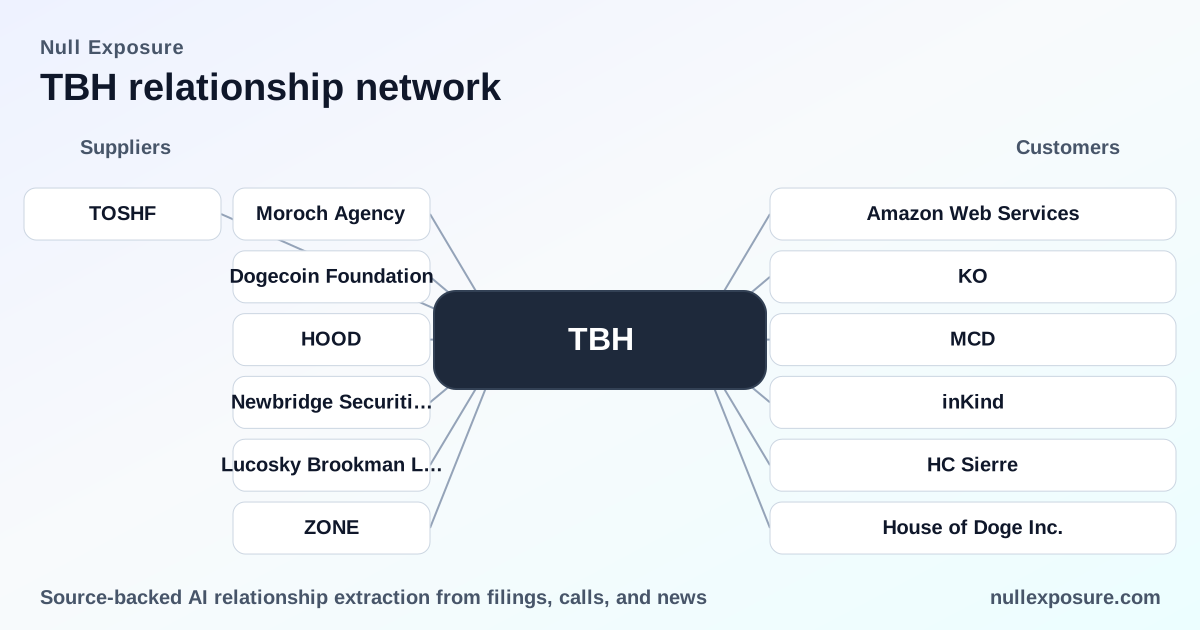
TBH (Brag House Holdings): customer map and what it means for investors
Brag House Holdings operates a Gen‑Z‑focused electronic gaming and esports platform that monetizes primarily through B2B channels — tournament fees, tertiary sponsorship fees, and advertising/marketing services sold to corporate sponsors. The company is executing a strategic combination with House of Doge to layer crypto payments and digital‑ownership infrastructure on top of its fan engagement assets; investors should treat TBH as an early‑stage, sponsorship‑driven media play where revenue is concentrated in B2B sponsorship executions rather than consumer subscription economics. For a quick gateway to the underlying signal set, see NullExposure’s coverage: https://nullexposure.com/
How to read the customer map: commercial posture and constraints
Brag House’s commercial model is sponsorship and activation first. The company reports that its current revenue has been generated through B2B tournament and tertiary fees, which implies a contracting posture centered on short-to-medium term marketing agreements rather than long-term platform lock‑ins. This leads to three practical operating signals for investors:
- Concentration of revenue on corporate sponsors. The visible relationships skew toward large brand partners and entertainment/crypto partners rather than a broad base of small payers, which increases revenue volatility tied to a handful of deals.
- Criticality is marketing/activation focused. These relationships are valuable for sponsors seeking Gen‑Z reach, but they are not infrastructure dependencies that would stop product operation if a partner leaves.
- Early maturity and execution risk. The company’s filings and press materials position current B2B revenue as the foundation for scale rather than an established recurring revenue engine — an indication that execution on sponsor renewals and expansion is the primary near‑term value driver.
Company‑level signal: TBH’s relationship stage is flagged as active with evidence that all current revenue has been generated through B2B tournament and tertiary fees (excerpt from FY filings). This is a direct indicator that sponsor deals are the current commercial lifeblood rather than diversified consumer receipts.
Relationship-by-relationship readout
Below are concise, transaction‑oriented summaries for every relationship captured in the record set, along with the source to validate the mention.
Amazon Web Services (from FY2024 10‑K)
TBH lists an Amazon Web Services Customer Agreement in its FY2024 10‑K, demonstrating that the company uses AWS as part of its cloud infrastructure for platform operations. According to TBH’s FY2024 10‑K filing, the AWS agreement is an explicit supplier/customer arrangement supporting the platform’s backend services.
Coca‑Cola (StockTwits article, Mar 10, 2026)
A media interview described TBH as having secured partnerships with Fortune‑500 brands including Coca‑Cola as part of its Gen‑Z engagement play; this positions Coca‑Cola as a marketing sponsor rather than a technology partner. The StockTwits article (published Mar 10, 2026) highlights Coca‑Cola in the company’s reported sponsor roster.
MCD / McDonald’s (StockTwits article, Mar 10, 2026)
The same March 2026 interview lists McDonald’s among Fortune‑500 sponsors, indicating TBH’s ability to attract mainstream quick‑service brands for tournament and promotional activations. The StockTwits piece references McDonald’s as a strategic sponsor in the firm’s marketing playbook.
McDonald’s (GlobeNewswire release, Nov 3, 2025)
A GlobeNewswire release reiterates that TBH has been securing Fortune‑500 partners like McDonald’s as part of a broader payments, asset management, and RWA strategy tied to the House of Doge merger. The November 3, 2025 press release lists McDonald’s in that sponsor cohort.
Coca‑Cola (GlobeNewswire release, Nov 3, 2025)
The GlobeNewswire release of Nov 3, 2025 also repeats Coca‑Cola among the Fortune‑500 partners that TBH cites in its strategic narrative, reinforcing prior press mentions of the relationship.
TDOG / 21Shares Dogecoin ETF (Bitget report, Mar 10, 2026)
A press piece covering TBH’s NASDAQ bell ceremony notes collaboration with House of Doge and 21Shares on launching the 21Shares Dogecoin ETF (TDOG), aligning TBH with crypto financial products through its merger partner. Bitget’s coverage (Mar 10, 2026) frames TBH and House of Doge as participants in the ETF launch festivities and promotional activity.
inKind (press release on strategic partnership, Mar 10, 2026)
House of Doge — identified as Brag House’s merger partner — entered a letter of intent with inKind to make Dogecoin accepted across inKind’s restaurant network, a partnership that ties TBH’s merged entity to payment acceptance trials at hospitality merchants. A press release reported Mar 10, 2026 describes this LOI and inKind’s 3+ million app users.
HC Sierre (GlobeNewswire release, Oct 22, 2025)
House of Doge and merger partner Brag House made a strategic investment to become a principal sponsor and the second‑largest owner of HC Sierre, a Swiss professional hockey club, signaling a sports‑sponsorship activation strategy in Europe. The October 22, 2025 GlobeNewswire release documents this sports investment.
Learfield (Investing.com article, May 4, 2026)
Investing.com reports that Brag House has partnerships with Learfield and university athletics programs, signaling campus and collegiate sports channels as distribution and sponsorship conduits. The May 4, 2026 article describes those partnerships in the context of the merger approval vote.
House of Doge Inc. (MarketScreener, Oct 2025)
A MarketScreener report notes that House of Doge Inc. entered into a definitive agreement to acquire Brag House, and earlier received funding tied to the Brag House relationship — establishing House of Doge as the strategic merger partner and operational anchor for crypto infrastructure initiatives. The MarketScreener coverage captures the October 2025 transaction narrative.
Coca‑Cola (duplicate GlobeNewswire ref for Nov 3, 2025)
A second GlobeNewswire entry reiterates Coca‑Cola in TBH’s partner list, cataloging the same Fortune‑500 sponsor claim within the company’s strategic press releases dated Nov 3, 2025.
Learfield (GlobeNewswire, Apr 8, 2026)
A GlobeNewswire release dated Apr 8, 2026 describes shareholder approval of the merger and again cites Learfield and university athletics partnerships as distribution channels for the combined entity’s sports‑fandom strategy.
What investors should take away
- Revenue construct: TBH’s current revenue base is B2B sponsor fees and tournament tertiary fees, so near‑term performance depends on closing and renewing marketing partnerships and scaling activations into collegiate and sports channels. This is an activation‑economics model, not a subscription recurring‑revenue model.
- Concentration risk: The press coverage and filings show a small set of high‑profile sponsors; sponsor concentration creates upside in successful renewals and material downside if key programs do not re‑book.
- Strategic pivot: The House of Doge merger introduces a crypto payments and sponsorship monetization layer that could expand use cases (payments, NFTs, ETF promotional tie‑ins) but also increases regulatory and execution complexity.
- Operating dependencies: The AWS listing in the 10‑K is a straightforward infrastructure dependency; commercial criticality lies with sponsor relationships rather than a single technology vendor.
For investors tracking partner validation and ongoing deal flow, NullExposure provides signal aggregation and timeline context — visit https://nullexposure.com/ for the coverage platform.
Final verdict: TBH is a sponsorship‑led, early‑stage media and payments roll‑up where execution on sponsor monetization and successful integration with House of Doge’s crypto infrastructure will determine whether headline partnerships translate into scalable revenue.