TrueBlue (TBI) — Customer Relationships and What They Signal for Investors
TrueBlue operates and monetizes as a specialized workforce solutions firm: it places contingent and permanent workers through multiple brands (PeopleReady, PeopleManagement, PeopleScout), charges staffing and RPO/MSP fees, and scales revenue with placement volume and on-site program management. Revenue is volume driven and geographically concentrated in North America, with a portfolio that includes both short-notice contingent work and multi-year managed programs that generate higher-margin recurring fees. For investors, the core thesis is simple: TrueBlue’s cash flow and valuation are tied to demand for contingent labor, client concentration among large accounts, and the company’s ability to convert scale into margin across its services. For more corporate relationship intelligence, visit https://nullexposure.com/.
Executive snapshot: how customers drive the business
TrueBlue reported roughly $1.616 billion in trailing revenue, a modest negative operating posture (TTM operating margin -3.4%), and a market capitalization around $181 million as of the latest quarter. The business mixes high-frequency, low-duration placements (PeopleReady general labor) with managed, higher-value services (PeopleManagement on-site staffing and PeopleScout RPO/MSP). This structure produces lumpy working-capital and margin dynamics: revenue scales quickly with demand spikes, but profitability remains sensitive to pricing, utilization and client mix.
- Concentration is meaningful: the top ten clients represented 22.4% of revenue in FY2024, and one client alone accounted for 11.4% of PeopleManagement segment revenue in FY2024.
- Geography is concentrated in North America, with the U.S. representing the vast majority of sales; PeopleScout has a broader footprint but is still U.S.-weighted.
- Contracting posture is mixed: the firm runs predominantly short-term contingency relationships alongside multi-year, scalable contracts.
These signals define both upside and vulnerability: TrueBlue scales rapidly when end-market labor demand is strong, but client loss or pricing pressure at a few large accounts will have an outsized impact on results.
The customer relationships disclosed in public reporting
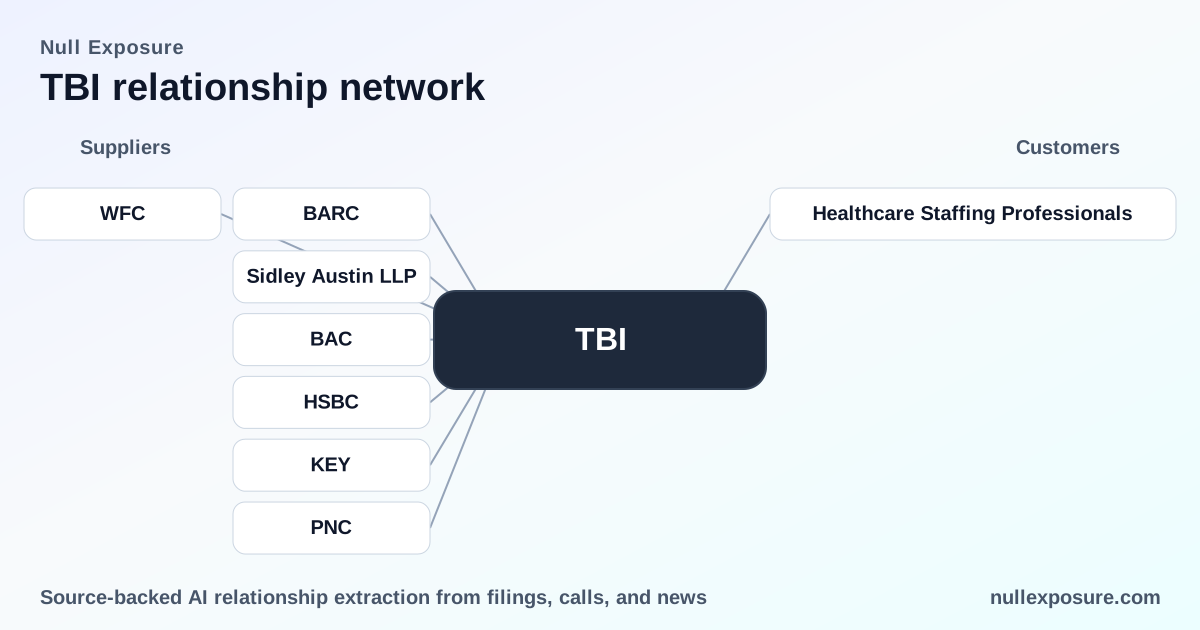
TrueBlue’s customer relationship reporting is sparse but informative. The searchable relationship set returned a single named customer reference:
Healthcare Staffing Professionals
Healthcare Staffing Professionals delivered approximately $14 million in revenue versus guidance of about $15 million in the third quarter of fiscal 2025, with gross profit on the order of $90 million vs. ~$93 million guidance cited in external commentary. This was highlighted in a PR Newswire release dated March 10, 2026, discussing TrueBlue’s fourth-quarter performance and shortfall. The disclosure is transactional: it signals a material client contribution to near-term revenue expectations and a small revenue variance relative to company guidance. (Source: PR Newswire, March 10, 2026.)
What the relationship list tells investors (and what it does not)
The single explicit relationship mention is notable for its focus on quarter-level revenue variance rather than long-term contractual description. That emphasis underscores TrueBlue’s operating reality: revenue outcomes are driven by near-term placement volumes and utilization, not always by locked-in long-term billing streams. The PR Newswire note shows TrueBlue’s results are discussed at the client-level when material to quarterly guidance, reinforcing the company’s dependence on a small number of sizeable customer engagements.
Operating-model constraints and business model signals
Below are company-level signals drawn from TrueBlue’s public disclosures that explain how the customer base shapes operations and risk.
- Contracting posture — predominantly short-term, with strategic multiyear programs. Company filings state that the majority of contracts are short-term, often cancellable on short notice, because the business fills contingent staffing needs; however, the firm also reports multi-year, scalable client contracts (PeopleManagement and PeopleScout) that provide steadier revenue streams. This hybrid contracting mix produces a business that is flexible but exposed to cyclical demand swings.
- Client concentration is material. TrueBlue’s ten largest clients made up 22.4% of revenue in FY2024, and a single client contributed 11.4% to the PeopleManagement segment that year. Loss or pricing pressure at a major account generates immediate revenue and margin headwinds.
- Customer criticality and service role are two-way. TrueBlue acts as a service provider supplying labor, while also functioning as a buyer of workforce capacity on behalf of customers through managed programs — a dual role that increases integration with client operations and heightens switching costs in managed programs.
- Geography is concentrated in North America, with global pockets of scale. The U.S. accounts for the vast majority of revenue (over 90% in reported regional splits), while PeopleScout extends TrueBlue’s reach to Canada, the U.K., and Australia. North American macro labor trends therefore dominate earnings risk and opportunity.
- Segment mix is service-centric. The business is fundamentally services-based, spanning contingent staffing, on-site program management, driver services and RPO/MSP. Services revenue scales with placement volume and program scale; margins improve when the company captures managed, recurring work versus transactional placements.
- Maturity signals: mixed. The existence of multiyear managed contracts alongside contingent placements suggests portions of the business are mature and recurring, but the high proportion of short-term placements indicates ongoing sensitivity to economic cycles.
Investment implications: risks, levers, and monitoring priorities
TrueBlue’s customer profile creates a clear set of investment levers and risks:
- Levers: Win or expand multi-year PeopleManagement and PeopleScout programs to lift recurring revenue and stabilize margins; increase penetration in managed services where pricing and stickiness are higher.
- Risks: Client concentration, short-notice contracts, and North America labor cycles. A single large client swing can move margins materially, and short-term contracts reduce revenue visibility.
- Monitoring priorities for investors: Track top-client revenue percentages each quarter, gross-profit per segment (PeopleReady vs. PeopleManagement vs. PeopleScout), and booking or retention metrics for managed programs. Watch macro indicators of staffing demand in industrial, healthcare and logistics sectors.
Bottom line and next steps
TrueBlue is a volume-driven staffing operator with a mixed contracting profile that generates scale but concentrates client and geographic risk. The company’s financials—$1.616 billion in revenue with negative operating margins and notable client concentration—frame it as a cyclical services play where the path to margin improvement runs through managed program growth and client diversification.
For investors seeking a deeper read into contractual dynamics and customer-level exposure, NullExposure curates relationship intelligence and constraint analysis to surface material counterparties and concentration trends; learn more at https://nullexposure.com/.
Bold takeaway: TrueBlue’s upside depends on converting transactional placements into sticky, managed programs while mitigating the outsized impact of a handful of large clients on near-term earnings.