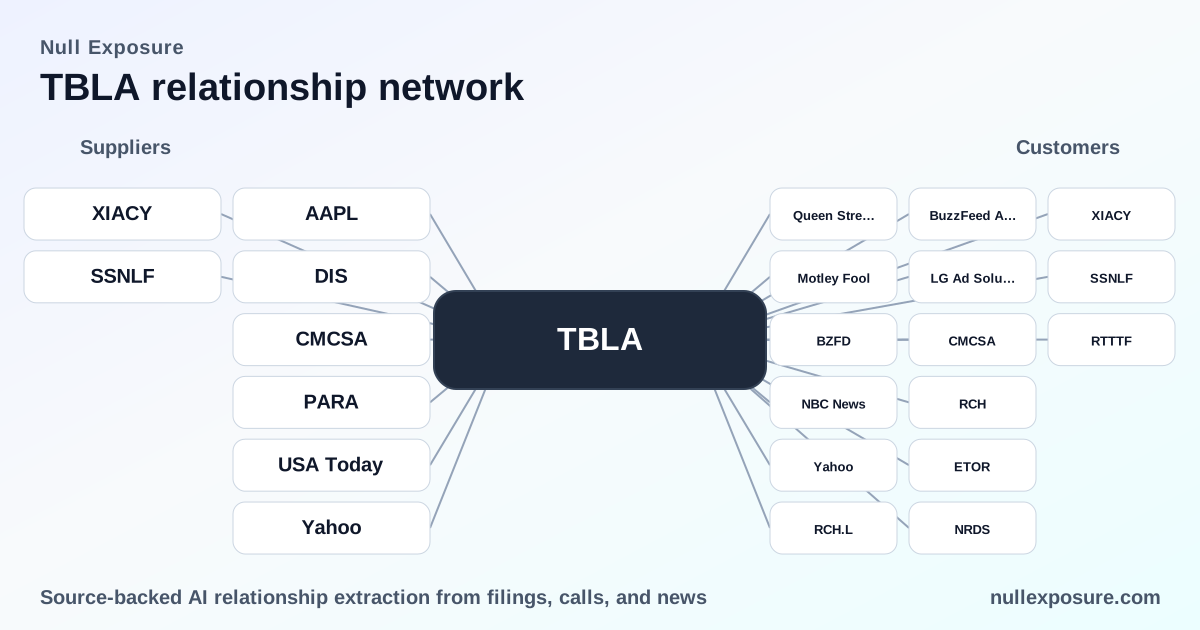
Taboola (TBLA) — Customer Map and Commercial Implications for Investors
Taboola is an ad-tech platform that sells personalized content discovery and AI-driven advertising solutions to publishers, device OEMs and advertisers. It monetizes by charging advertisers for clicks, impressions and conversions and by sharing revenue with publisher partners; recent product launches—Realize (agentic AI for advertisers) and DeeperDive (a generative AI answer engine for publishers)—drive higher-value demand and deeper integration across the open web. For investors, the business is a scale play: the platform converts publisher attention and OEM distribution into predictable advertiser spend while margin expansion depends on product-led adoption and partner concentration.
If you want a concise, sourced snapshot of Taboola’s customer relationships and what they mean for revenue and risk, this report compiles every relationship cited in public materials and explains implications for contracting posture, concentration and criticality. For a broader signal set and comparable company tracking, visit https://nullexposure.com/.
Why customers matter now: product-led monetization and integration risk
Taboola’s recent go-to-market centers on two interoperable revenue engines: advertiser-facing Realize—which automates campaign outcomes—and publisher-facing DeeperDive—which keeps users on site and monetizes queries. Both products increase Taboola’s ability to extract higher spend per client, but they also raise integration requirements: full value requires installing Taboola Pixel and server-to-server tracking, which is a multi-month technical onboarding for publishers and advertisers. Product adoption therefore drives higher lifetime value but increases switching costs for customers and the company’s exposure to a handful of large deals.
The company reports a global footprint of scaled advertisers and meaningful revenue concentration: Taboola disclosed roughly 2,100 scaled advertisers worldwide and cited Yahoo as representing ~13% of revenue for 2024, a material concentration signal that has implications for contract negotiation leverage and revenue stability.
(If you’d like an enterprise-grade feed of these relationship signals, see https://nullexposure.com/.)
Taboola’s customers — who is using what, and where it matters
Below is a complete, sourced list of every customer relationship mentioned in the public results set and a short plain-English description of the engagement.
-
NerdWallet / NRDS — Taboola highlighted NerdWallet as a personal-finance advertiser that adopted Realize and new predictive audience formats in the Q4 2025 earnings discussion. (Taboola Q4 2025 earnings call, Mar 2026)
-
Motley Fool — Named alongside NerdWallet as a personal-finance advertiser leveraging Realize for format diversification and predictive audiences. (Taboola Q4 2025 earnings call, Mar 2026)
-
Queen Street — Cited with Motley Fool and NerdWallet as an advertiser in personal finance that adopted Realize. (Taboola Q4 2025 earnings call, Mar 2026)
-
BuzzFeed Asia / BZFD — BuzzFeed Asia selected Taboola’s DeeperDive generative AI answer engine for deployments in Singapore, Malaysia and the Philippines to boost engagement and onsite monetization. (Yahoo Finance / Taboola press release coverage, Nov 2025–Mar 2026)
-
USA TODAY Co. / TDAY / Gannett (GCI) — USA TODAY is listed among publishers integrating DeeperDive on site, signaling distribution on a major US news network. (USA TODAY report / GlobeNewswire press release, Jun 2025 / Apr 2026)
-
NBC News / CMCSA — NBC News is cited as a publisher using Taboola’s technology and Realize demand; placement on NBC properties is strategically valuable for advertiser reach. (Taboola press releases and media reports, Apr 2026)
-
Yahoo — Yahoo is a major commercial partner: Taboola reported exclusive Yahoo native advertiser buying arrangements and disclosed Yahoo-produced revenue and traffic acquisition cost figures—Yahoo represented approximately 13% of Taboola revenue for 2024. (Taboola filings and press updates, FY2024 disclosures; Taboola blog, 2025–2026)
-
Reach / RCH.L / RCH / RTTTF — Reach (UK publisher group) selected DeeperDive, reflecting UK market traction for Taboola’s AI answer engine. (Finviz and press coverage, Mar 2026)
-
HuffPost UK — Integrated DeeperDive to provide conversational, contextual responses on its site; another European publisher win for the product. (Taboola press release / Finviz coverage, Apr 2026)
-
Ouest‑France — Named among European publishers joining DeeperDive as Taboola expands language support. (GlobeNewswire press release, Apr 2026)
-
El Nacional — Latin‑language publisher listed in DeeperDive expansion, indicating multi‑lingual deployment plans. (GlobeNewswire press release, Apr 2026)
-
Ynet — Israeli publisher included in the DeeperDive roll‑out and language expansion commentary. (GlobeNewswire press release, Apr 2026)
-
India Today — India Today is included in Taboola’s announced DeeperDive publisher list, marking presence in South Asia. (Taboola press materials, Apr 2026)
-
LG Ad Solutions — LG Ad Solutions partnered with Taboola to power “Performance Enhancer,” a cross‑channel CTV/digital solution that uses Taboola inventory and Realize capabilities to link TV campaigns to measurable digital outcomes. (Simply Wall St and Taboola marketing, Mar 2026)
-
Samsung — Taboola lists Samsung among OEM partners using Taboola technology (via Taboola News or device-level placements), signaling feed distribution on hardware and additional ad touchpoints. (Taboola press releases and investor PR, Apr 2026)
-
Xiaomi — Also named as an OEM partner, reinforcing Taboola’s device distribution strategy in Asia. (Taboola press releases and partner announcements, 2026)
-
Strand Marketing — Cited as an advertiser expressing early positive results from Realize, demonstrating agency-level endorsement of the platform’s campaign optimization. (Taboola press release / GlobeNewswire, Apr 2026)
-
Great Vision HK — Identified in Q&A coverage as a contract the company discussed publicly; analyst commentary noted uncertainty about replacement. (Earnings Q&A coverage summarized by Intellectia, 2026)
-
eToro / ETOR — eToro was referenced in Taboola marketing materials showing a 29% CVR lift when using Taboola’s GenAI Motion Ads, illustrating measurable advertiser performance gains. (Taboola marketing hub case study, 2026)
-
Realize — Although a Taboola product rather than a third‑party customer, Realize functions as a buyer‑facing platform and is central to multiple advertiser wins cited across earnings and press materials. (Taboola product announcements and marketing, 2026)
-
Additional ticker mentions (SSNLF, XIACY, 0L2T.LON, GCI, CMCSA, etc.) — These entries are symbolic references accompanying publisher and OEM mentions (for example, SSNLF for Samsung or XIACY for Xiaomi), confirming that Taboola’s customer set spans broadcasters, global publishers and device manufacturers. (Multiple Taboola press releases and third‑party news items, Mar–Apr 2026)
What the customer map implies for investors
-
Concentration risk is real: Taboola explicitly named Yahoo as a material revenue source (~13% of 2024 revenue), and disclosed significant traffic acquisition costs tied to that relationship; that is a measurable concentration and bargaining leverage risk for the company. (Taboola FY2024 disclosure)
-
Contracting posture favors platform lock‑in: DeeperDive and Realize require data integrations (Taboola Pixel + server‑to‑server tracking) to reach full effectiveness; this raises customer switching costs and makes onboarding cadence a gating factor for revenue growth. (Taboola marketing hub, 2026)
-
Revenue mix is product‑led and global: Evidence of enterprise OEM deals (Samsung, Xiaomi), major publishers (USA TODAY, NBC, Reach) and scaled advertisers (NerdWallet, eToro) underlines a global, multi‑channel monetization strategy that can expand ARPU but depends on successful rollout across languages and devices. (Taboola press releases and earnings, 2025–2026)
-
Maturity and spend profile: Taboola defines a “Scaled Advertiser” as >$100k trailing four‑quarter spend and reported an average revenue per scaled advertiser near $199k in Q4 2024—this positions the company in the mid‑market to enterprise range for advertiser monetization. (Taboola investor materials, Q4 2024)
Bottom line
Taboola is executing a product-driven platform strategy that increases monetization per customer while concentrating exposure to a handful of large publisher and OEM relationships—most notably Yahoo. For investors, growth upside is credible through Realize and DeeperDive adoption across publishers, agencies and device OEMs; downside is concentrated counterparty risk and the pace of technically intensive onboarding.
For continuing coverage of commercial relationships and to track similar signals across other ad‑tech platforms, explore the research toolkit at https://nullexposure.com/.