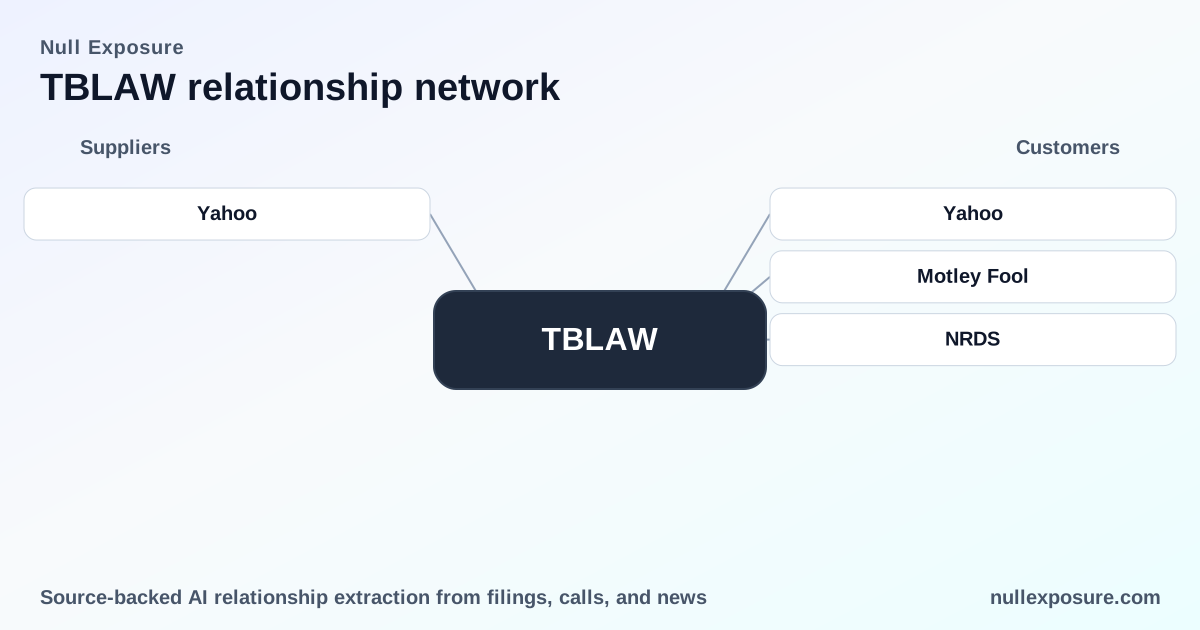
Taboola (TBLAW) — Customer Map and Commercial Dynamics
Taboola operates a content-discovery and native advertising platform that connects advertisers with digital publishers and consumers. The company monetizes by selling ad placements to advertisers on a cost-per-click, cost-per-mille, or cost-per-action basis and sharing revenue with publishers, with many clients buying through short, campaign-specific insertion orders rather than long-term contracts. For investors evaluating customer risk and revenue durability, the mix of usage-based billing, short-term contracting, global reach, and a handful of meaningful customers defines both the upside of scale and the primary downside of concentration. Learn more at https://nullexposure.com/.
Executive summary: what investors should take away
Taboola’s revenue engine is fundamentally transactional and performance-linked: advertisers pay when users click, view, or convert. That creates high operational leverage when campaigns scale, but limited revenue visibility because many advertisers operate on campaign insertion orders that can be canceled with 24 hours’ notice. The customer list disclosed in company filings and calls shows a blend of major platform relationships and direct-brand advertisers adopting new product capabilities — evidence of both distribution breadth and advertiser reliance.
How the commercial model shapes investor risk
Taboola’s public disclosures and excerpts expose several structural characteristics that drive investor judgment:
- Contracting posture — short-term, campaign-driven: The company explicitly states many advertiser relationships are governed by insertion orders for individual campaigns and that advertisers can terminate campaigns with 24 hours’ notice. This makes revenue inherently variable and dependent on ongoing campaign performance and sales execution.
- Revenue mechanics — usage-based, performance pricing: Taboola recognizes revenue on CPC, CPM, and CPA bases, which ties cash flow directly to user engagement and conversion rates rather than fixed recurring fees. This improves scalability but reduces predictability.
- Geographic scope — global exposure with concentration in developed markets: Taboola reports nearly 600 million daily active users globally and receivables concentrated in the U.S., Israel, Germany and the U.K., signaling both reach and regional revenue concentration.
- Customer role and lifecycle — buyer-driven, with an ‘always-on’ cohort: Advertisers are the paying customers; many are described as “always-on,” suggesting a class of long-duration buyers that provide more stable spend alongside shorter, campaign-only advertisers.
These points combine into a company-level signal: Taboola delivers scalable, usage-tied revenue growth but has material customer concentration and limited contractual lock-in. See the detailed relationship notes below for how these dynamics show up in Taboola’s disclosed partners. If you want a broader intelligence snapshot, visit https://nullexposure.com/.
Customer relationships investors should know
Yahoo — a material revenue contributor in FY2024
Taboola disclosed in its FY2024 Form 10‑K that it recorded revenues from Yahoo of $233,640, which the filing states represented approximately 13% of the company’s total revenue for the year ended December 31, 2024. That level of concentration into a single named counterparty is meaningful for revenue risk and negotiating leverage. (Source: Taboola 2024 Form 10‑K)
Motley Fool — advertiser adopting Taboola’s Realize product
In the company’s 2025 Q4 earnings call, Taboola management listed Motley Fool as one of several advertisers that adopted the “Realize” product, leveraging capabilities such as predictive audiences and format diversification to broaden campaign effectiveness. This indicates ongoing product-led adoption among brand advertisers. (Source: 2025 Q4 earnings call transcript)
NerdWallet / NRDS — advertiser penetration of newer capabilities
NerdWallet (ticker NRDS) was also cited on the 2025 Q4 earnings call among advertisers adopting Realize and using new features like predictive audiences and format diversification, signaling that financial-services publishers and comparison sites are engaging Taboola’s advanced targeting and format tools. The company specifically referenced NerdWallet by name in the earnings call discussion of advertiser adoption. (Source: 2025 Q4 earnings call transcript)
What those relationships mean for revenue quality and concentration
- Single-customer concentration is real and measurable. The Yahoo disclosure showing approximately 13% of 2024 revenue from one counterparty creates a clear concentration locus that investors must monitor for renewal, pricing, and payment risk.
- Advertiser adoption of product enhancements supports monetization upside. Mentions of Motley Fool and NerdWallet adopting Realize indicate product-driven expansion among higher-value advertisers, which can lift yield per impression or click if adoption converts into incremental spend.
- But short-term insertion orders blunt visibility. Even when large advertisers adopt new products, the company’s short-term insertion order model and 24‑hour termination window limit contractual protection and long-term revenue certainty.
Strategic implications for operators and investors
- Banks and treasurers should model revenue volatility explicitly. Given the usage-based, campaign-billed nature of Taboola’s revenue, stress scenarios should assume rapid campaign repricing and periodic client churn.
- Commercial teams should prioritize converting ‘always-on’ advertisers to multi-campaign commitments. The more customers can be shifted from one-off insertion orders to continuous, multi-campaign buys, the more predictable the top line becomes.
- Risk management must monitor large counterparties for concentration and collection risk. The disclosed Yahoo concentration in 2024 elevates the need for credit and payment monitoring of marquee partners.
Final evaluation and monitoring checklist
- Track renewal/contract changes for the Yahoo relationship and any disclosures about concentration in subsequent filings.
- Monitor product adoption metrics and case studies tied to Realize to assess whether adoption by Motley Fool, NerdWallet, and peers translates to sustainable higher yield.
- Watch Taboola’s disclosure of receivable geography and aging, because the company’s global footprint introduces currency and collection complexity even while diversifying counterparty risk.
Bold conclusions: Taboola’s monetization model scales well with usage and product adoption, but revenue predictability is constrained by short-term insertion orders and meaningful customer concentration. For an up-to-date intelligence suite on Taboola’s customer and partner footprint, see https://nullexposure.com/.