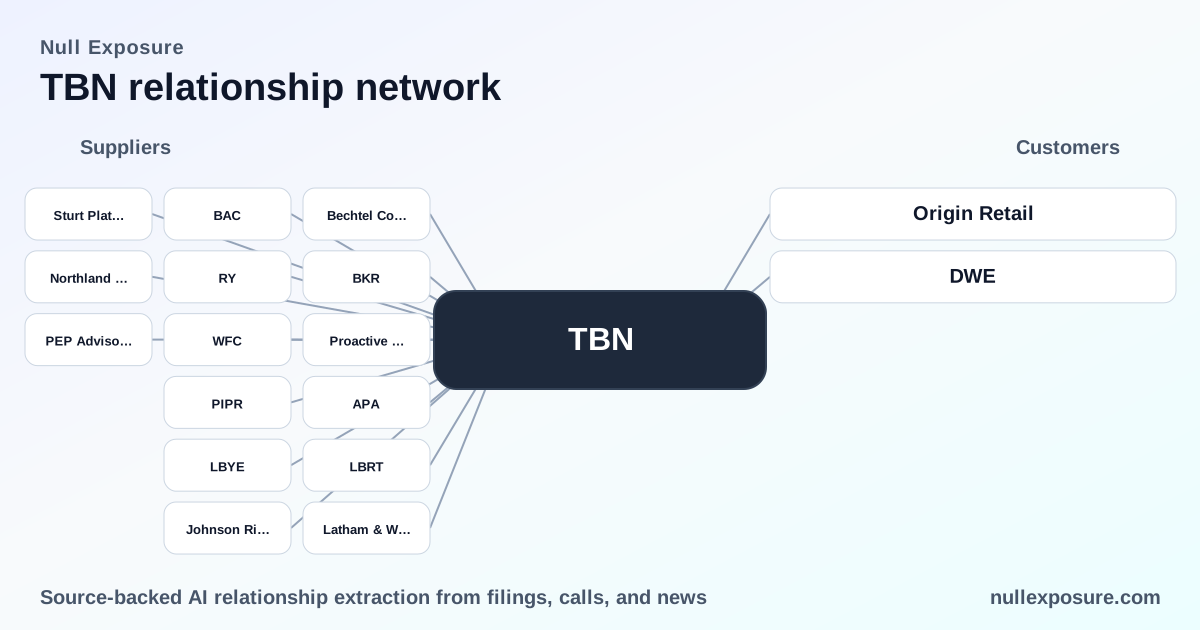
Tamboran Resources (TBN): The customer map that underwrites first‑gas economics
Tamboran Resources operates as an upstream explorer and project developer focused on unconventional gas in Australia’s Beetaloo Basin, monetizing through long‑term gas sales, acreage dispositions, and joint‑venture arrangements that convert exploration value into contracted revenue streams ahead of first gas. Its commercial model leans on multi‑year take‑or‑pay contracts and strategic partner capital to de‑risk development while retaining upside on retained acreage and equity in operating vehicles. For a concise view of Tamboran’s commercial counterparties and what they imply about project finance and market access, see the NullExposure research hub: https://nullexposure.com/.
How Tamboran turns acreage into contracted cashflows
Tamboran’s operating playbook bundles three revenue levers: (1) sell future gas under long‑dated contracts that provide predictable cashflow timing for financing, (2) divest non‑core acreage to raise near‑term capital, and (3) form JV and financing arrangements to dilute development risk while keeping a material operator position. This combination produces a mix of stable contracted cash expectations and episodic sale proceeds from acreage disposals.
The customer and partner ledger — relationship by relationship
Below I cover every customer and partner relationship disclosed in the available records. Each entry is a plain‑English summary with a concise source reference.
Origin Retail
Tamboran (through the TB1 Operator) agreed to supply Origin Retail under a gas sale agreement that can deliver up to 5.97 Mmboe per annum (2.99 Mmboe net to Tamboran), with the supply start window between 1 January 2025 and 31 December 2028 and an initial term of 10 years from the start date unless extended. This is a cornerstone long‑term commercial commitment that anchors project offtake volumes. According to Tamboran’s FY2025 Form 10‑K (tbn‑2025‑06‑30).
Northern Territory government
Tamboran has contracted fully contracted, CPI‑linked take‑or‑pay sales to the Northern Territory government extending to mid‑2041, securing a stable domestic anchor offtake and delivering a significant portion of early production under government purchase terms. A Proactive Investors report covering FY2026 referenced these NTG agreements and their role in Tamboran’s financing strategy (Proactive Investors, FY2026).
Daly Waters Energy, LP
Daly Waters Energy appears as a joint‑venture participant and counterparty in agreements concerning ownership, management and financing of the Beetaloo JV, reflecting the pooled capital and governance arrangements that underpin further drilling and development. An Investing.com item (May 2026) described agreements signed with Daly Waters Energy, LP and other JV parties related to JV ownership and financing (Investing.com, FY2026).
DWE (acreage purchaser)
Tamboran executed a US$15 million acreage sale to DWE announced in May 2025, representing active monetization of non‑operating acreage to strengthen the balance sheet ahead of first gas. This sale is an example of Tamboran extracting near‑term liquidity by disposing of selected acreage positions (Proactive Investors, FY2025).
Elliott Energy / Elliott Energy I Pty Ltd
Tamboran renegotiated terms of an earlier asset sale with Elliott Energy such that Elliott acquires interests within a new P2DA for a total consideration of US$15 million; in another disclosure Elliott Energy I Pty Ltd is identified as taking a non‑operating, non‑controlling interest across roughly 100,000 acres of Tamboran’s 77.5% position for US$15 million. These are structured acreage transfers that reduce Tamboran’s near‑term funding burden while keeping JV partner alignment on development. Reporting on these revisions appeared in media coverage in May 2026 (Aktiencheck and Investing.com, FY2026).
What the constraints tell investors about Tamboran’s commercial posture
The documented constraints in Tamboran’s customer landscape form a coherent commercial signal:
-
Long‑term contracting posture: Multiple excerpts show Tamboran pursuing decade‑long supply commitments (for example, the Origin GSA carries a 10‑year term from the start date and the NTG supply agreement runs to mid‑2041). These contracts are designed to support project financing by creating predictable revenue ramps and bankable cashflows. (Company filing evidence in FY2025 and contractual excerpts.)
-
Government counterparty criticality: The Northern Territory government is a meaningful counterparty under CPI‑linked take‑or‑pay terms, which raises the strategic importance of the project for local energy security and provides high counterparty credit for early volumes. (NTG supply terms cited in FY2026 reporting.)
-
Large‑enterprise optionality: Tamboran has memoranda of understanding with subsidiaries of bp and Shell for potential long‑term purchases (4.4 MTPA referenced in filings), signaling access to global buyers even if those MOUs are not binding; treat this as a company‑level signal of potential high‑quality offtakers rather than a firm commitment. (Company disclosures referenced in constraints.)
-
Seller and JV posture: Tamboran is both an operator selling gas and a party selling acreage or non‑operating interests to finance development, reflected in multiple acreage transactions and JV reallocations during FY2025–FY2026. These moves reduce near‑term cash burn and align third‑party capital with execution risk.
Taken together, these signals show a company that trades equity and asset positions to build a portfolio of long‑dated, take‑or‑pay offtakes and government‑backed contracts, enabling financing of first‑gas development while sharing execution risk with partners.
Investment implications and risks investors should weigh
- Positive: Long‑dated offtakes and NT government purchase commitments materially enhance project bankability and reduce merchant exposure on early volumes; acreage sales and JV formations provide non‑dilutive liquidity and partner capital to advance drilling and infrastructure spend.
- Negative: The company is still pre‑first‑gas with negative EBITDA and no current revenue, so execution risk and timing remain primary drivers of valuation; contractual start windows (e.g., Origin GSA start between 2025–2028) compress dependency on achieving operational milestones on schedule.
- Counterparty concentration: Heavy reliance on a handful of large counterparties and government contracts concentrates counterparty risk, though those counterparties provide credit strength compared with purely merchant buyers.
Bottom line — what this customer map means for capital allocators
Tamboran has deliberately replaced some exploration upside with contracted, long‑dated offtake and strategic acreage monetizations, creating a hybrid risk profile attractive to investors seeking development‑stage energy exposures backed by offtake and partner capital. The commercial architecture is clear: anchor the project with government and long‑term buyers, sell non‑core acreage to fund activity, and use JV partners to share capital intensity.
For a structured view of these counterparties and additional relationship signals, visit the NullExposure research platform: https://nullexposure.com/.
Key takeaways: long‑term, take‑or‑pay orientation; government anchoring; active acreage monetization; and JV financing to de‑risk first gas.