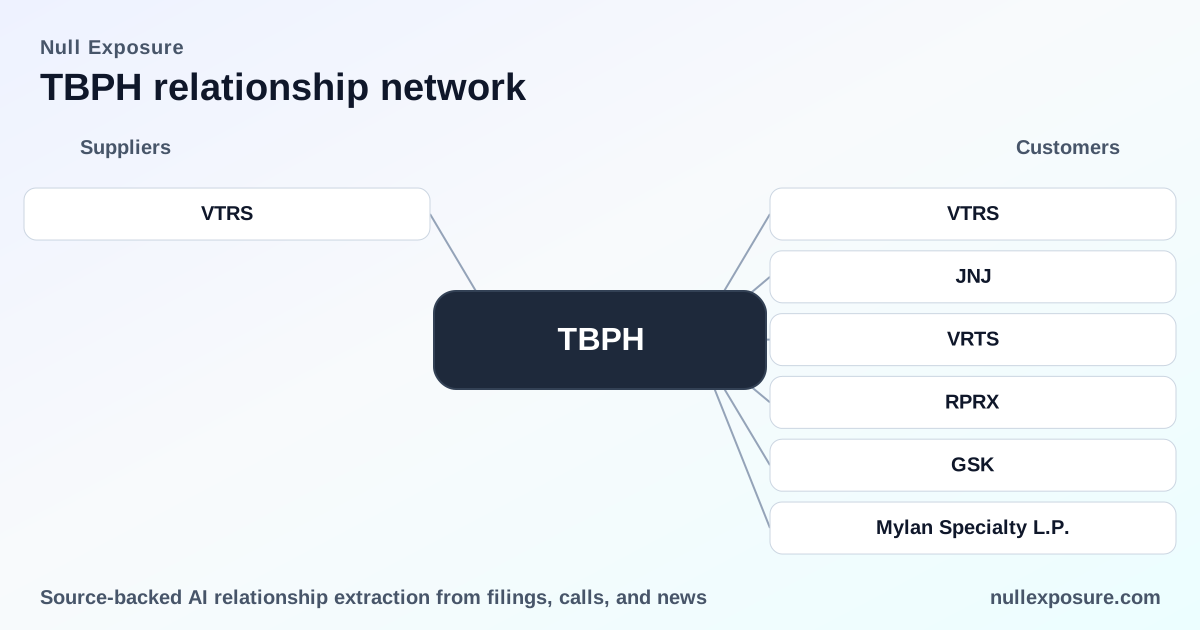
Theravance Biopharma (TBPH): Customer Relationships and Revenue Drivers
Theravance Biopharma operates as a specialty biopharma firm that monetizes intellectual property through commercial partnerships, royalty and milestone monetizations, and profit‑share co‑promotion agreements rather than relying on a broad direct sales force. Its near‑term cash flow is dominated by partnership receipts (profit‑share on a marketed COPD product and discrete milestone payments), while its pipeline investments determine longer‑term upside.
If you evaluate counterparty exposure or underwriting risk for TBPH, this relationship map and revenue architecture should be your starting point — for a structured feed of these relationships visit https://nullexposure.com/.
The business model in one paragraph
Theravance’s operating model is partner‑centric: the company discovers and develops organ‑selective therapeutics and outsources commercialization and many late‑stage commercial risks to partners in exchange for a share of profits, milestone payments, and previously retained royalty economics. That structure produces periods of lumpy, partner‑driven receipts (sales milestones and contingent royalty payments) alongside steady collaboration revenue from co‑promotion agreements.
Counterparty map — the counterparts you must track
Viatris Inc. (VTRS / “Viatris”)
Theravance co‑promotes and shares U.S. profits and losses on YUPELRI (revefenacin) under a 65% (Viatris) / 35% (Theravance) split in the U.S., with Theravance also receiving royalties outside the U.S.; the agreement is the company’s primary source of collaboration revenue. This relationship generated profit‑share receipts and a $25 million U.S. sales milestone paid in January 2026, and Viatris led U.S. commercialization with reported full‑year 2025 net sales driving milestone triggers. (Sources: Theravance press release / PR Newswire, Q3 2025 financial results; RTTNews and TradingView coverage, March–May 2026.)
Royalty Pharma (RPRX)
Theravance sold royalty interests in TRELEGY ELLIPTA to Royalty Pharma and received contingent milestone payments, including a $50 million payment in February 2025 which Theravance recorded as the maximum available under that arrangement. The Royalty Pharma monetization materially shifted Theravance’s future royalty profile into near‑term cash. (Sources: Theravance 2024 Form 10‑K (FY2024) and company press releases summarized on PR Newswire / TradingView, FY2024–FY2026.)
GlaxoSmithKline / Glaxo Group Limited (GSK)
Historically, Theravance had an economic interest in payments tied to GSK’s TRELEGY ELLIPTA through earlier collaboration agreements; most of those royalty interests were sold to Royalty Pharma by mid‑2025, but the historical linkage explains prior TRELEGY‑related receipts. (Source: RTTNews feature on Theravance product history and PR Newswire communications citing agreements with Glaxo affiliates, FY2022–FY2026.)
Janssen Pharmaceutical (Johnson & Johnson; JNJ)
Theravance previously partnered with Janssen on izencitinib (a gut‑selective JAK inhibitor); that collaboration ended following disappointing clinical results, and the relationship illustrates pipeline partnership risk where upfront payments are finite and clinical outcomes can terminate the commercial pathway. Theravance received a $100 million upfront in 2018 with further contingent economics that were not realized after termination. (Source: BioSpace reporting on Janssen’s exit from the izencitinib program, reported in 2026 recounting FY2021 program events.)
Mylan Specialty L.P. (a Viatris company)
Mylan Specialty L.P. is referenced as the registered owner of the YUPELRI trademark and is operationally connected to Viatris’ commercialization of revefenacin; this is a trademark/branding relationship that reflects the corporate structure underlying the Viatris collaboration. (Source: Theravance PR Newswire release announcing phase‑4 study results for YUPELRI, FY2024.)
What this relationship set tells you about how Theravance operates
- Revenue concentration: The company’s top line is dominated by collaboration, licensing and milestone receipts rather than broad product royalties or a diversified sales portfolio. That concentration produces high volatility but also the potential for discrete cash inflection points when milestones are hit.
- Contracting posture: Theravance adopts a partnership posture — outsourcing commercialization and retaining selective economic upside (profit‑share, royalties, milestones) instead of bearing full commercialization expense. This reduces operating leverage but increases counterparty dependence.
- Counterparty criticality: A small set of partners (notably Viatris and Royalty Pharma) generate the material receipts; those relationships therefore represent single‑point risks for near‑term cash generation.
- Maturity and optionality: The business shows both legacy monetizations (sale of Trelegy royalties) and active co‑promotion deals, reflecting a hybrid maturity—some programs are mature and monetized, while others are clinical assets with binary outcomes. These are company‑level signals derived from the public record and reported transactions (company filings and press coverage, FY2022–FY2026).
Investment implications and risk checklist
- Cash inflections are partner dependent. Milestone payments (e.g., $25M from Viatris and $50M from Royalty Pharma) materially move the cash profile; track sales trajectories that trigger such payments. (Source: PR Newswire and TradingView summaries, FY2025–FY2026.)
- Profit‑share exposure caps upside and downside. The 35% profit participation in U.S. Yupelri ties Theravance tightly to Viatris’ commercial execution and market competition dynamics. (Source: PR Newswire Q3 2025 release.)
- Pipeline binary events remain consequential. Past program terminations (e.g., the Janssen izencitinib collaboration) underscore clinical risk and the limited protection offered by upfront receipts. (Source: BioSpace, retrospective reporting on the Janssen collaboration.)
- Monetization strategy reduces long‑term royalty stream but raises near‑term liquidity. The sale of TRELEGY royalties to Royalty Pharma traded persistent income for immediate milestone payments, altering long‑term revenue composition. (Source: Theravance 10‑K FY2024 and PR Newswire, FY2025.)
For a consolidated, queryable view of these counterparties and the documents that disclose their economics, see https://nullexposure.com/.
Bottom line
Theravance is a partner‑leveraged biotech whose short‑term valuation and liquidity depend on a handful of contractual receipts and commercialization partnerships rather than diversified product sales. Investors and counterparty risk managers should monitor Viatris U.S. sales of YUPELRI, milestone triggers from royalty monetizations, and clinical readouts that could re‑shape pipeline value — those three dimensions drive both upside and downside for TBPH in the near term.