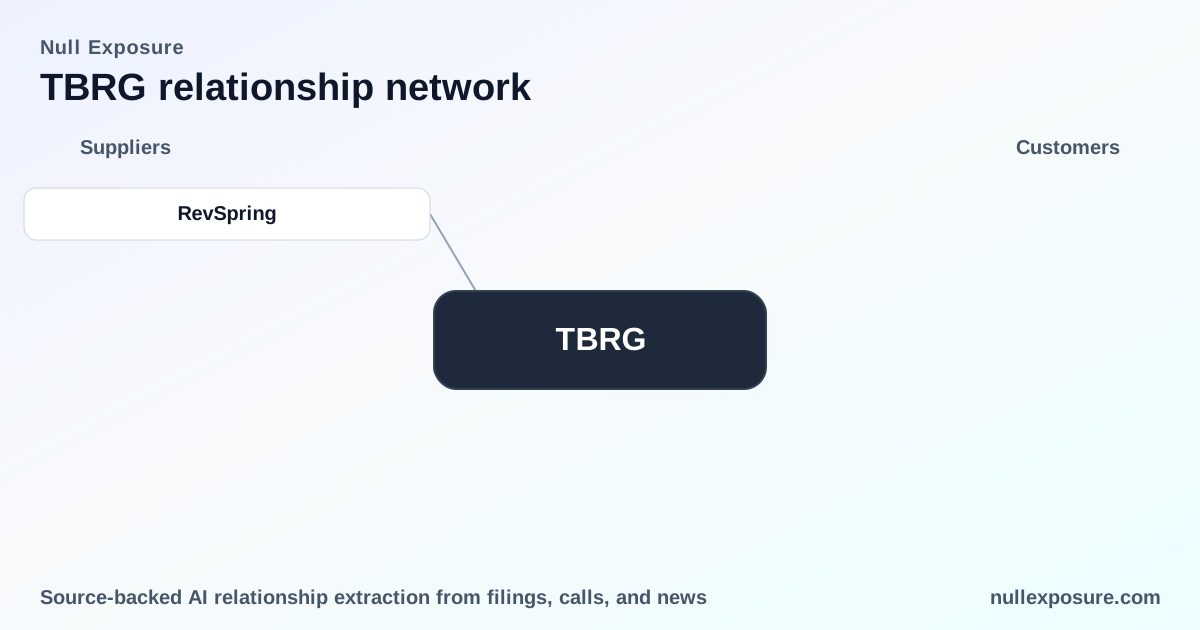
TruBridge (TBRG): Customer relationships drive a recurring, services-heavy EHR franchise
TruBridge operates as a healthcare IT and services company that monetizes through a mix of software licensing (increasingly SaaS subscriptions), professional services, managed IT and RCM services, and long‑term financing for system purchases. Its go‑to‑market targets community and small‑to‑mid sized hospitals where the company bundles EHR software with ongoing services and financing to lock in multi‑year revenue streams and high retention.
For a concise view of customer activity and public relationship disclosures, see https://nullexposure.com/.
Why customer relationships are the economic center of the story
TruBridge’s business model is relationship-driven: the company sells both product (TruBridge EHR) and a spectrum of services (Revenue Cycle Management, consulting, managed IT). That mix produces sticky recurring revenue when customers adopt Cloud EHR and ongoing managed services, while professional services and financing provide near‑term revenue and margin variability. Public filings and disclosure excerpts indicate a deliberate migration from perpetual licenses to a subscription/SaaS posture, and that evolution changes revenue recognition, cash flow timing, and gross/operating margin composition.
- Contracting posture: The company shifted historically from perpetual licenses to a SaaS subscription model; Cloud EHR is explicitly delivered as a monthly subscription. Financing arrangements and short‑term payment plans persist for on‑premise or perpetual deals.
- Concentration and counterparty profile: TruBridge targets community hospitals (mostly small institutions). Approximately 97% of its acute care hospital base comprises hospitals with fewer than 100 beds, implying a large number of relatively low‑value customers rather than a few enterprise accounts.
- Criticality of relationships: High retention—flagship EHR retention around 97.3% in 2024 and overall retention in the mid‑to‑high 90s from 2021–2024—signals that TruBridge’s platform is mission‑critical for its installed base and that churn is limited.
- Maturity and lifecycle: The installed base is mature, with long standing client relationships and multi‑year financing receivables (typical terms two to seven years), reinforcing predictable revenue but creating receivable concentration and credit exposure.
These are company‑level operating characteristics derived from public excerpts and filings.
Publicly disclosed customer relationships (what’s on record)
The following relationships are the universe of customer references returned for TruBridge in the available outreach and press sources. Each entry includes a short plain‑English recap and the source context.
Java Medical Group — expanded partnership for EHR and Financial Health technology
Java Medical Group expanded its partnership with TruBridge to adopt or expand use of TruBridge EHR and associated Financial Health technology and services in FY2026, reinforcing the company’s strategy of cross‑selling software and RCM/managed services to existing community provider customers. This disclosure was reported by SimplyWallSt in May 2026 as part of FY2026 coverage. (Source: SimplyWallSt, reported May 4, 2026.)
Artesia General Hospital — selects Microsoft Dragon Copilot integrated into TruBridge EHR
Artesia General Hospital selected TruBridge’s EHR with an integration of Microsoft Dragon Copilot, evidencing TruBridge’s push to add third‑party AI/voice capabilities into its clinical product suite and to modernize customer deployments; this selection is referenced in FY2025 reporting. The item was reported via MarketScreener in May 2026 describing the FY2025 decision. (Source: MarketScreener coverage of TruBridge news, reported May 4, 2026.)
What these customer disclosures imply for investors and operators
These publicly cited relationships are limited in number but typify TruBridge’s commercial playbook: win smaller community hospitals and clinics, deliver a bundled stack of EHR plus financial and professional services, and incrementally modernize the product with partnerships (for example, with Microsoft) to deepen stickiness. The two disclosed deals underline three structural features:
- Cross‑sell and upsell are core growth levers. Java Medical Group’s expanded partnership underscores that once a baseline EHR contract exists, TruBridge can monetize additional Financial Health and services offerings.
- Product modernization protects retention. Integration of contemporary tools such as speech‑to‑text/AI assistants (Microsoft Dragon Copilot) is a defensive product investment to maintain high retention and reduce attrition risk to competitors.
- Small account scale but high aggregate value. Individual deals are with smaller hospitals, which limits single‑account concentration risk but makes revenue growth reliant on volume, service penetration and financing economics.
Financial and risk considerations tied to the customer model
Investors need to weigh the following, grounded in company disclosures and reported metrics:
- Revenue predictability vs. cash conversion: The shift to subscription/SaaS increases recurring revenue predictability, but it can spread revenue recognition over time, reducing near‑term cash unless financed. Concurrently, TruBridge’s use of long‑term financing for purchases (receivables with terms up to seven years) increases receivable balances and credit risk on hospital customers.
- Retention reduces acquisition pressure but caps topline variability: Retention rates in the mid‑to‑high 90s (flagship EHR ~97.3% in 2024; retention between 92.1%–98.2% in 2021–2024) provide a stable base for upsell, but substantial topline growth requires either increased penetration of services per customer or new customer additions.
- Geographic concentration is domestic‑heavy. Most revenue is generated domestically, so macro dynamics affecting U.S. community hospitals—reimbursement trends, labor shortages, and capital budgets—directly influence TruBridge’s addressable opportunity.
- Customer size profile shapes product and sales economics. With ~97% of acute customers under 100 beds, the company’s sales, implementation and support model must be highly scalable and efficiently delivered; poor execution here will compress margins.
Near‑term watchlist for active investors
- Monitor reported migration rates to Cloud EHR and how that transitions revenue toward subscription billing.
- Track receivables and financing disclosures (credit performance, allowance for losses) given multi‑year payment arrangements.
- Watch cross‑sell metrics: growth in RCM and managed services as a percentage of revenue will determine margin expansion potential.
- Follow product integrations (AI/speech partners) and any evidence they materially improve clinician adoption, time‑to‑value, or reduce churn.
If you want a consolidated, regularly updated view of TruBridge customer disclosures and relationship signals, visit https://nullexposure.com/ for further analysis.
Bottom line — what investors should take away
TruBridge is a services‑anchored EHR vendor that converts a large, small‑hospital installed base into recurring subscription and services revenue through a mix of Cloud EHR, RCM, consulting and financing. High retention and a clear SaaS migration path are strengths, while receivable financing, reliance on numerous smaller customers, and execution risk in scaling services are the principal operational risks. For investors evaluating TBRG, the critical questions are whether upsell penetration and SaaS adoption accelerate enough to justify the company’s valuation multiple, and whether credit management of long‑term financing keeps receivable risk contained.