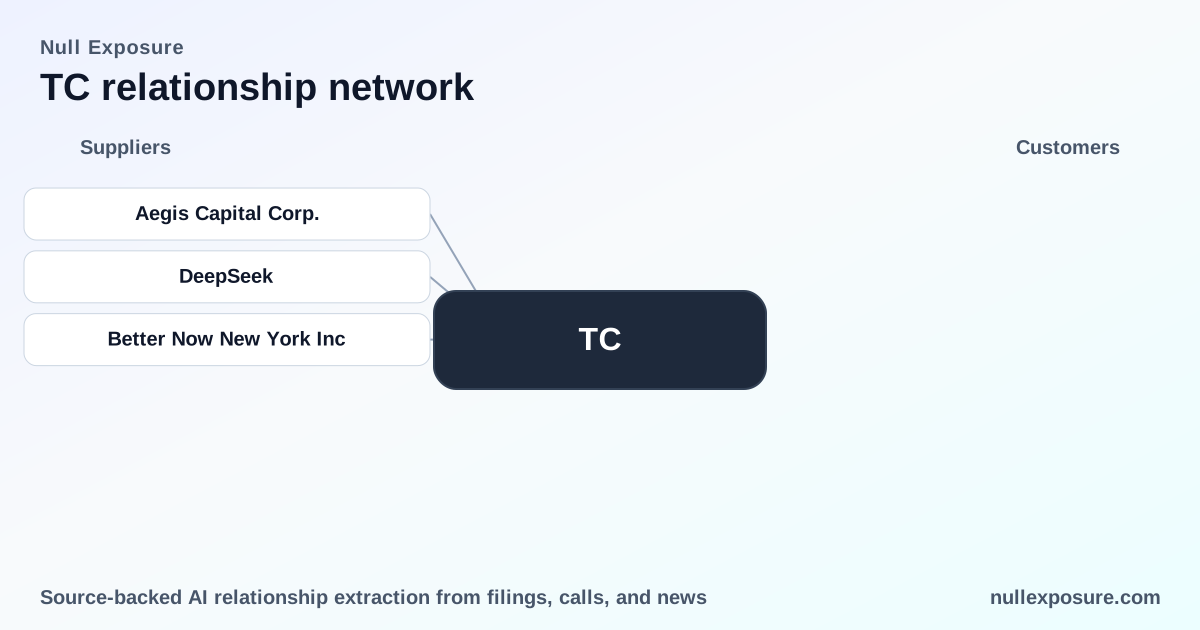
TuanChe (TC): Customer Relationships and What They Signal for Investors
TuanChe is an omnichannel automotive marketplace that connects dealers, manufacturers and shoppers across digital and offline touchpoints in China. The company monetizes primarily through advertising and service fees charged to auto dealers and OEMs for lead generation and traffic conversion, supplemented by value-added transaction services; its revenue base is dealer-centric and tied directly to auto sales activity and dealer marketing budgets. For investors, the critical question is how stable and concentrated the company's customer relationships are, and how those relationships interact with a capital structure that shows negative operating margins and significant EBITDA losses.
For a concise reference to our platform and methodology, see https://nullexposure.com/ — the site where we aggregate relationship intelligence for investment due diligence.
Business model in plain English: where cash comes from and what that implies
TuanChe operates a marketplace that sells attention and qualified customer introductions to car dealers and OEM partners. Revenues are recorded as fees for advertising, subscription-like dealer services, and success-based transaction services. The financial profile shows limited top-line scale (Revenue TTM: $36.65M) but material operating losses (EBITDA: -$115.28M), indicating that the company is still investing heavily in growth and product expansion while its dealer monetization has not reached positive operating leverage. The platform’s pricing power is concentrated on dealer spend, so macro auto cycles and dealer marketing budgets directly affect cash flow.
Key public financial points (latest reported through Q2 2025):
- Market capitalization: $208.8M
- Revenue (TTM): $36.65M
- Gross profit (TTM): $26.85M
- EBITDA: - $115.28M
- Operating margin (TTM): -2.07 (indicative of ongoing investment and structural loss)
How to read customer relationships on TuanChe: anatomy and concentration
TuanChe’s business model drives a contracting posture that is dealer- and OEM-focused, with many small contracts and a few large accounts. That structure implies:
- Contracting posture: Predominantly commercial, sales-driven contracts with dealers and advertising agreements with OEMs; high churn risk if dealers reallocate marketing spend.
- Concentration signal: Revenue dependence on a dealer base means concentration risk exists at the industry level (automotive) and potentially at the account level if large dealer groups account for a meaningful share.
- Criticality: For dealers, TuanChe is one of several digital lead-generation channels; the service is important but replaceable, so customer switching costs are moderate.
- Maturity: The economics show an immature monetization curve — healthy gross margin but negative EBITDA — signaling a company still scaling product-market fit and distribution.
No explicit contractual constraints or vendor-specific covenants were provided in the relationship data set; this absence is itself a company-level signal that no specialized or restrictive third-party constraints were recorded in the reviewed relationship feed.
For more on our relationship research and tools, visit https://nullexposure.com/.
All recorded customer relationships (complete list)
The dataset returned a single counterparty in the customer scope. Below is the human-readable, investor-oriented summary and citation.
Prime Management Group Limited — what the relationship entry shows
Prime Management Group Limited is present in TC’s customer-relationship feed with a single excerpt noting an agreement signed on September 10 and that the entity is incorporated in the British Virgin Islands. The relationship record contains one mention and links to a news item reporting the agreement. Source: Investing.com news report referencing the agreement and the BVI incorporation (news item dated May 4, 2026).
- According to an Investing.com news item (May 4, 2026), an agreement was signed on September 10 with Prime Management Group Limited, which is incorporated in the British Virgin Islands. The item is cited in the relationship extraction for TC.
What this single counterparty tells investors
Although the extraction returns only one named counterparty, the entry conveys a few important signals:
- Offshore counterparty existence: Presence of a BVI-incorporated counterparty suggests TuanChe contracts can involve offshore entities or intermediary managers; this matters for legal, tax, and recoverability analysis in dispute scenarios.
- Low visibility of counterparties: Only a single counterparty surfaced in the customer-scope feed; this implies either limited public reporting on individual dealer contracts or that TuanChe’s client roster is dispersed and not heavily concentrated in named, publicly disclosed counterparties.
Risk and opportunity framework tied to relationships
Investors should weigh the customer relationship profile against the financials:
- Risk: revenue sensitivity to dealer budgets. Given the dealer-centric monetization, macroeconomic swings in auto sales directly compress revenue and can amplify negative margins.
- Risk: limited disclosed counterparty concentration. Sparse public naming of customers raises potential concerns about client concentration being opaque; this makes revenue forecasting and counterparty credit risk assessment harder.
- Opportunity: high gross margins on core services. The company reports positive gross profit ($26.85M TTM), indicating the product has unit-level economics that can scale if dealer acquisition and retention improve.
- Operational leverage path: If the company stabilizes dealer contracts and reduces customer acquisition cost, fixed-cost absorption could materially improve margins given the current gross-profit base.
Practical next steps for investors evaluating TC customer risk
- Request detailed customer concentration schedules and aging of receivables to understand dependence on top dealers and credit risk.
- Probe contractual terms used with offshore or intermediary entities such as BVI incorporations to assess enforceability and collection pathways.
- Monitor dealer churn metrics and campaign ROI reporting as leading indicators of revenue durability.
Bottom line: what the relationship snapshot means for market positioning
TuanChe runs a dealer-funded marketplace with reasonable unit economics at gross-profit level but negative operating leverage while transitioning to scale. The customer feed lists Prime Management Group Limited as an offshore-named counterparty, which highlights that some client contracts traverse BVI entities — an operational detail investors should verify for legal and receivables risk. For investors focused on customer-side risks and revenue durability, the crucial focus is on dealer concentration, contract terms, and receivables transparency.
For ongoing relationship intelligence and deeper counterparty mapping tools, explore https://nullexposure.com/ — the central hub for our customer-relationship analyses.