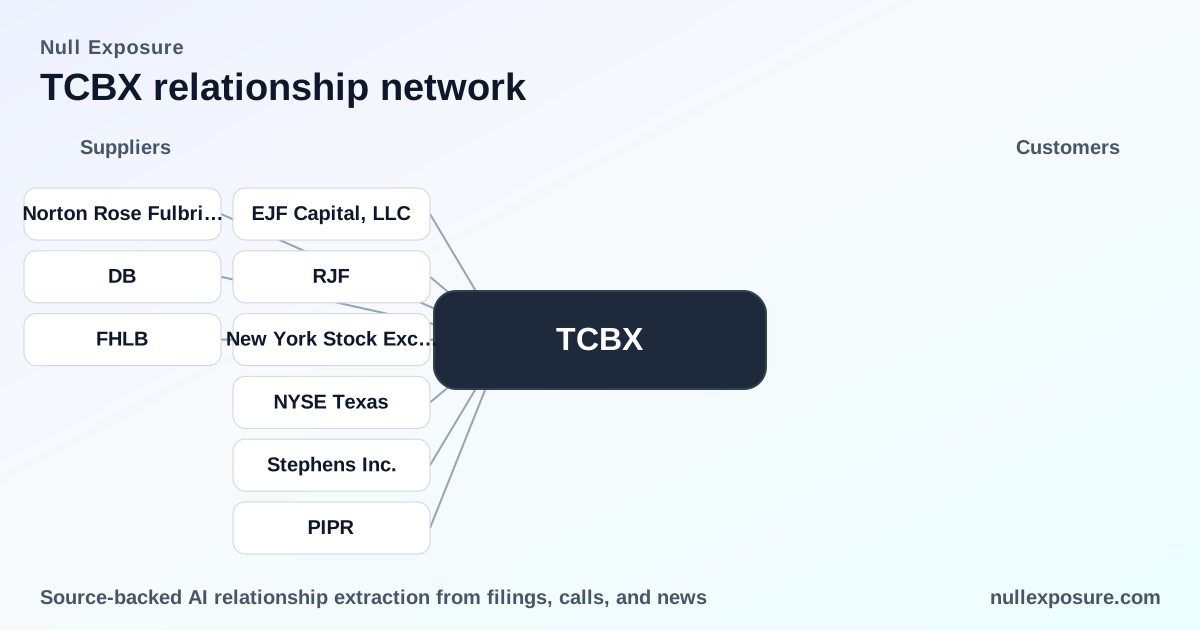
Third Coast Bancshares (TCBX): Customer Relationships That Drive a Texas-Centric Commercial Bank
Third Coast Bancshares operates and monetizes as a regional commercial bank holding company: it originates loans and takes deposits from small- and mid-sized businesses and individuals within Texas markets, then earns net interest income and fee income while selectively selling or securitizing large commercial loans to manage capital and concentration. The company’s branch footprint, large core deposit base, and active loan portfolio are the revenue engine; capital markets executions and third‑party buyers are the balance sheet lever for growth and risk transfer. For deeper relationship intelligence and monitoring, visit the Null Exposure platform: https://nullexposure.com/.
Quick investor read: what the latest customer interactions reveal
Two recent, concrete customer-related events illustrate how Third Coast deploys its balance sheet and partnerships to scale commercial lending while reducing concentration: (1) the operational integration of Keystone Bank after acquisition, and (2) a $150 million commercial real estate securitization arranged by EJF Capital for a loan originated by Third Coast Bank. Both items underscore an active commercial-lending franchise that uses capital markets and M&A to manage growth and concentration.
Keystone Bank integration — expanding the franchise through M&A
Third Coast announced the successful integration of Keystone Bank into its operational platform during its Q1 earnings call on April 23, 2026. The integration is an execution event that expands branch and customer coverage and folds Keystone into Third Coast’s systems and origination channels. According to a published report summarizing the Q1 commentary, the transaction is now operationally complete (HarianBasis, May 4, 2026: https://www.harianbasis.co/en/third-coast-bancshares-keystone-acquisition).
EJF Capital securitization — active use of the capital markets
EJF Capital closed a securitization of a $150 million commercial real estate loan that Third Coast Bank originated, demonstrating Third Coast’s strategy of using secondary market buyers to offload large CRE exposures and recycle capital for new lending. The transaction was announced in a Business Wire release distributed via FinancialContent on June 4, 2025 (Markets/FinancialContent, June 4, 2025: https://markets.financialcontent.com/stocks/quote/news?Symbol=NQ%3ATCBX).
What these relationships say about how Third Coast operates
These two customer-related actions are consistent with a commercially oriented regional bank that combines direct lending to local businesses with strategic balance-sheet management:
- Concentration management through sales and securitizations. The $150 million CRE securitization indicates that Third Coast will transfer outsized loans to institutional buyers to stay within legal lending limits and preserve capital.
- Growth by acquisition and operational consolidation. The Keystone integration signals a roll-up approach at the franchise level: growth via M&A that is then brought into centralized operations.
- Service-provider posture with its customers. Third Coast acts as a lender and financial services provider—offering SBA lending and interest-rate swap products to qualified commercial borrowers—which drives recurring fee and interest income.
For additional visibility into counterparties and exposure monitoring, see Null Exposure: https://nullexposure.com/.
Constraints and business-model signals investors should treat as company-level intelligence
The public disclosures and excerpts provide several company-level characteristics that shape credit and operational risk:
- Geographic concentration: All branches and the principal business are centered in Texas (Greater Houston, Dallas–Fort Worth, Austin–San Antonio, plus one branch in Detroit, Texas). This concentration increases local economic sensitivity and amplifies regional credit-cycle exposure.
- Customer mix skewed to small and mid-market commercial borrowers: The bank’s primary income derives from interest on loans to small- and medium-sized businesses, professionals, and individuals, positioning Third Coast as a classic relationship lender to mid-market customers rather than a national corporate lender.
- Material single-name concentration exists: The ten largest loan relationships totaled approximately $371.1 million, or 9.4% of the total loan portfolio as of December 31, 2024, indicating meaningful exposure to a small number of large borrowers.
- Active balance-sheet management with sizeable commitments: Total loans were $3.97 billion and total deposits $4.31 billion as of December 31, 2024, with commitments to extend credit noted at $(Dollars in thousands) 1,568,824—signals of scale in commercial lending and standby commitments.
- Use of FHLB credit support for public funds: Letters of credit with the FHLB totaling $535.8 million at December 31, 2024, are used to collateralize public fund deposits exceeding FDIC limits, reflecting reliance on Federal Home Loan Bank facilities for liquidity and public-deposit business.
- Spend and exposure bands suggest large-ticket lending activity: Lending limits and concentration metrics show legal lending limits (~$136.2 million) with the largest single relationship at $67 million—creating periodic needs to syndicate or securitize larger loans.
These constraints collectively describe a bank with concentrated geography, mid‑market commercial focus, material top-ten exposures, and an operational model that actively uses capital markets and third‑party liquidity tools.
How each relationship fits into that operating model
- Keystone Bank integration expands the bank’s local customer base and branch footprint, accelerating organic loan origination and deposit capture in target Texas markets; the deal is now integrated operationally (HarianBasis, May 4, 2026).
- The EJF Capital securitization of a $150 million CRE loan demonstrates a tactical sale of large loans to reduce concentration and free capital for new originations, consistent with Third Coast’s documented lending scale and limits (Business Wire / FinancialContent, June 4, 2025).
Investment implications and risk checklist
Third Coast’s evident playbook offers a clear set of investment positives and risk anchors:
-
Positives
- Strong core deposit base and branch network in multiple Texas markets support stable funding.
- Active capital markets usage (securitizations and loan sales) helps manage concentration and regulatory lending limits.
- Niche commercial lending focus fosters sticky customer relationships and fee opportunities (SBA Preferred Lender benefits, swap offerings).
-
Risks
- Regional concentration in Texas increases exposure to local economic and CRE cycles.
- Material top-ten exposures mean borrower-level stress could have outsized portfolio impact.
- Reliance on wholesale facilities (e.g., FHLB letters of credit) for specific deposits creates liquidity dependencies.
Key takeaway: Third Coast’s customer interactions show a regional lending franchise that grows by originating commercial loans while deliberately transferring large-ticket risk to institutional counterparties. That model supports profitability through interest spread and fee income, but it requires disciplined concentration management and access to secondary buyers.
Bottom line
For investors and operating partners, Third Coast demonstrates a disciplined combination of relationship lending, targeted M&A, and active capital markets execution to manage growth and concentration. Monitor top‑borrower trends, securitization activity, and regional economic indicators in Texas to assess near-term credit and valuation risk. For ongoing monitoring and deeper counterparty linkage analysis, Null Exposure provides continuous coverage and relationship mapping: https://nullexposure.com/.