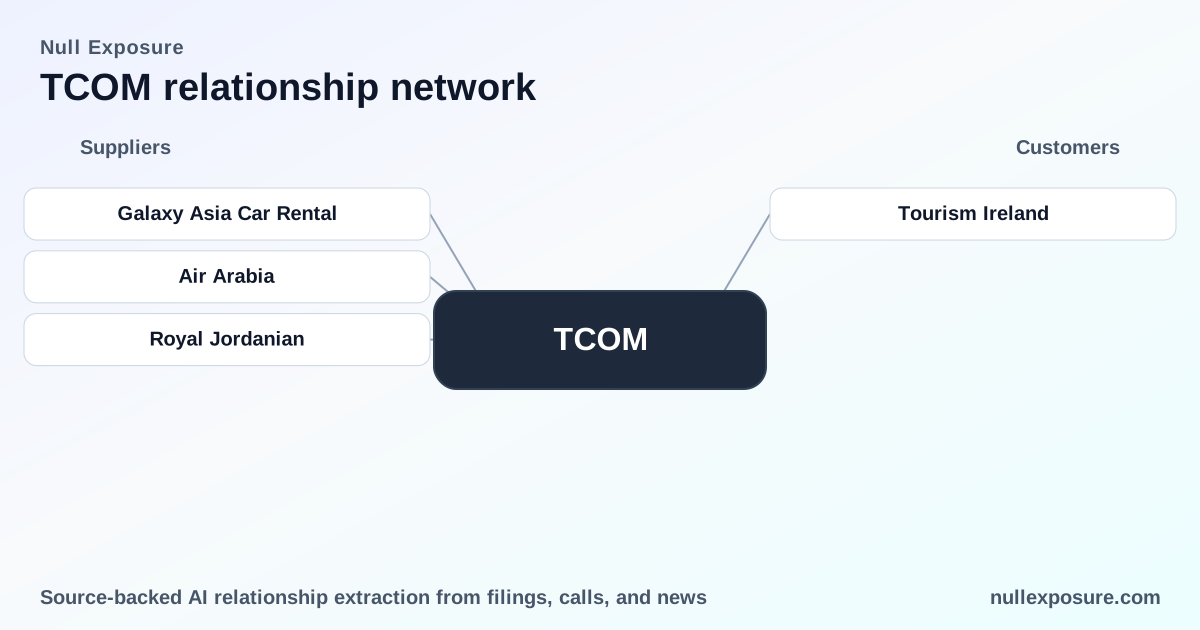
Trip.com Group (TCOM) — what the Tourism Ireland tie-up tells investors
Trip.com Group operates a global travel marketplace that monetizes through accommodation and ticketing fees, packaged-tour margins, corporate travel services, and marketing/advertising solutions that sell distribution and high-value traveler reach to destination partners. The company’s scale—roughly $62.4 billion in trailing revenue and double-digit operating leverage—lets it convert promotional access and data-driven marketing into cash flow, turning destination marketing relationships into recurring commercial revenue streams. For a closer read on commercial counterparty exposures and partner dynamics, see https://nullexposure.com/.
Platform-to-partner: how Trip.com structures commercial relationships
Trip.com is a two-sided travel marketplace that contracts with suppliers on inventory and with destination partners on marketing and distribution, so its contracting posture is a mix of negotiated supplier agreements and campaign-based commercial arrangements. The company’s concentration profile is low on the buyer side (millions of retail customers) and moderate on the seller/partner side, since large tourism boards or anchor hotel groups can deliver outsized distribution value in specific campaigns.
- Contracting posture: Trip.com signs both long-running supplier contracts (hotel and transport inventory) and campaign-based marketing deals with tourism authorities, where payments are tied to promotion, visibility and measurable bookings.
- Criticality: For destination partners seeking Chinese and broader Asian travelers, Trip.com is a highly critical distribution channel given its reach across 50 countries and a large active customer base.
- Maturity and scale: Trip.com’s $62.4B TTM revenue, positive EBITDA and depressed trading multiples relative to earnings imply an established, cash-generative business that leverages scale to sell marketing and distribution at attractive margins.
These company-level signals indicate a business model that blends stable transaction revenue with higher-margin partnership services sold to destinations and advertisers.
What the public records show about Tourism Ireland
Trip.com’s customer relationship feed captures two press reports, both published March 10, 2026, that describe a Tourism Ireland partnership. Each item is summarized below.
Tourism Ireland — global marketing memorandum with Trip.com (Travel and Tour World, Mar 10, 2026)
Trip.com will provide Tourism Ireland access to its global customer base—including brands Trip.com and Ctrip—that reach travelers in 50 countries and regions, enabling Ireland to target millions of potential tourists through the platform’s marketing channels. According to Travel and Tour World, the agreement explicitly emphasizes reaching high-value Chinese travelers using Trip.com’s distribution and promotional tools. Source: Travel and Tour World, March 10, 2026 (https://www.travelandtourworld.com/news/article/tourism-ireland-signs-mou-with-trip-com-group-to-boost-global-reach-using-ai-marketing-to-attract-high-value-travelers-and-drive-sustainable-growth/).
Tourism Ireland — campaign partnership leveraging AI-driven strategies (Travel and Tour World, Mar 10, 2026)
A second Travel and Tour World report describes the partnership as leveraging Trip.com Group’s advanced marketing tools and AI-driven strategies to convert platform reach into bookings from China’s growing market; the piece frames Trip.com as the distribution and ad-tech partner connecting Dublin, Beijing and other cities. Source: Travel and Tour World, March 10, 2026 (https://www.travelandtourworld.com/news/article/tourism-ireland-partners-with-trip-com-group-in-shanghai-to-expand-irish-appeal-connecting-dublin-beijing-and-chinas-growing-market-heres-what-to-know-about-the-future-of-travel/).
Both items corroborate the same strategic point: Trip.com sells destination reach and targeted marketing capability to Tourism Ireland as a commercial partner, positioning the company as a conduit to high-value Chinese outbound travelers.
Why this relationship matters to investors
The Tourism Ireland examples illuminate several actionable investment signals about Trip.com’s customer relationships and revenue mix:
- Upsell of higher-margin offerings: Selling marketing and AI-driven promotional campaigns to national tourism boards converts transaction-based platform scale into recurring, higher-margin revenue lines.
- Channel criticality for partners: For destination marketing organizations targeting China, Trip.com functions as a primary channel; this increases the company’s pricing power on campaign economics for specific geographies.
- Low single-customer concentration at the corporate level: While a tourism board is a meaningful campaign client, Trip.com’s global retail base and broad supplier roster keep single-customer concentration risk moderate rather than acute.
- Distribution-driven leverage: The economics of destination partnerships exaggerate returns on reach—small incremental bookings from targeted campaigns scale profitably because of low incremental cost of distribution on a large platform.
These dynamics support the narrative that destination marketing relationships are strategic margin adjacencies to a core transactions business, not core transactional dependencies.
Company-level constraints and commercial posture
There are no customer-level constraints captured in this feed for FY2026. At the company level, the following operating characteristics are evident and material to underwriting partner exposure:
- Contracting posture: Mix of longer-term supplier contracts and shorter-term campaign agreements with marketing partners.
- Concentration: Broad retail and supplier base dilutes single-client revenue risk; partner campaigns can be material episodically.
- Criticality: Platform reach is strategically important to destination partners targeting China and Asia, creating asymmetric bargaining leverage.
- Maturity: Scale and positive EBITDA support reinvestment in marketing technology (AI targeting) that strengthens the value proposition for tourism boards.
These signals inform an investor’s view of counterparty risk: partners gain meaningful distribution, but Trip.com’s diversified revenue and platform economics limit existential concentration risk.
Near-term investor takeaways
- Positive revenue mix expansion: Partnerships like Tourism Ireland reposition Trip.com to capture higher-margin advertising and marketing revenue on top of transactional volumes.
- Strategic defensibility: Platform scale and AI-driven targeting create durable advantages for selling promotional services to national and regional tourism bodies.
- Moderate partner risk: Tourism boards are important but episodic clients; the firm’s large retail footprint and supplier relationships protect against single-client revenue shocks.
For a deeper mapping of Trip.com’s counterparty exposures and how partner campaigns translate into revenue, investors can review our portal at https://nullexposure.com/.
Bottom line
Trip.com converts marketplace scale into monetizable marketing relationships with destination partners; the Tourism Ireland announcements from March 10, 2026, illustrate the company’s ability to sell high-value distribution and AI-driven marketing to national tourism authorities. That capability strengthens revenue diversification and margin upside while keeping single-customer concentration risk contained within a broad, mature platform.