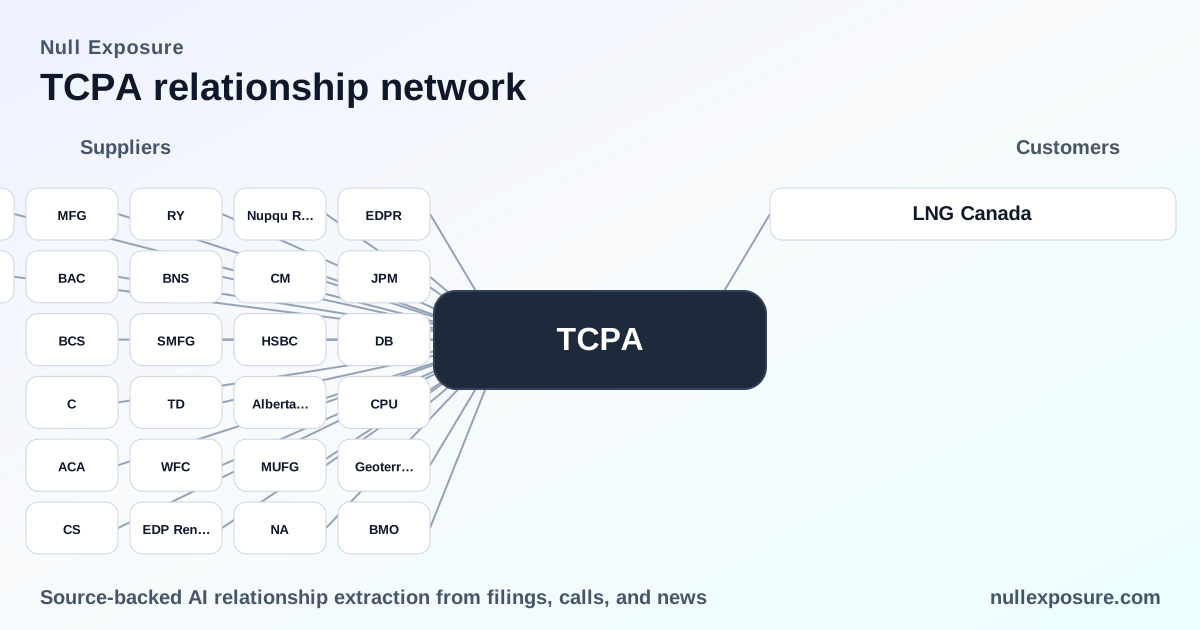
TCPA customer relationships: where the revenue flows and what large customers disclose
TCPA sells cloud-native customer engagement and compliance software to enterprises, packaging automated marketing, communications orchestration, and regulatory tooling into subscription and usage-priced products. The company monetizes through recurring licensing, implementation and support services, and add-on compliance modules that institutional customers pay to remain active and auditable. For investors, the signal set from customer disclosures points to high-touch enterprise deals concentrated in energy and utility sectors, where uptime and regulatory compliance are the commercial anchors.
If you want a concise reference to how TCPA’s customer network maps to enterprise counterparties, see the firm overview at Null Exposure: https://nullexposure.com/.
Why customers matter: revenue durability and operating posture
Enterprise customers in regulated industries generate stable, multi-year contracts and demand rigorous compliance support. That produces two financial characteristics for TCPA: predictable recurring revenue from large accounts and high implementation costs tied to bespoke integrations. Contracting posture leans toward service-level agreements and retention incentives rather than one-off sales; concentration in a small number of large customers increases revenue volatility but boosts gross contract value when deals close.
Key business-model signals:
- Concentration: Large regulated customers imply meaningful account concentration risk.
- Criticality: Service is operationally critical to customers that run regulated infrastructure, which supports stickiness.
- Maturity: Relationships are anchored in multi-year contracts and integration work consistent with a mature enterprise-sales model.
Visit the Null Exposure homepage for a consolidated view of customer-side intelligence: https://nullexposure.com/.
The customer roster, relationship-by-relationship
Below are the customer relationships surfaced in public reporting. Each entry summarizes the counterparty relationship in plain English and cites the underlying public source.
Great River Hydro LLC
Great River Hydro purchased TransCanada’s Northeast hydroelectric assets (TC Hydro) in a transaction valued at $1.065 billion, representing a divestiture of generation assets. According to Utility Dive (May 2026), that sale transferred operational responsibility for 600 MW of hydro capacity to Great River Hydro LLC.
Source: Utility Dive report on TransCanada divestitures, May 2026.
Helix Generation LLC
Helix Generation LLC acquired several gas-fired plants and a wind facility—Ravenswood, Ironwood, Ocean State Power, and Kibby Wind—in a $2.2 billion package that reflects strategic asset reallocation away from merchant generation. Utility Dive reported this disposition as part of a broader asset monetization program in May 2026.
Source: Utility Dive report on TransCanada divestitures, May 2026.
Energy East Pipeline Ltd.
Energy East appears in regulatory materials as the counterparty for valuation and toll-inclusion discussions related to natural gas mainline assets, implicating pipeline toll economics and rate-base calculations. A Canada Energy Regulator ministerial briefing binder (FY2021) details the valuation issues for removal from and inclusion in various rate bases.
Source: CER ministerial briefing binder on the proposed Energy East project, FY2021.
Hydro‑Québec Distribution
Hydro‑Québec Distribution is identified as an off‑taker for electricity and steam services in the province of Québec, evidencing local utility-level power supply contracts that support industrial park customers. TC Energy’s operations documentation (FY2019) describes supply arrangements that meet provincial demand and provide process steam to adjacent industrial facilities.
Source: TC Energy operations page summary, FY2019.
Weyerhaeuser (WY)
Weyerhaeuser receives on-site power from the Bear Creek Cogeneration Plant, which produces up to 100 megawatts of electricity for the Grande Prairie pulp and sawmill and Alberta’s competitive market, illustrating an embedded industrial customer relationship. TC Energy operations documentation highlights the plant’s role in serving Weyerhaeuser’s Grande Prairie facilities (FY2019).
Source: TC Energy operations page, FY2019.
LNG Canada
LNG Canada figures as the downstream anchor for the Coastal GasLink pipeline; that project would transport gas to a major LNG terminal and draws scrutiny for economic and social impacts. The Rainforest Action Network (March 2026) contextualized the Coastal GasLink pipeline’s role in supplying LNG Canada and the broader sector implications.
Source: RAN The Understory feature on Coastal GasLink and LNG Canada, March 2026.
What this customer mix implies for TCPA’s go‑to‑market and risk profile
The customer list is dominated by energy, utility and industrial counterparties with high regulatory sensitivity. That drives certain operational and commercial realities investors must price:
- Contracting posture: Expect multi-year, SLA-driven contracts with significant vendor governance and compliance requirements. This elevates sales and customer-success costs but reduces churn once integration is complete.
- Concentration risk: Large counterparty relationships mean a small number of customers can represent a high share of revenue; downside or divestiture activity across a single sector can create step-function declines in bookings.
- Criticality and switching costs: Serving regulated operations (power plants, pipelines, LNG terminals) implies elevated switching costs and entrenchment, supporting subscription retention and potential for upsell into compliance and analytics modules.
- Maturity signal: The presence of industrial and utility names suggests enterprise-level implementations rather than SMB rollouts; this aligns with longer sales cycles and a services-heavy revenue mix.
On constraints and disclosures — what the record shows (and does not show)
The customer-scope extraction returned no explicit contractual constraints such as exclusivity clauses, minimum spend guarantees, or maturity schedules. That absence is itself informative: it signals either that public reporting and news coverage focus on asset sales and project partners rather than contractual filings, or that TCPA’s customer arrangements are structured as standard commercial SaaS contracts without unusual, reportable covenants. Investors should treat the lack of constraints in public sources as a disclosure gap, not proof of absence.
Investment implications and next steps
The public customer signals position TCPA as a vendor embedded with regulated energy and industrial customers—a profile that supports recurring revenue but concentrates exposure in cyclical, capital-intensive sectors. Valuation should reflect a trade-off: higher average contract value and stickiness versus concentration and sector-specific regulatory risk.
If you are building a diligence checklist, prioritize:
- Contract term lengths and renewal cadence with top energy customers.
- Revenue concentration metrics for the top 5–10 accounts.
- Evidence of compliance and SLA penalties that could affect margin under service outages.
For a consolidated view of TCPA’s customer intelligence and to track updates to these relationships, visit Null Exposure: https://nullexposure.com/.