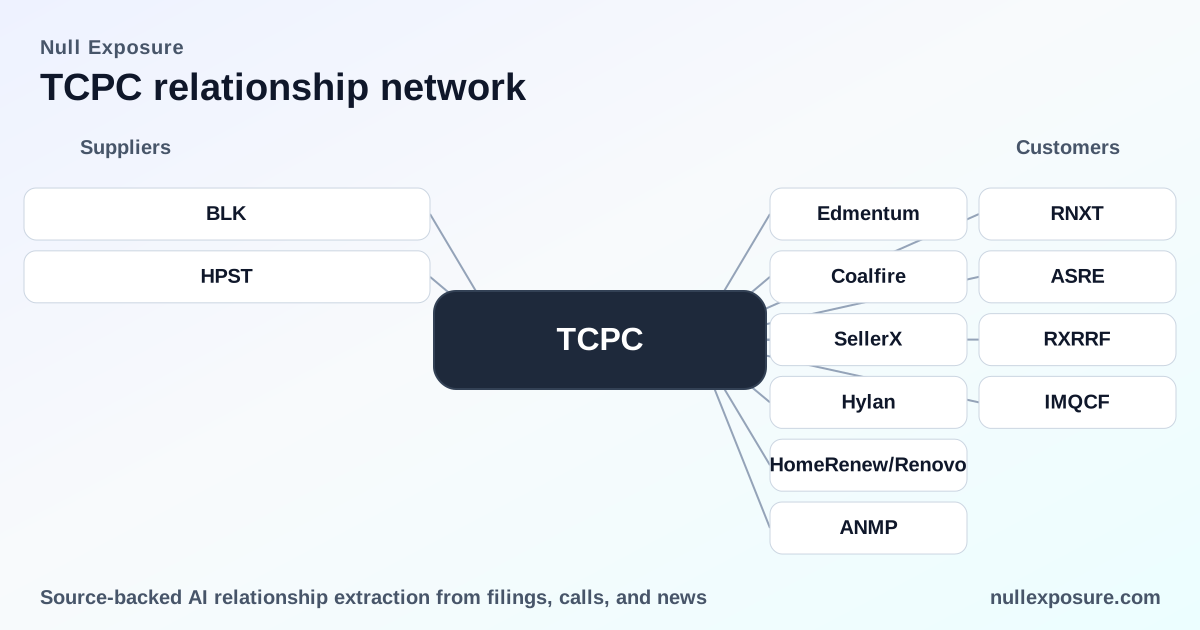
BlackRock TCP Capital (TCPC): NAV pressure from a handful of stressed portfolio credits
BlackRock TCP Capital Corp (TCPC) operates as a BlackRock‑managed BDC that originates and holds primarily senior‑secured loans and selected debt/equity instruments to middle‑market companies, monetizing through interest income, yield spreads, and occasional realized gains while delivering a high‑income dividend profile to shareholders. Recent public commentary and investigative reporting identify a concentrated set of investments that materially compressed NAV in FY2026, underlining credit selection and sector concentration as the near‑term driver of performance. For a clearer read on portfolio exposures and counterparties, visit https://nullexposure.com/.
What matters for investors: concentrated credits, NAV sensitivity, and yield generation
TCPC’s model is straightforward: generate steady coupon income from middle‑market loans and protect principal with senior collateral where possible, while selectively owning equity or preferred that increases upside — at the cost of volatility in downcycles. The company’s FY2026 disclosures and subsequent market commentary show a small group of credits accounted for the majority of NAV decline, shifting the short‑term story from steady dividend yield to capital preservation and write‑downs.
Key takeaways:
- Portfolio concentration is high: a handful of credits drove a large portion of the NAV hit disclosed in early 2026. (ClaimDepot, Jan 23, 2026 disclosure.)
- Loans and equity coexist in positions: some investments combine debt and equity exposure, increasing mark‑to‑market volatility. (InsiderMonkey Q4 2025 earnings call transcript, Mar 10, 2026.)
- Geographic and sector exposure skew toward software and services across APAC and EMEA, implying cross‑border credit complexity. (Company constraint excerpts, FY2026.)
The credits that matter — plain English, named sources
Below are every relationship referenced in public commentary and investigative coverage; each entry is a concise investor‑oriented note with the original source.
-
Coalfire — TCPC held a $4 million first‑lien loan to cybersecurity services provider Coalfire, recorded as one of the larger individual investments in the quarter. (InsiderMonkey Q4 2025 earnings call transcript, Mar 10, 2026.)
-
Edmentum — TCPC’s position in Edmentum is entirely preferred and common equity, making it highly sensitive to changes in enterprise value and a material contributor to NAV decline reported in January 2026. (InsiderMonkey Q4 2025 earnings call transcript, Mar 10, 2026; ClaimDepot investigation referencing the Jan. 23, 2026 disclosure.)
-
SellerX — SellerX was cited as contributing $0.22 per share, about 13% of the NAV decline, highlighting the outsized impact of a single private credit exposure. (InsiderMonkey Q4 2025 earnings call transcript, Mar 10, 2026; also included in ClaimDepot’s Jan. 2026 portfolio attribution.)
-
Hylan — TCPC marked down a position that included both debt and equity for Hylan due to underperformance and liquidity concerns, signaling both credit stress and valuation uncertainty. (InsiderMonkey Q4 2025 earnings call transcript, Mar 10, 2026; ClaimDepot Jan. 2026 disclosure included Hylan among contributors.)
-
Anacomp (ANMP) — Management identified Anacomp as one of the largest contributors to net realized losses for the quarter, a direct hit to the 4Q results. (InsiderMonkey Q4 2025 earnings call transcript, Mar 10, 2026.)
-
Renovo (RNXT) / HomeRenew/Renovo — TCPC moved forward with writing down its Renovo investment in the fourth quarter; ClaimDepot’s Jan. disclosure also groups HomeRenew/Renovo among credits driving NAV loss. (InsiderMonkey Q4 2025 earnings call transcript, Mar 10, 2026; ClaimDepot Jan. 23, 2026.)
-
Astra (ASRE) — Astra was named alongside Anacomp as a significant portfolio company contributor to realized losses in the period, representing a material mark event. (InsiderMonkey Q4 2025 earnings call transcript, Mar 10, 2026.)
-
Razor / RXRRF — Razor accounted for $0.24 per share or roughly 15% of the NAV decline and management stated the position was written down to zero, indicating total impairment. (InsiderMonkey Q4 2025 earnings call transcript, Mar 10, 2026; ClaimDepot referenced Razor among the Jan. disclosures.)
-
InMobi (IMQCF) — Management marked down its position in InMobi, a digital advertising company, and ClaimDepot cites InMobi within the group that produced about two‑thirds of the NAV loss. (InsiderMonkey Q4 2025 earnings call transcript, Mar 10, 2026; ClaimDepot Jan. 23, 2026.)
Each of the entries above is drawn from TCPC’s management commentary in the Q4 2025 earnings call transcript (captured by InsiderMonkey, March 10, 2026) and the ClaimDepot investigative summary that cited the Jan. 23, 2026 disclosure attributing ~67% of NAV loss to named credits.
What the constraints tell us about TCPC’s operating posture
The public constraint excerpts give signals about how TCPC structures and concentrates its book:
-
Contracting posture — long‑term tenor is material. Debenture maturity language and multiple term loans in the portfolio indicate multi‑year commitments and semiannual interest mechanics, reinforcing duration and refinancing risk as part of the credit profile. (Company constraint excerpts, FY2026.)
-
Geographic exposure — meaningful APAC and EMEA positions. Portfolio term loans and revolvers tied to entities in Australia, Singapore and Germany show TCPC extends beyond U.S. middle‑market credits into cross‑border structures that increase legal and operational complexity. The EMEA excerpt explicitly names SellerX (Germany) and Razor (Germany). (Company constraint excerpts identifying specific facilities, FY2026.)
-
Sector tilt — software and services dominate new originations. Multiple first‑lien term loans to software companies and references to IT and advisory services demonstrate a clear bias toward technology and services companies, concentrating risk where valuations and revenue cyclicality are more volatile. (Company constraint excerpts listing software credits, FY2026.)
-
Maturity and coupon profile — mid‑late 2020s maturities and floating/fixed mixes. Excerpts show maturities clustered in the 2025–2029 window with a mix of SOFR‑based and fixed coupons plus PIK tranches, indicating a blended yield strategy with embedded refinancing and payment‑in‑kind risk. (Company constraint excerpts, FY2026.)
Collectively, these constraints portray a BDC that pursues higher yields via cross‑border, software/service‑oriented credits with multi‑year tenors and mixed cash/PIK structures — a combination that enhances returns in benign cycles and magnifies NAV moves when specific credits underperform.
If you want a structured view of how these counterparties affected TCPC’s NAV and what that implies for forward dividend coverage and capital preservation, explore the full analysis at https://nullexposure.com/.
Investment implications — what to watch next
For investors and operators evaluating TCPC customer relationships, the investment checklist is clear:
- Monitor future disclosures for additional credit write‑downs and realized losses by name; the recent NAV swing was concentrated and thus repeatable if similar credits exist.
- Track dividend sustainability relative to core interest income and realized loss frequency; high yield alone is not durable if principal impairment accelerates.
- Pay attention to geographic/legal complexity when assessing recovery assumptions — cross‑border workouts in APAC/EMEA differ materially from U.S. restructurings.
Bold conclusion: TCPC delivers yield through an active, concentrated middle‑market credit strategy; FY2026 demonstrated that concentration produces outsized NAV volatility when a handful of credits fail. Investors should prioritize credit‑level transparency and the pace of write‑downs before relying on headline dividend yield.