TScan Therapeutics (TCRX): How the Amgen Collaboration Shapes Commercial Trajectory
TScan Therapeutics operates a T cell receptor discovery platform that monetizes through research collaborations, licensing of intellectual property, and milestone-driven collaboration revenue tied to partner R&D activity. The company generates the majority of near-term external revenue from strategic pharma partnerships rather than product sales, while its balance sheet and development cadence are driven by the timing and intensity of partner research programs.
For a quick exploration of relationship-level exposure across TScan’s customers, visit https://nullexposure.com/ for the full view of partner signals and disclosure context.
Why the Amgen collaboration is the headline for investors
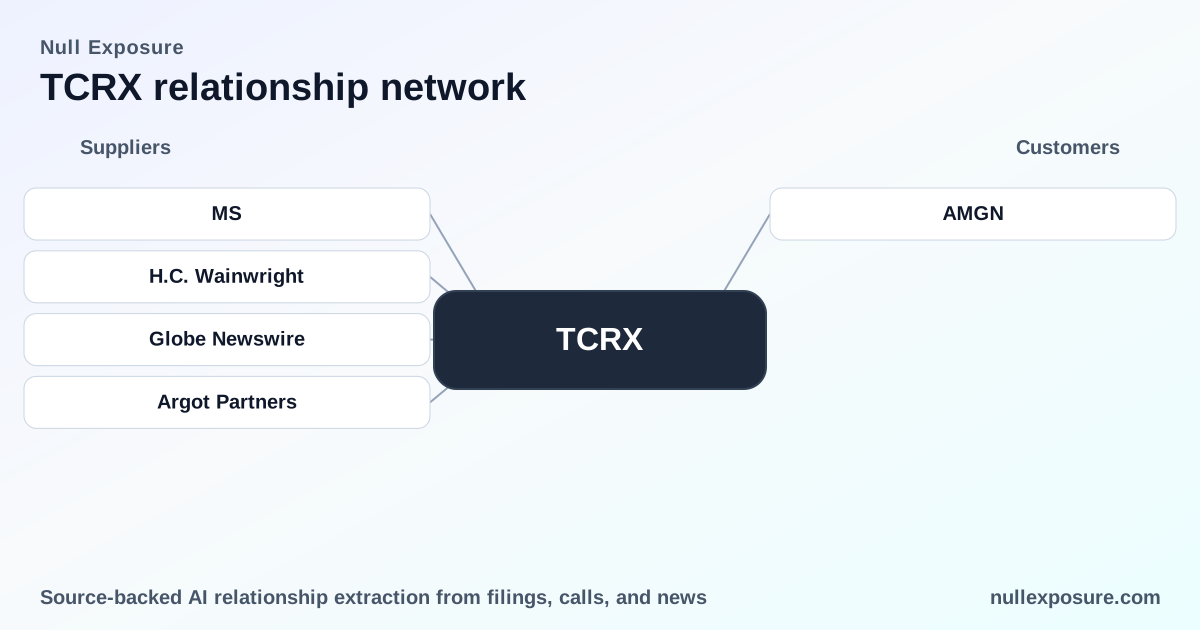
TScan’s partnership with Amgen is the most visible commercial relationship and the primary driver of collaboration income reported in recent years. Amgen engages TScan for research activities and an intellectual property license, and fluctuations in research timing under this agreement explain much of the company’s year-over-year collaboration revenue swings. According to a TradingView summary of TScan’s FY2026 disclosures, research under the Crohn’s disease collaboration with Amgen produced $10.3 million of collaboration and license revenue in FY2026 and contributed to operational progress reported for the year (TradingView, March 2026). Company press releases filed on GlobeNewswire for Q2 and Q3 2025 and the FY2025/FY2026 financial updates repeatedly attribute revenue increases to the timing of Amgen-driven research activities (GlobeNewswire, 2025–2026).
Financial and operational significance of the Amgen work
- TScan recorded meaningful deferred revenue tied to partner commitments, and the company’s filings show that Amgen-related activity moves revenue recognition across periods — a timing-sensitive revenue profile that inflates or depresses reported top line in specific quarters depending on research throughput.
- The firm itself has concluded that Amgen is a customer in the form of research delivery plus an IP license, establishing a licensee relationship that carries both near-term revenue and longer-term IP considerations (company filings summarized in FY2025–FY2026 disclosures).
All customer relationships in scope: concise, investor-ready list
Amgen (AMGN) — TScan’s collaboration with Amgen centers on Crohn’s disease research and an IP license, and it produced $10.3 million of collaboration and license revenue in FY2026; company statements across 2025–2026 attribute revenue variability to the timing of research activity under this agreement (TradingView, March 9, 2026; GlobeNewswire press releases, 2025–2026).
- According to TScan’s FY2026 disclosures summarized by TradingView, research activities under the Crohn’s disease collaboration materially increased collaboration revenue and contributed to operational progress for the year (TradingView, March 2026).
- TScan’s investor releases on GlobeNewswire for Q2, Q3 and full-year reporting repeatedly note that increases were “primarily due to timing of research activities pursuant to the Company’s collaboration agreement with Amgen,” confirming the contract is the principal short-term revenue driver (GlobeNewswire, 2025–2026).
Contract features, constraints, and what they mean for execution
TScan’s disclosures and constraint signals outline a familiar biotech partner model: multi-year research commitments, license components, and revenue recognition tied to partner activity. Key operating-model signals for investors:
- Long-term research posture: Company disclosures estimate the research term at approximately three years, which implies multi-year revenue visibility tied to discrete research milestones and resource deployment rather than recurring product sales.
- Active, license-oriented relationship with Amgen: Filings record revenue recognition and deferred revenue tied to the Amgen Agreement (reported revenue of $2.8 million in 2024 and $14.2 million in 2023 related to this agreement, with $12.9 million of deferred revenue at Dec 31, 2024), indicating ongoing activity and timing-related earnings volatility (company filings summarized in FY2024–FY2026 statements).
- Commercialization sensitivity to payors: At the company level, TScan discloses that successful commercialization depends on coverage and reimbursement from government health authorities and private insurers, a standard but material constraint for companies prosecuting new biologics in oncology and immunology markets.
Together these characteristics create a business model where revenue concentration, timing risk, and IP licensing economics are the dominant forces for near- to medium-term valuation, while product commercialization and payer uptake remain longer-term uncertainties.
For detailed partner mapping and historical disclosure extracts, see https://nullexposure.com/ for the full dataset and source links.
The Novartis closure — a company-level signal for partnership lifecycle
TScan’s disclosures also document a completed research relationship with Novartis: the research term under the Novartis Agreement ended in March 2023, and the company recognized $5.8 million of revenue associated with that agreement during 2023 (company filings). This termination signals two investor-relevant points: TScan executes finite, project-based collaborations that can conclude after a research term, and the company recognizes both revenue and cost reimbursements tied to concluded collaborations, which affects both the income statement and R&D expense presentation in the years those projects wind down.
Implications for valuation and operating risk
Investors evaluating TScan should weigh several concentrated, high-conviction factors:
- Concentration risk: Amgen is the dominant reported customer-driven revenue source in recent reporting. That concentration means partner activity and timing materially affect reported results and cash runway assumptions.
- Timing-driven earnings volatility: Revenue recognition depends on discrete research milestones and the scheduling of partner work; quarter-to-quarter revenue is therefore lumpy and correlates with partner program cadence rather than organic sales.
- License/IP upside with contingent payoffs: The licensee role and IP transfers embedded in collaborations provide potential upside via milestones and downstream royalties, but those payoffs are contingent on successful development and later commercialization.
- Commercialization and reimbursement exposure: Company-level disclosures highlight dependence on government and private payors for downstream commercialization — a standard constraint that will shape long-term realized value if and when TCRX programs transition to late-stage development or commercialization.
Bottom line: partner-driven growth with concentrated execution risk
TScan’s near-term financial story is controlled by partner research flows, with Amgen as the principal customer driving recent collaboration revenue. Investors should treat TScan as a platform company whose short-term performance is a function of partner program timing and medium-term upside depends on successful translation of licensed IP into monetizable clinical programs. Concentration with Amgen and the completed Novartis research term create a mix of demonstrated partner traction and execution risk that will dominate valuation until product-level revenue streams emerge.
For deeper relationship analytics and source-level disclosure extracts, visit https://nullexposure.com/ to review the primary documents and time-series signals that underpin these conclusions.