Tucows (TCX): Customer relationships that define risk and runway
Tucows operates three distinct revenue engines — Ting (retail fiber and fixed wireless internet), Wavelo (software and professional services for communication service providers) and Tucows Domains (global domain registration via a reseller network) — and monetizes through a mix of monthly consumer subscriptions, long‑term domain registration renewals, usage‑sensitive platform fees, and professional services contracts. For investors, the defining dynamics are a broad base of small retail customers and resellers that produce steady recurring cash flows, combined with a concentrated set of large Wavelo clients that drive material platform revenue and create single‑customer risk. Explore deeper at https://nullexposure.com/.
Why the customer mix matters: predictability versus concentration
Tucows’ business model blends short‑term consumer revenues with longer, contractual B2B platform deals. Ting consumer services are month‑to‑month subscriptions, which limits long‑term revenue visibility but reduces contractual liability; domain registrations are purchased for one to ten years, creating a base of durable, high‑margin annuity-like cash flows through renewals; Wavelo combines subscription‑style platform fees with variable, usage‑based components and professional services, tying revenue to both activity and multi‑year implementations. These contract characteristics result in diverse revenue cadence: steady low-ticket recurring income alongside lumpy, higher‑value B2B bookings.
Geography and channel also shape exposure. Tucows distributes domains through a global reseller network (34,000+ resellers across ~200 countries), while Ting and most Wavelo services are focused in North America, concentrating operational and regulatory risk regionally. Service concentration is material: the company disclosed that one Wavelo customer (EchoStar) represented 10.7% of total net revenue in FY2024, putting meaningful weight on retention and pricing with that counterparty. These structural facts make Tucows a company where consumer churn management and a handful of large B2B contracts both drive the investment thesis.
Customer roll call — the relationships you should know
Dish
Dish shows up in Tucows’ earnings commentary connected to subscriber transitions and revenue mix. An Investing.com recap of Tucows’ Q4 2025 earnings call (published May 4, 2026) highlights subscriber churn and transitions related to Dish’s Boost base as a driver of adjusted EBITDA dynamics. (Investing.com, Q4 2025 earnings highlights, May 4, 2026: https://ca.investing.com/news/company-news/tucows-inc-tcx-q4-2025-earnings-call-highlights-strong-revenue-growth-amid-strategic--4457256)
City of Alexandria
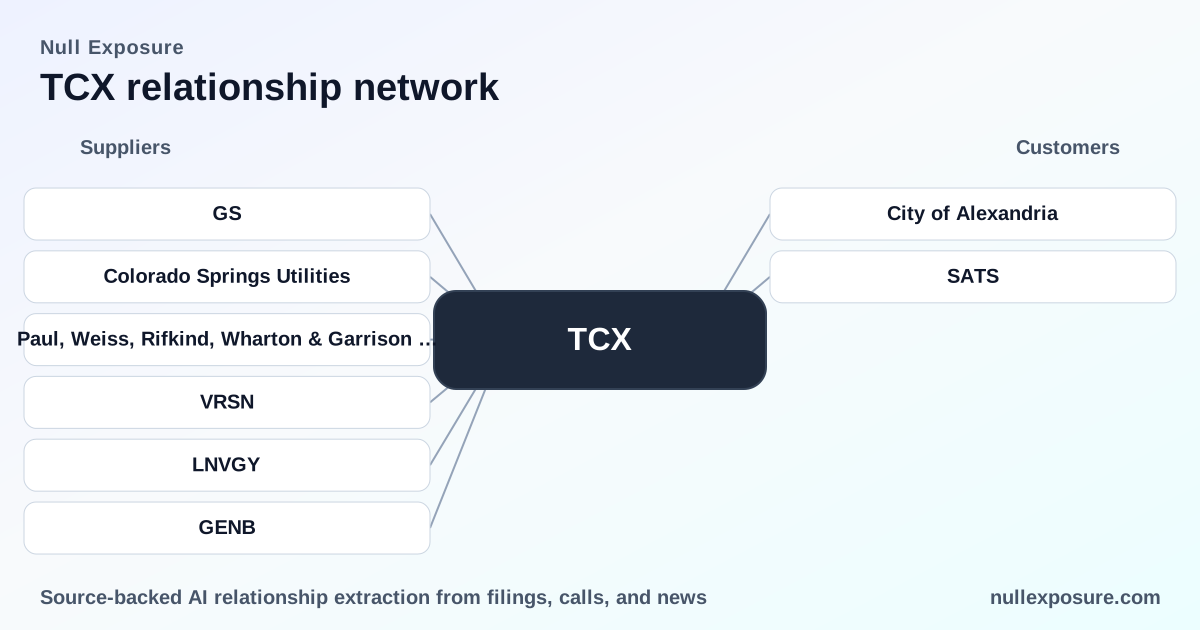
Ting’s largest market milestone includes an anchor municipal agreement with the City of Alexandria, where Ting’s fiber buildout covers 4,000 affordable housing units as part of that local commitment — a commercial relationship that demonstrates Ting’s municipal partnership model and on‑the‑ground expansion strategy. (PR Newswire release, March 10, 2026: https://www.prnewswire.com/news-releases/ting-internet-lights-largest-market-to-date-bringing-fast-reliable-fiber-internet-to-alexandria-virginia-301770487.html)
Radix
Radix is cataloged among strategic wins for Tucows’ Domains/Wavelo businesses; management listed the Radix contract as evidence of steady domain performance and targeted platform traction during the company’s Q2 FY2025 investor commentary. (Yahoo Finance coverage of Tucows Q2, May 4, 2026: https://finance.yahoo.com/news/tucows-q2-loss-narrows-y-153200148.html)
EchoStar (news coverage)
Operational commentary in investor materials credits EchoStar with expansion‑led growth, where Wavelo’s commercial moves (including a new EchoStar rate card) and a focus on larger Tier‑1 and Tier‑2 deals drove revenue while lower‑margin small clients were deprioritized. That strategic posture underlines how Wavelo is optimizing customer mix away from low‑return engagements. (Yahoo Finance coverage of Tucows Q2, May 4, 2026: https://finance.yahoo.com/news/tucows-q2-loss-narrows-y-153200148.html)
EchoStar (FY2024 10‑K disclosure)
The FY2024 Form 10‑K explicitly discloses that one Wavelo customer, EchoStar, accounted for 10.7% of total net revenue for the year ended December 31, 2024, and notes that professional services and platform revenue concentration to this customer introduces material dependence risk. The filing quantifies the exposure and frames retention of this customer as a primary commercial imperative. (Tucows FY2024 Form 10‑K, disclosure for year ended Dec 31, 2024: tcx-2024-12-31)
SATS (duplicate record tied to EchoStar disclosure)
A parallel record labeled SATS in the company’s disclosure set repeats the same FY2024 language that EchoStar accounted for 10.7% of revenue, suggesting a mapped or duplicated disclosure entry in public filings and data feeds; the underlying business implication — single‑customer concentration in Wavelo — is the same. (Tucows FY2024 Form 10‑K, disclosure for year ended Dec 31, 2024: tcx-2024-12-31)
What these relationships imply for investors
- Revenue diversification is real but imperfect. The global reseller footprint and retail consumer base create a broad recurring revenue floor; however, Wavelo’s dependence on a single large customer introduces earnings volatility and concentration risk. This is reflected in the company’s disclosure that EchoStar equaled 10.7% of FY2024 revenues, and in spend-band evidence where that relationship maps to the $10M–$100M band historically.
- Contracting posture is mixed and strategically important. Short‑term, month‑to‑month Ting customer contracts limit long‑term visibility but keep capital commitments low; domain registrations provide longer duration rights (1–10 years) and thus a different margin profile; Wavelo blends subscription recognition with usage‑based and fixed‑platform fees plus professional services, creating upside but also lumpy performance.
- Operational focus is on scaling higher‑margin B2B deals and municipal builds. Wins like Radix and municipal deployments such as the City of Alexandria are consistent with management’s public emphasis on improving mix and expanding serviceable footprints.
- Key risk and catalyst checklist: retention of EchoStar or a meaningful replacement, continued growth of Ting serviceable addresses and account activation, and margin expansion from Wavelo’s larger deals.
For a focused review of customer‑level exposures and to map concentration risk against company disclosures, see additional analysis at https://nullexposure.com/.
Bottom line
Tucows is a hybrid operator: consumer subscription cash flow and global reseller scale provide a stable base, while Wavelo’s targeted, higher‑value B2B contracts create both upside and single‑customer risk. Investors should weight the company’s ability to convert Wavelo pipeline into multiple large, durable contracts and Ting’s local market rollouts against the disclosed concentration with EchoStar when modelling revenue and downside scenarios.