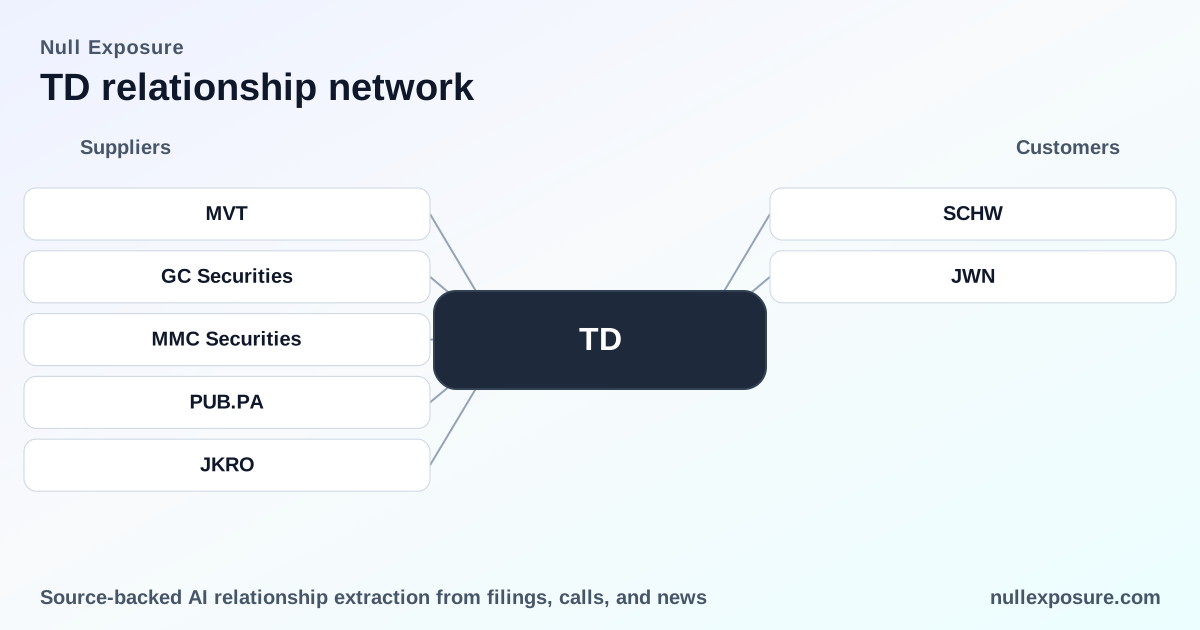
TD Bank: customer relationships that drive capital markets fees and commercial lending spread
Toronto‑Dominion Bank operates a dual retail/commercial franchise and a global capital‑markets business. The firm monetizes through interest margin and fee income: consumer deposits and card balances underpin lending spread, while TD Securities generates recurring advisory, underwriting and ATM sales‑agent fees for corporate clients. For investors, the relationship map shows a wide sponsorship role across underwriting, at‑the‑market (ATM) programs, credit facilities and charitable partnerships—a diversified customer exposure that supports predictable fee streams and episodic capital markets revenue.
Explore more research at https://nullexposure.com/.
Strategic signals: what the relationship list tells investors about TD’s operating model
TD’s customer roll‑call reveals four operating model characteristics that matter for valuation and risk:
- Contracting posture: transactional and sponsor roles dominate. The bulk of items are sales‑agent, bookrunner or arranger engagements rather than long‑term exclusive mandates, consistent with a market‑making and investment banking posture.
- Concentration: low single‑counterparty concentration. Deals span biotech, real estate, infrastructure, telco and community partners, signaling broad sector diversification of fee sources.
- Criticality: a mix of strategic and ancillary relationships. TD acts as indispensable lender in several credit facilities and as a replaceable distribution agent on ATM programs; the former represents higher counterparty stickiness.
- Maturity: rollout of short‑term capital markets mandates alongside multi‑year credit agreements. Expect variability in fee timing but stable contribution from syndicated lending and card‑balance growth.
Below I catalog every customer relationship in the source set and cite the original reporting.
Relationship roll‑call — concise, source‑backed notes
- BCAX: TD Securities (USA) LLC is the sales agent for BCAX’s at‑the‑market offering under a Sales Agreement dated October 3, 2025 (prospectus supplement; StockTitan, Mar 2026).
- FTHY: The First Trust High Yield Fund has a committed facility with The Toronto‑Dominion Bank, New York Branch capped at $230 million (Form N‑CSRS; StreetInsider, May 2026).
- SCHW: TD surrendered board seats at Charles Schwab and now operates as a service provider under an Insured Deposit Account agreement, marking a shift from strategic partner to service provider (MarketMinute analysis, Mar 2026).
- ARX: TD Securities (USA) LLC served as an additional bookrunner on Accelerant Holdings’ NYSE IPO, supporting underwriting distribution (Investing.com, May 2026).
- NAKA: Kindly MD listed TD Securities among the ATM sales agents for its ATM program, positioning TD in equity distribution (Investing.com, May 2026).
- ANAB: AnaptysBio terminated its ATM Sales Agreement with TD Securities, ending further ATM issuances under that program (TradingView news, May 2026).
- TU (Telus): Telus retained TD Securities (and Jefferies) to monetize its healthcare unit, reflecting TD’s advisory mandate on strategic divestiture (The Globe and Mail, Mar 2026).
- The Charles Schwab Corporation: Separate coverage reiterates TD’s shift to a service provider role under the IDA agreement with Schwab (MarketMinute, Mar 2026).
- PVLA: TD Securities acted as a representative of the underwriters on Palvella Therapeutics’ share offering, alongside Cantor and Stifel (TradingView, Mar 2026).
- HBM (Hudbay): TD Securities Inc. is acting as financial advisor to Hudbay in its Arizona Sonoran acquisition, providing sell‑side advisory fees (Resource‑Capital news, May 2026).
- ABSI (Absci): An S‑3 shelf and sales agreement permits up to $100M of common stock sales through TD Securities (USA) LLC, supporting future ATM activity (StockTitan filings, Mar 2026).
- AD (Array Digital Infrastructure): Array amended its credit agreement with Toronto Dominion (Texas) LLC as part of a lending amendment, reflecting TD’s role as a lender in infrastructure finance (Investing.com, May 2026).
- ALLO (Allogene): TD Securities (USA) LLC is named as the sales agent under Allogene’s ATM sales agreement, reinforcing repeat ATM engagements (StockTitan, May 2026).
- RLJ: TD Bank, N.A. served as a Joint Lead Arranger/Documentation Agent on RLJ Lodging Trust’s refinancing, evidencing syndicated lending participation (CityBiz, Mar 2026).
- SCHW‑P‑D: TD sold its remaining Charles Schwab shares on February 12, 2025, completing a public divestiture of equity (Finviz report, Mar 2026).
- EML (Eastern Company) — item 1: EML recorded a $0.5M write‑off tied to termination of a prior TD Bank agreement in Q4 2025 as it refinanced into a new Citizens Bank facility, indicating replacement of a TD facility (Investing.com earnings transcript, May 2026).
- UE (Urban Edge Properties): TD Bank, N.A. is a Documentation Agent on UE’s revolving credit facility and TD Securities listed among Passive Joint Lead Arrangers, showing dual commercial lending and capital markets roles (Yahoo Finance/PR, Mar 2026).
- Foundation for Orange County Public Schools, Inc.: Received a $250,000 grant from the TD Charitable Foundation (TD corporate story, May 2026).
- Good Shepherd Housing and Family Services, Inc.: Received a $250,000 TD Charitable Foundation grant (TD press release, May 2026).
- Greater Bergen Community Action, Inc.: Received $250,000 from TD Charitable Foundation (TD press release, May 2026).
- Hands on Hartford, Inc.: Received $250,000 from TD Charitable Foundation (TD press release, May 2026).
- Hispanic Family Centre of Southern New Jersey, Inc.: Received $250,000 from TD Charitable Foundation (TD press release, May 2026).
- Hispanic Unity of Florida, Inc.: Received $250,000 from TD Charitable Foundation (TD press release, May 2026).
- SATX (SatixFy): TD Securities (USA) LLC acted as financial advisor during SatixFy’s go‑shop process that contacted ~75 parties, assisting in sale process outreach (Canadian Defence Review, Mar 2026).
- Legal Counsel for the Elderly: Received $250,000 from TD Charitable Foundation (TD press release, May 2026).
- Mental Illness Recovery Center, Inc.: Received $250,000 from TD Charitable Foundation (TD press release, May 2026).
- Montgomery Housing Partnership, Inc.: Received $250,000 from TD Charitable Foundation (TD press release, May 2026).
- New Jersey Citizen Action Education Fund, Inc.: Received $250,000 from TD Charitable Foundation (TD press release, May 2026).
- Nueva Esperanza, Inc.: Received $250,000 from TD Charitable Foundation (TD press release, May 2026).
- Open Sky Community Services, Inc.: Received $250,000 from TD Charitable Foundation (TD press release, May 2026).
- Penquis C.A.P., Inc.: Received $250,000 from TD Charitable Foundation (TD press release, May 2026).
- Philadelphia Chinatown Development Corporation: Received $250,000 from TD Charitable Foundation (TD press release, May 2026).
- Pisgah Legal Services: Received $250,000 from TD Charitable Foundation (TD press release, May 2026).
- RUPCO, Inc.: Received $250,000 from TD Charitable Foundation (TD press release, May 2026).
- SeniorLaw Center: Received $250,000 from TD Charitable Foundation (TD press release, May 2026).
- Services for Underserved, Inc.: Received $250,000 from TD Charitable Foundation (TD press release, May 2026).
- Sunset Park Health Council dba Family Health Centers at NYU Langone: Received $250,000 from TD Charitable Foundation (TD press release, May 2026).
- Tedford Housing: Received $250,000 from TD Charitable Foundation (TD press release, May 2026).
- The Foundation for Delaware County: Received $250,000 from TD Charitable Foundation (TD press release, May 2026).
- The Sharing Center: Received $250,000 from TD Charitable Foundation (TD press release, May 2026).
- United Community Corporation: Received $250,000 from TD Charitable Foundation (TD press release, May 2026).
- WellLife Network Inc.: Received $250,000 from TD Charitable Foundation (TD press release, May 2026).
- York Street Project: Received $250,000 from TD Charitable Foundation (TD press release, May 2026).
- LAC‑W (Lithium Americas warrants): Lithium Americas’ equity program will be managed by TD Securities, indicating TD’s role in metals sector capital markets (Benzinga, Mar 2026).
- MFC (Manulife): Manulife received a research report from TD Securities updating analyst outlook, reflecting TD’s sell‑side research relationships (The Globe and Mail, Mar 2026).
- CLDX (Celldex): TD Securities served with Leerink as representatives of the underwriters on Celldex’s offering, supporting biotech distribution (TradingView, May 2026).
- SYM (Symbotic): TD Securities acted as an additional book‑running manager on Symbotic’s proposed offering, performing equity distribution duties (MarketMinute/QuiverQuant, Dec 2025–Mar 2026).
- SERA (Sera Prognostics): Sera had an intended $50M ATM with TD Securities for Class A stock, though no shares were sold under that arrangement, showing TD’s placement in potential ATM programs (Investing.com, 2025 filing note).
- IDT: IDT entered a revolving credit facility with TD Bank, N.A. for up to $25 million, confirming TD’s role as a corporate lender (QZ report, Mar 2026).
- Ability Housing, Inc.: Received $250,000 from TD Charitable Foundation (TD press release, May 2026).
- Bay Area Legal Services, Inc.: Received $250,000 from TD Charitable Foundation (TD press release, May 2026).
- Bright Harbor Healthcare: Received $250,000 from TD Charitable Foundation (TD press release, May 2026).
- Brooklyn Legal Services Corporation A: Received $250,000 from TD Charitable Foundation (TD press release, May 2026).
- Caritas Communities, Inc.: Received $250,000 from TD Charitable Foundation (TD press release, May 2026).
- Catholic Charities Community Services, Archdiocese of New York: Received $250,000 from TD Charitable Foundation (TD press release, May 2026).
- Catholic Charities Diocese of Venice, Inc.: Received $250,000 from TD Charitable Foundation (TD press release, May 2026).
- Central Connecticut Coast YMCA: Received $250,000 from TD Charitable Foundation (TD press release, May 2026).
- Charlotte Family Housing: Received $250,000 from TD Charitable Foundation (TD press release, May 2026).
- Community Legal Aid Society, Inc.: Received $250,000 from TD Charitable Foundation (TD press release, May 2026).
- FamilyAid Boston, Inc.: Received $250,000 from TD Charitable Foundation (TD press release, May 2026).
- Florida Legal Services, Inc.: Received $250,000 from TD Charitable Foundation (TD press release, May 2026).
- Foster Forward: Received $250,000 from TD Charitable Foundation (TD press release, May 2026).
- Housing Trust of Rutland County, Inc.: Received $250,000 from TD Charitable Foundation (TD press release, May 2026).
- AVXL (Anavex): Filed a $150M ATM sales agreement with TD Securities referenced in its 10‑Q, demonstrating TD’s recurring ATM role in small‑cap biotech (StockTitan, Mar 2026).
- Waypoint: Waypoint listed as a $250,000 TD Charitable Foundation grantee (TD press release, May 2026).
- A (GeneDx / Gene DX holdings entry): The company has a Sales Agreement with TD Securities (TD Cowen) for up to $75M in ATM capacity, per its SEC filing (StockTitan/WGS 10‑K, Apr 2024 filing note).
Bottom line for investors
TD’s relationship map confirms a diversified franchise that earns recurring lending income and episodic capital‑markets fees. The pattern of ATMs, bookrunner slots and syndicated credit roles shows a bank positioned to capture deal flow across sectors while using its charitable footprint to sustain community presence. For deeper counterparty analysis and live tracking of TD’s market engagements, visit https://nullexposure.com/.
Bold takeaway: TD’s customer mix reduces single‑counterparty exposure while preserving fee upside from capital markets and syndications.