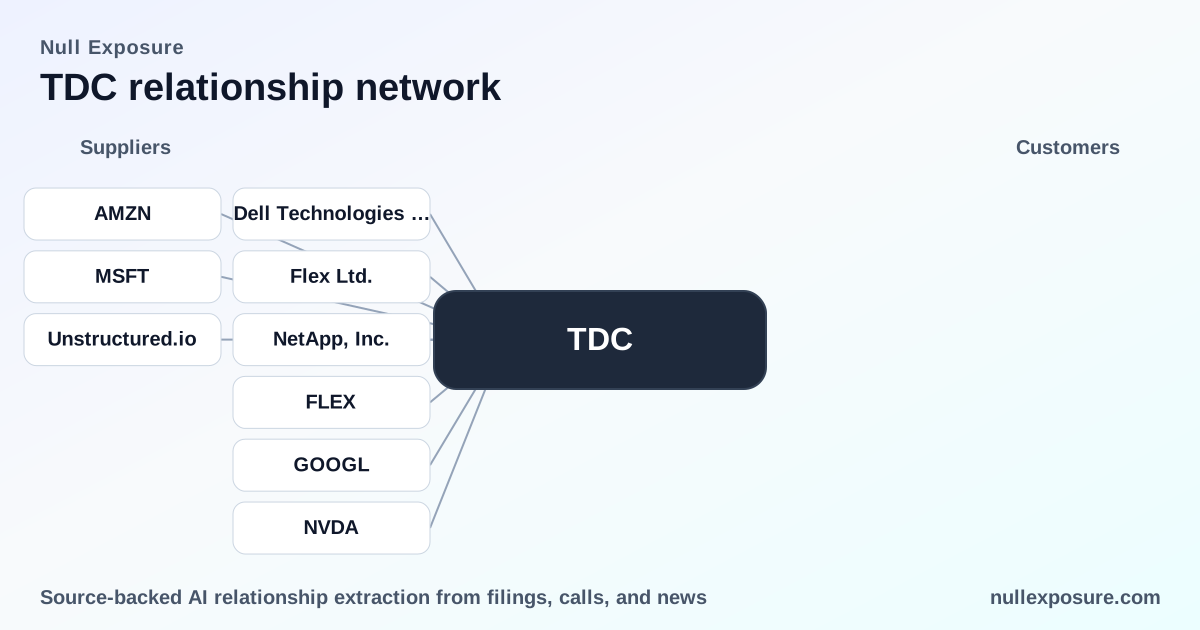
Teradata (TDC): Customer Relationships and What They Signal for Investors
Teradata is a hybrid-cloud analytics software provider that monetizes through a mix of recurring subscriptions, consumption-based cloud usage, perpetual licenses, hardware sales, and professional consulting. The company sells primarily to large enterprises across global markets, collecting stable recurring revenue while preserving upside via elastic, usage-driven cloud arrangements and one-time services projects. For investors, the core thesis is straightforward: stable cash flow from subscription contracts combined with growth optionality from cloud consumption and consulting creates a predictable base with cyclical expansion potential. Learn more at https://nullexposure.com/ if you want a concise commercial snapshot of customer footprints and relationship signals.
What Teradata sells, in investor language
Teradata’s go-to-market mixes three monetization engines:
- Subscription and consumption: recurring revenue from on-premise and cloud subscriptions, with cloud deals structured as a minimum commitment plus elastic, usage-priced increments recognized monthly.
- Product sales: a combination of perpetual software licenses and hardware units, recognized as product revenue when delivered.
- Services: professional services and consulting that both implement and extract value from customer deployments and generate higher-margin, project-based revenue.
These characteristics are visible in the company’s SEC disclosures: Teradata describes subscription terms ranging from one month to five years and explicitly calls out capacity- and consumption-based pricing in its cloud arrangements, with minimums recognized ratably and variable usage recognized as consumed.
How the contracts and market posture shape risk/reward
Teradata’s commercial model creates a set of operational constraints that investors should treat as structural, not transitory:
- Subscription-first billing and usage-based elasticity create predictable recurring revenue with upside during heavy utilization cycles. The company’s filings state recurring revenue includes on-premises and cloud subscriptions, and cloud pricing includes both fixed minimums and elastic consumption components.
- Enterprise customer focus drives sales cycles and customization needs. Teradata targets global enterprise accounts that demand scale, integration, and speed.
- Global footprint diversifies geographic exposure: Teradata operates in approximately 40 countries and reports exposure across the Americas, EMEA, and APJ regions.
- Low single-customer concentration reduces counterparty concentration risk: the company reports no customer accounting for 10% or more of revenue.
- Mixed revenue streams (software, hardware, consulting) mean investors should track the proportion of recurring versus project revenue to assess operating leverage and gross margin sustainability.
- Direct sales orientation signals higher fixed-cost selling infrastructure and potential leverage when renewal rates and upsells accelerate.
These are company-level signals derived from Teradata’s public filings and segment disclosures; they define the company’s operating dynamics without depending on any single customer relationship.
The customer record: explicit relationships found in the public record
The dataset returned one explicit customer mention. Each relationship below is summarized in plain English with a concise source reference.
Capital One — legacy Teradata warehouse, constrained by on-premise limits
Capital One historically used a Teradata data warehouse but shifted attention to cloud-native platforms because on-premises infrastructure restricted who could use the data and limited the range of analytics workflows. This reflects the broader enterprise transition from on-premise data warehouses to more elastic cloud architectures. Source: SiliconANGLE, July 9, 2022 (news report discussing Capital One’s move away from traditional on-premises limitations).
What the relationships — and their scarcity — imply
Only one explicit customer mention surfaced in the examined record. That sparsity is meaningful in its own right: Teradata’s customer relationships are largely embedded, enterprise-level deals typically disclosed at the contract or revenue-group level rather than through frequent public name-checks. The company’s own disclosures emphasize broad enterprise targeting and segmentation into Product Sales and Consulting Services, which explains why specific customer mentions will be episodic rather than ubiquitous.
Key investment implications and risks
- Recurring revenue strength: Subscription and usage-based models provide a durable revenue base that supports valuation multiple expansion when growth is consistent. Teradata reports significant gross profit and operating margin that reflect this mix.
- Cloud transition execution matters: The move from on-premise to hybrid/cloud architectures is both a growth opportunity and a competitive battleground. Companies that convert legacy customers to cloud consumption contracts unlock higher lifetime value.
- Modest concentration risk: No single customer accounts for 10%+ of revenue, reducing headline counterparty risk but requiring vigilance on renewal and upsell rates across a broad enterprise base.
- Mixed revenue adds volatility: Consulting and hardware sales will create lumpiness; investors should monitor the cadence of services projects and product shipments relative to recurring revenue trends.
- Sales investment and returns: A direct sales model creates fixed cost leverage; management must demonstrate efficient customer acquisition and expansion economics to justify operating leverage.
For a focused view of how these commercial dynamics map to customer footprints and relationship signals, revisit our homepage at https://nullexposure.com/ for additional profiles and comparative analysis.
Bottom line for investors and operators
Teradata’s commercial model combines stable recurring revenue with built-in upside from consumption and a global enterprise customer base that lowers concentration risk. The public record shows enterprise customers such as Capital One relied on Teradata’s legacy data warehouse, illustrating both the company’s historical strength in large-account deployments and the secular pressure from cloud-native competitors. Investors should underwrite value based on subscription retention and cloud consumption growth, while operators should prioritize converting installed on-premise bases into elastic cloud engagements to capture incremental revenue.
For practitioners and research teams evaluating customer risk and revenue durability, Teradata represents a company with predictable base earnings and discretionary upside conditional on cloud migration and consulting momentum. Explore further company profiles and relationship intelligence at https://nullexposure.com/.